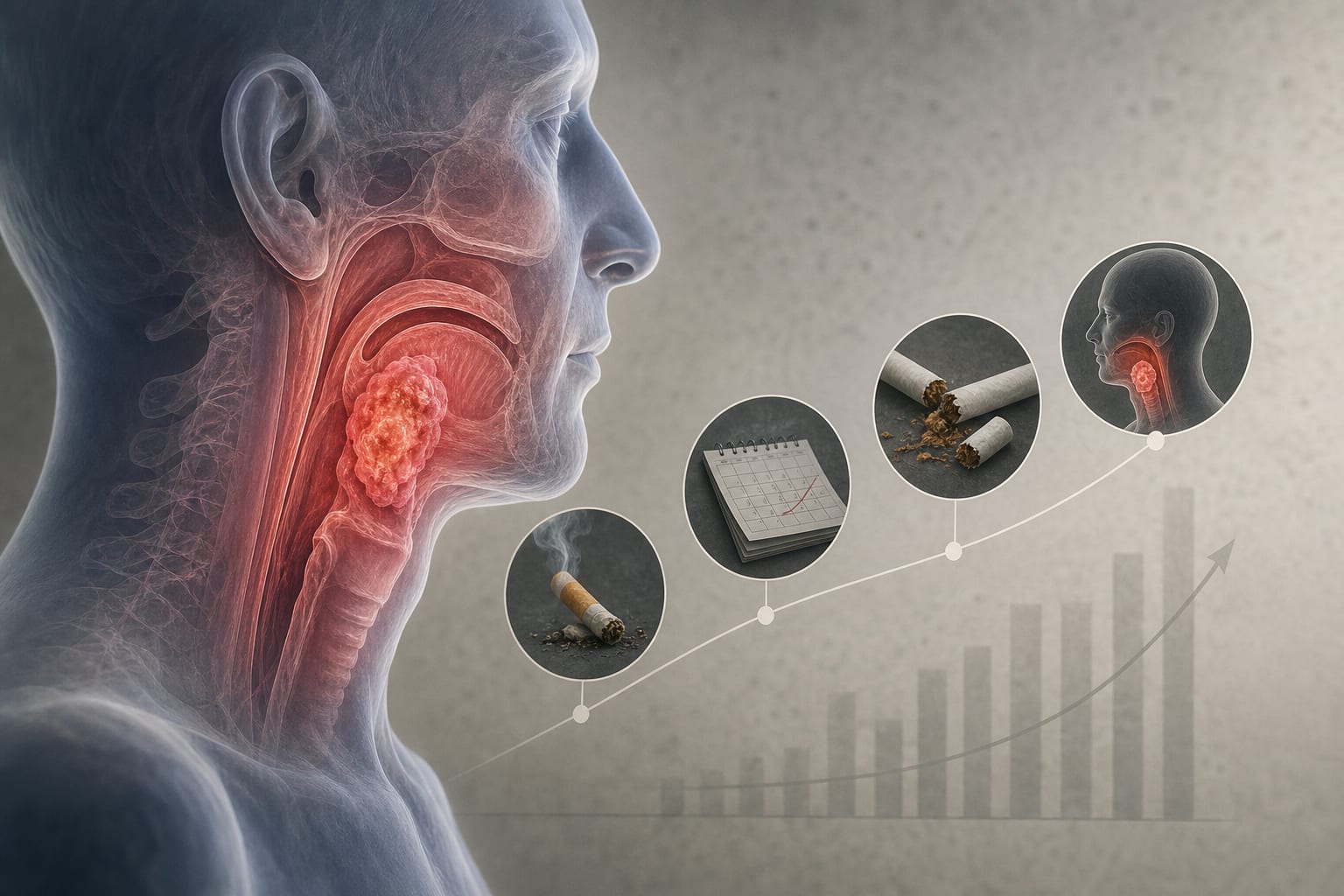
Rethinking smoking assessment in head and neck squamous cell carcinoma: are we missing something?
-
By
-
Riccardo Gili
-
Luigi Lorini
-
Davide Smussi
-
Armando Di Bello
-
Paolo Bossi
-
Carlo Resteghini
-
July 1, 2026
Clinical Scorecard: Reevaluating Smoking Evaluation in Head and Neck Squamous Cell Carcinoma: Are Important Factors Overlooked?
At a Glance
| Category | Detail |
|---|
| Condition | Head and Neck Squamous Cell Carcinoma (HNSCC) |
| Key Mechanisms | Tobacco exposure duration and type significantly influence HNSCC risk and outcomes. |
| Target Population | Patients with Head and Neck Squamous Cell Carcinoma, particularly long-term smokers. |
| Care Setting | Oncology and clinical assessment protocols. |
Key Highlights
- Smoking duration is a stronger predictor of HNSCC risk than pack-years.
- Log cigarette-years may provide better prognostic information than traditional metrics.
- Smoking cessation improves survival outcomes in HNSCC patients.
- Alternative tobacco products increase HNSCC risk and are often overlooked in assessments.
- Current smoking status at diagnosis correlates with inferior treatment response.
Guideline-Based Recommendations
Diagnosis
- Consider smoking duration and cessation status in risk assessment.
Management
- Incorporate alternative tobacco product use into risk models.
Monitoring & Follow-up
- Regularly assess smoking status and duration in HNSCC patients.
Risks
- Active smoking at diagnosis is associated with poorer treatment outcomes.
Patient & Prescribing Data
Patients diagnosed with Head and Neck Squamous Cell Carcinoma.
Smoking cessation is linked to improved survival; alternative tobacco use complicates risk assessment.
Clinical Best Practices
- Utilize duration-based metrics for smoking exposure assessment.
- Integrate smoking history into electronic health records for better risk stratification.
- Educate patients on the risks of both traditional and alternative tobacco products.
Related Resources & Content