A Practical Primary Care Guide to Assessing and Managing Long COVID
-
By
-
Anita Chopra
-
Hector F. Bonilla
-
Abby L. Cheng
-
October 9, 2026
Clinical Scorecard: A Practical Primary Care Guide to Assessing and Managing Long COVID
At a Glance
| Category | Detail |
|---|---|
| Condition | Clinical topic addressed by the source article: A Practical Primary Care Guide to Assessing and Managing Long COVID |
| Key Mechanisms | The supplied excerpt describes suspected pathophysiological mechanisms but does not identify them. |
| Target Population | Patients or participants described in the source article. |
| Care Setting | Primary care framework for recognition, focused evaluation, counseling, and initiating symptom-based management. |
Key Highlights
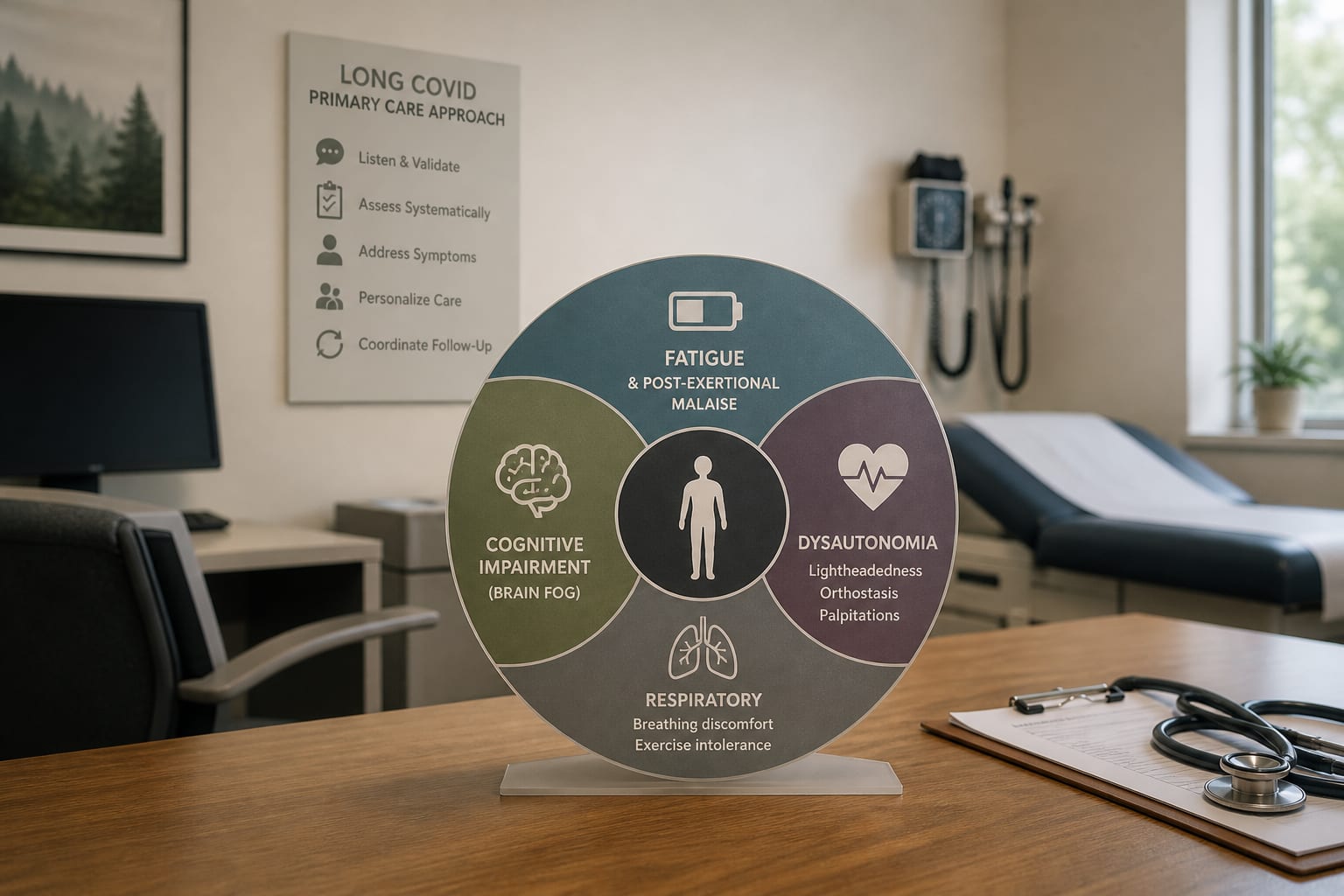
- Commonly reported symptoms include fatigue, post-exertional malaise, cognitive impairment, and lightheadedness or orthostasis.
- Other reported symptoms include gastrointestinal complaints, sleep disturbance, pain, or breathing discomfort without a clear alternative etiology on traditional assessment.
- Recognizing symptom clusters may facilitate recognition of Long COVID and associated conditions, including ME/CFS and POTS.
- The review conceptualizes manifestations in three categories: lasting effects of acute end-organ injury, triggered or aggravated chronic disease, and ongoing biological dysregulation. Verify the latter two categories against the full source before retaining.
- The narrative review presents a pragmatic primary care framework for considering Long COVID, focused evaluation, counseling, symptom-based management, and referral decisions.
Guideline-Based Recommendations
Diagnosis
- In clinical settings, consider Long COVID when symptoms are new or worsened following confirmed or suspected acute SARS-CoV-2 infection and continue beyond 3 months.
- Ask about preceding infection or potential triggers when evaluating relevant new symptoms; the review's cases illustrate fatigue and post-exertional malaise, orthostatic symptoms, and cognitive impairment.
- Distinguish research definitions, which may require laboratory confirmation, from clinical conceptualizations that may include suspected infection.
Management
- The review describes counseling and initiating symptom-based management; the supplied excerpt does not provide specific treatment recommendations.
Monitoring & Follow-up
- Assess functional changes, including effects on routine tasks, work, and customary activities, as illustrated in the clinical vignettes.
- Ask about symptom exacerbation after exertion and its duration when relevant, as illustrated in the fatigue and post-exertional malaise vignette.
Risks
- Symptoms may impair daily activities and work performance, as illustrated in the clinical vignettes.
- The source states that the lack of validated diagnostic biomarkers and curative treatment may leave patients and clinicians confused, overwhelmed, and frustrated.
- The source identifies brief primary care visits, clinician burnout, and restricted access to subspecialty consultation as healthcare-system limitations.
Patient & Prescribing Data
The excerpt describes people with new or persistently worsened symptoms after confirmed or suspected SARS-CoV-2 infection and includes adult clinical vignettes. It does not provide pediatric prevalence estimates in the supplied text.
The excerpt states that validated diagnostic biomarkers and curative treatment are lacking and describes a framework for counseling and initiating symptom-based management; it does not provide prescribing data.
Clinical Best Practices
- Use a longitudinal primary care approach that draws on knowledge of patients' health and home circumstances.
- Ask about preceding infection, including mild or suspected COVID-19 that may not have been tested or medically evaluated.
- Characterize fatigue, post-exertional worsening, cognitive symptoms, and orthostatic symptoms during focused evaluation.
- Recognize symptom clusters that may be associated with ME/CFS or POTS.
- The review describes counseling, symptom-based management, and decisions about specialty referral; consult the full source for specific practices.
Related Resources & Content
Based on findings from:
Long COVID in Primary Care: A Practical Approach to Evaluation and Management
Anita Chopra, Hector F. Bonilla, Abby L. Cheng. Journal Of General Internal Medicine, 2026.
https://link.springer.com/article/10.1007/s11606-026-10901-w
This content is an AI-generated, fully rewritten summary based on a published scholarly article. It does not reproduce the original text and is not a substitute for the original publication. Readers are encouraged to consult the source for full context, data, and methodology.