Rituximab in Myasthenia Gravis: a real-world study using inverse probability of treatment weighting - Scorecard - MDSpire

Rituximab in Myasthenia Gravis: a real-world study using inverse probability of treatment weighting

  • By

  • Yong Lin Wang

  • Chao Zhu

  • Mahima Kapoor

  • Gary Cutter

  • Carolina Barnett-Tapia

  • Helmut Butzkueven

  • Wenwen Zhang

  • Gabor Lovas

  • Csilla Rozsa

  • Jeannine Heckmann

  • Stefan Blum

  • Laurie McLaughlin

  • Katherine Buzzard

  • Yi Chao Foong

  • Elisabeth Chroni

  • Dimitra Veltsista

  • Belinda Cruse

  • Mina Botrous

  • Stephen Reddel

  • Mastura Monif

  • Anneke van der Walt

  • July 2, 2026

  • 0 min

Share

Clinical Scorecard: Evaluating Rituximab's Effectiveness in Myasthenia Gravis: A Real-World Analysis Utilizing Inverse Probability of Treatment Weighting

At a Glance

CategoryDetail
ConditionMyasthenia Gravis
Key MechanismsAntibody-mediated dysfunction at the neuromuscular junction.
Target PopulationAChR-Ab positive Myasthenia Gravis patients.
Care SettingReal-world observational registry study.

Key Highlights

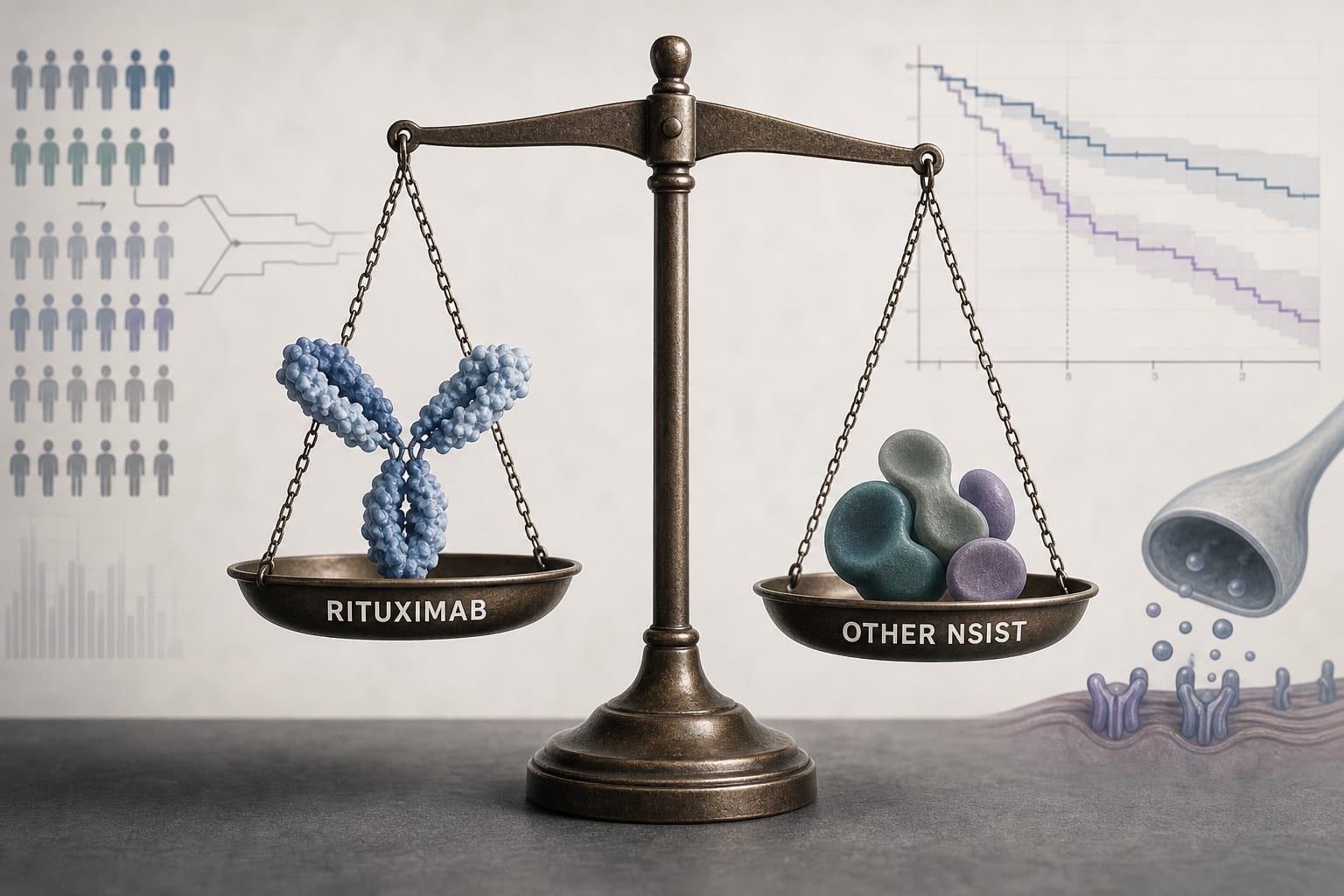
  • Rituximab did not show improved time-to-improvement compared to second NSIST.
  • 169 patients were included in the time-to-event analysis.
  • No statistical difference in hazard ratio between treatments (HR = 1.27, p = 0.48).
  • Study utilized inverse probability of treatment weighting for confounding adjustment.
  • Primary outcome was a composite clinical endpoint representing patient acceptable symptom state.

Guideline-Based Recommendations

Diagnosis

  • Diagnosis of Myasthenia Gravis confirmed by AChR-Ab positive serology.

Management

  • Initial treatment typically involves corticosteroids, with additional NSISTs for steroid-sparing.

Monitoring & Follow-up

  • Regular assessments of Myasthenia Gravis Composite (MGC) score.

Risks

  • Corticosteroids have significant adverse effects impacting quality of life.

Patient & Prescribing Data

Patients with AChR-Ab positive Myasthenia Gravis.

Rituximab is often used in refractory cases but lacks definitive comparative effectiveness evidence.

Clinical Best Practices

  • Consider corticosteroids as first-line treatment for Myasthenia Gravis.
  • Evaluate the need for additional NSISTs based on patient response to corticosteroids.
  • Utilize IPTW methods to adjust for confounding in observational studies.

Related Resources & Content

Original Source(s)

Related Content