Changes in circulating immune cells and cytokines after high-intensity aerobic exercise in patients with prostate cancer undergoing active surveillance from the ERASE randomized controlled trial - Scorecard - MDSpire
Conexiant’s news site is now MDSpire News. Learn more
Advertisement
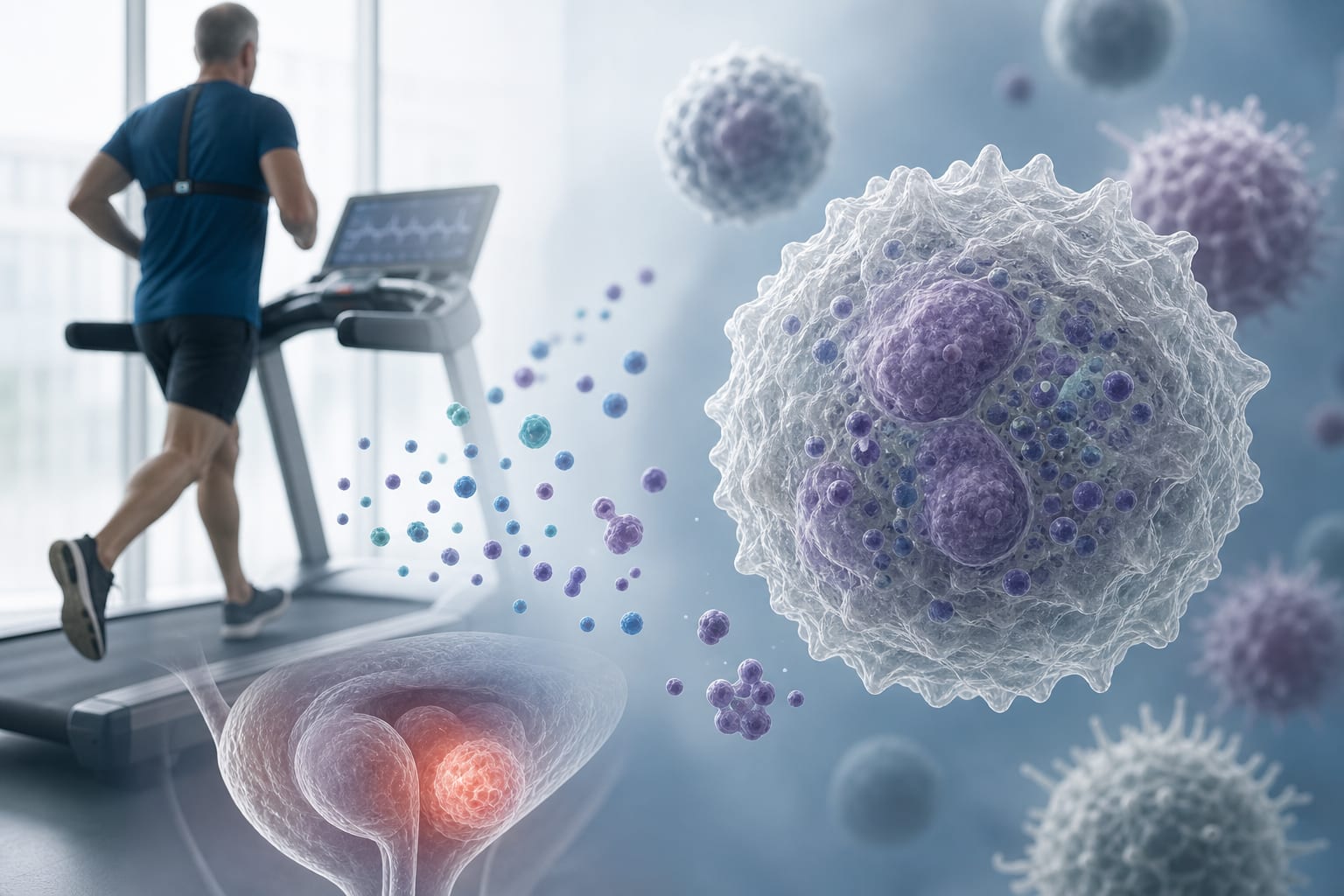
Impact of High-Intensity Aerobic Exercise on Immune Cell Dynamics and Cytokine Levels in Prostate Cancer Patients Undergoing Active Surveillance: Insights from the ERASE Randomized Controlled Trial
Clinical Scorecard: Impact of High-Intensity Aerobic Exercise on Immune Cell Dynamics and Cytokine Levels in Prostate Cancer Patients Undergoing Active Surveillance: Insights from the ERASE Randomized Controlled Trial
At a Glance
Category
Detail
Condition
Localized Prostate Cancer
Key Mechanisms
High-intensity interval training (HIIT) effects on immune cell dynamics and cytokine levels.
Target Population
Men with localized prostate cancer undergoing active surveillance.
Care Setting
Clinical trial setting
Key Highlights
HIIT significantly increased the circulating proportion of NK-cell subsets.
PBMC-mediated cytotoxicity improved with HIIT compared to usual care.
IL-4 and IL-12p70 levels decreased significantly in the HIIT group.
Attendance in the HIIT group was 96% of prescribed sessions.
No significant changes in T cell or B cell subsets were observed.
Guideline-Based Recommendations
Diagnosis
Histologically confirmed very low to favorable intermediate-risk prostate cancer.
Management
Consider supervised high-intensity interval training for patients undergoing active surveillance.
Monitoring & Follow-up
Assess immune cell dynamics and cytokine levels before and after exercise interventions.
Risks
Exclusion of patients with contraindications to vigorous physical activity.
Patient & Prescribing Data
52 men with localized prostate cancer undergoing active surveillance.
12-week supervised HIIT program showed significant immune modulation.
Clinical Best Practices
Implement structured exercise programs in cancer care settings.
Monitor immune responses in patients undergoing active surveillance.
The goal of this clinical trial is to learn if Adaptive Radiation Therapy (ART) is safe and effective in treating patients with locally advanced pancreatic cancer.
The goal of this clinical trial is to find out if giving extra adaptive radiation therapy after standard chemoradiation treatment is safe and helpful for people with rectal cancer.