The boundary between microbial detection and implant-related infection: a structured narrative review of analytical credibility, biological persistence, host response, and clinical causality - Scorecard - MDSpire
Conexiant’s news site is now MDSpire News. Learn more
Advertisement
Distinguishing Microbial Detection from Implant-Related Infection: A Structured Narrative Review of Analytical Validity, Biological Persistence, Host Response, and Clinical Causality
Clinical Scorecard: Distinguishing Microbial Detection from Implant-Related Infection
At a Glance
Category
Detail
Condition
Clinical topic addressed by the source article: Distinguishing Microbial Detection from Implant-Related Infection
Key Mechanisms
Mechanisms or clinical associations described in the source article.
Target Population
Population described in the source article.
Care Setting
Clinical investigations of orthopaedic implants sampled during routine or exclusively mechanical fracture-device removal, arthroplasty or spinal revision for failure, and other evaluation contexts in which infection was not unequivocally established.
Key Highlights
Microbial detection alone does not establish implant-related infection; interpretation requires a coherent evidence chain under the applicable diagnostic framework.
The review evaluates analytical credibility, biological viability or persistence, and causal links to host response, tissue injury, implant failure, or clinically meaningful outcomes.
The significance of a positive finding depends on sampling context; revision cohorts may be confounded because infection could have contributed to the failure prompting revision.
Absence of fever, sinus tract, purulence, or elevated systemic inflammatory markers does not by itself exclude clinically relevant indolent infection.
The review is a structured narrative review, not a systematic evaluation of intervention effects or diagnostic accuracy; heterogeneity precluded meta-analysis.
Guideline-Based Recommendations
Diagnosis
The review discusses interpretation under applicable diagnostic frameworks; the supplied excerpt does not name specific frameworks or provide their criteria.
Management
Monitoring & Follow-up
Risks
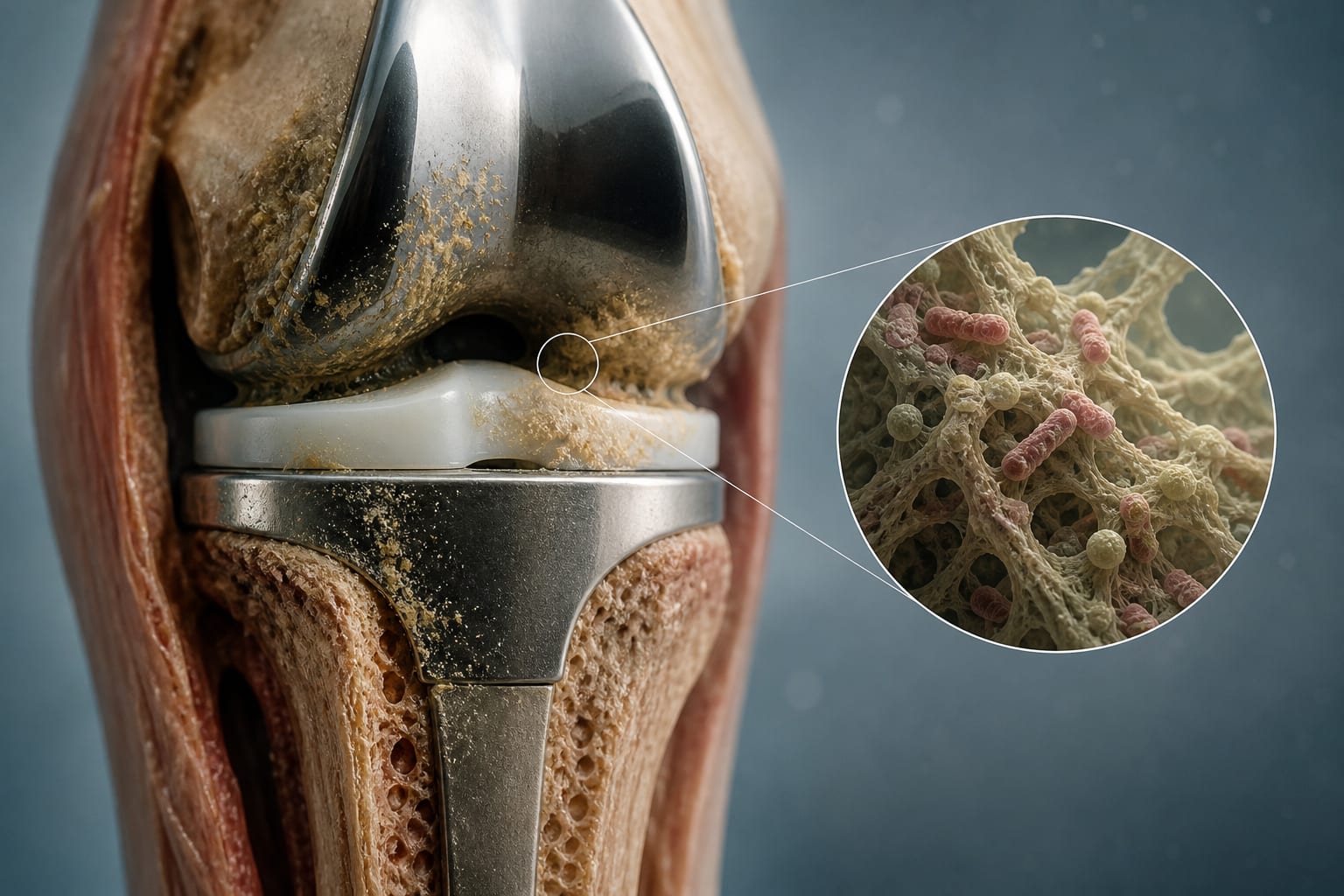
A positive microbiological, molecular, or biofilm-associated signal may reflect contamination, non-viable material, viable persistence without clinical manifestations, or infection missed because workup was incomplete or host response attenuated.
During revision for failure, pain, loosening, osteolysis, stiffness, pseudarthrosis, or screw loosening can represent manifestations of indolent infection.
Absence of fever, sinus tract, purulence, or increased systemic inflammatory markers does not establish absence of clinically relevant disease.
Patient & Prescribing Data
The review prioritizes adult clinical investigations of orthopaedic implants sampled when infection was not unequivocally established, including longitudinal studies of patients with unexpected positive intraoperative cultures.
The supplied article text does not provide treatment or prescribing recommendations.
Clinical Best Practices
Interpret “presumed aseptic” as a preoperative designation based on the investigations performed, not proof that infection is absent.
Consider the sampling context and whether implant failure prompted revision; the review notes greater confounding in arthroplasty and spinal revision cohorts than in routine fracture-device removal without recognized failure.
Do not treat molecular or animal investigations as independently demonstrating clinical causality.
Machine-learning models distinguished healthy knees from those with osteoarthritis-related cartilage damage, but age and BMI performed as well as or better than the vibration-based models.