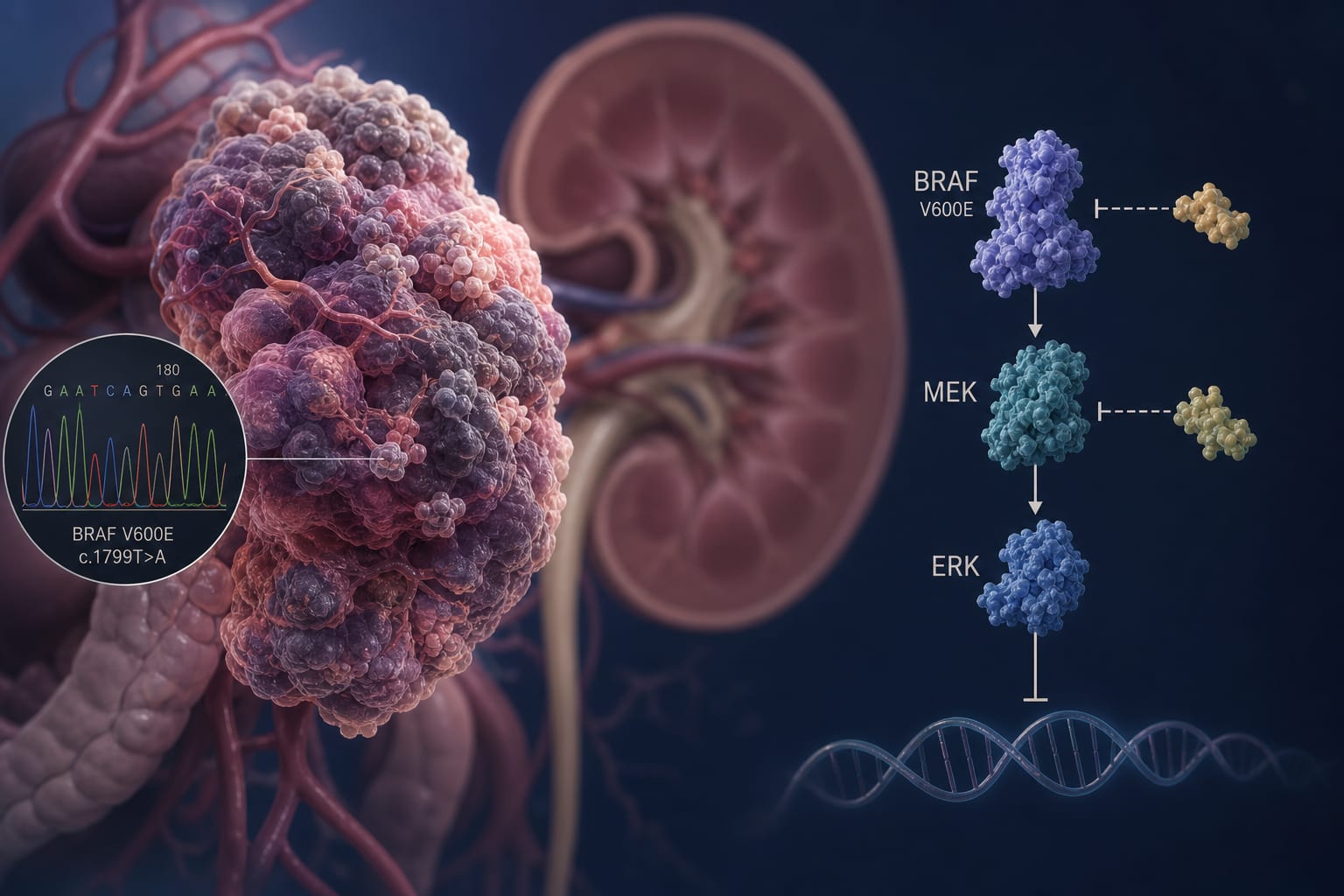
BRAF V600E-mutated metastatic Wilms tumor with complete response to targeted RAF/MEK inhibition: a post-treatment follow-up case report
-
By
-
Iliani Slika
-
Carlene K. Edwards
-
Kenneth J. Cohen
-
Alan D. Friedman
-
Christine A. Pratilas
-
Patience Odeniyide
-
May 7, 2026
-
Clinical Scorecard: Complete Response to Targeted RAF/MEK Inhibition in a Case of Metastatic Wilms Tumor with BRAF V600E Mutation: A Follow-Up Report
At a Glance
| Category | Detail |
|---|
| Condition | Wilms Tumor (WT) |
| Key Mechanisms | BRAF V600E mutation targeted therapy using BRAF and MEK inhibitors. |
| Target Population | Pediatric patients with recurrent Wilms tumor harboring BRAF V600E mutation. |
| Care Setting | Oncology, specifically pediatric oncology. |
Key Highlights
- First report of long-term survival after targeted therapy for multiply relapsed BRAF V600E WT.
- Patient achieved complete remission after treatment with dabrafenib and trametinib.
- Patient remains disease-free two years after discontinuation of targeted therapy.
Guideline-Based Recommendations
Diagnosis
- Use imaging and next-generation sequencing to confirm BRAF V600E mutation in relapsed WT.
Management
- Consider BRAF and MEK inhibition for patients with BRAF V600E mutation in relapsed WT.
Monitoring & Follow-up
- Conduct regular imaging and plasma-based cfDNA testing for BRAF V600E to monitor disease status.
Risks
- Monitor for minor adverse effects such as treatment-related pyrexia during targeted therapy.
Patient & Prescribing Data
Pediatric patients with recurrent Wilms tumor and BRAF V600E mutation.
Dabrafenib and trametinib administered in 28-day cycles based on pediatric dosing.
Clinical Best Practices
- Utilize molecular profiling to guide treatment decisions in relapsed Wilms tumor.
- Implement a multidisciplinary approach for managing complex cases of relapsed WT.
References