Clinical Scorecard: Prognostic Impact of Residual Clonal Plasma Cell Proliferation After Autologous Stem Cell Transplantation in Multiple Myeloma
At a Glance
Category
Detail
Condition
Multiple myeloma (MM) after autologous stem cell transplantation (ASCT)
Key Mechanisms
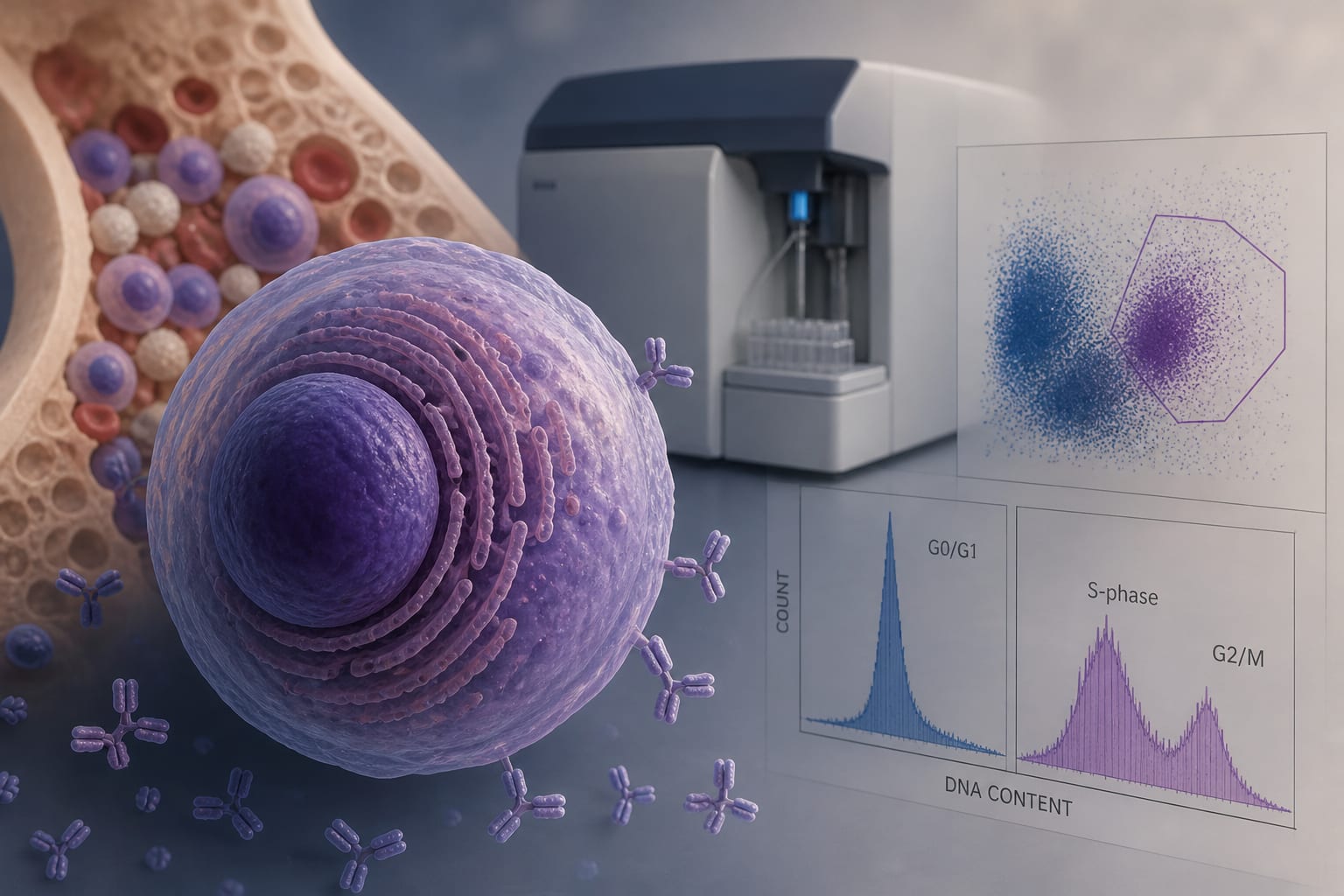
Post-ASCT clonal plasma cell S-phase percentage measures proliferative activity; categories were <2% and ≥2%.
Target Population
Patients with MM who underwent ASCT within one year of diagnosis and had an evaluable post-ASCT bone marrow assessment.
Care Setting
Post-ASCT prognostic assessment using bone marrow sampling at day +60, day +100, or both.
Key Highlights
Among 1,055 patients, post-ASCT S-phase was quantifiable in 172; 883 had no or insufficient clonal plasma cells for assessment.
Median PFS was 95 months for non-assessable S-phase, 37 months for S-phase <2%, and 11 months for S-phase ≥2%.
Median OS was not reached for the non-assessable and <2% groups and was 53 months for the ≥2% group.
S-phase ≥2% was independently associated with inferior PFS (HR 1.9, 95% CI 1.1–3.1) and OS (HR 3.3, 95% CI 1.5–7.0).
Among 160 patients with paired measurements, median PFS was 37 months for low-low, 22 months for high-low, 17 months for low-high, and 7 months for high-high; median OS was not reached for low-low and high-low, 83 months for low-high, and 25 months for high-high.
Guideline-Based Recommendations
Diagnosis
The study assessed clonal plasma cell S-phase by flow cytometry using aberrant immunophenotype and light-chain restriction to establish clonality, followed by DNA-content analysis.
At least 300 abnormal plasma cells were required for reliable cell-cycle assessment; specimens with absent or insufficient clonal cells were recorded as non-assessable.
Management
The article reports prognostic associations and does not provide treatment recommendations based on S-phase results.
Monitoring & Follow-up
Post-ASCT marrow samples were assessed at day +60 (days 45–75), day +100 (days 76–130), or both; when both were available, the earlier sample was selected.
For paired ASCT and post-ASCT measurements, proliferative activity was classified as low-low, high-low, low-high, or high-high using the 2% threshold.
Risks
Post-ASCT S-phase ≥2% was associated with inferior PFS and OS in multivariable analyses.
The study was retrospective and conducted at a single center; most patients had non-assessable S-phase because clonal plasma cells were absent or insufficient.
Patient & Prescribing Data
Retrospective Mayo Clinic, Rochester cohort of 1,055 patients with MM who underwent ASCT within one year of diagnosis from January 2013 through August 2024.
Maintenance therapy was not assigned by the study. In a sensitivity analysis of 130 patients receiving post-ASCT maintenance, median PFS was 10.0 months with S-phase ≥2% versus 41.7 months with S-phase <2%.
Clinical Best Practices
In this cohort, non-assessable S-phase indicated absent or insufficient clonal plasma cells for assay assessment; the authors state that the 300-cell adequacy criterion was not an MRD sensitivity threshold.
The study classified quantifiable S-phase as <2% or ≥2%.
Among patients with paired measurements, median PFS was 37 months for low-low, 22 months for high-low, 17 months for low-high, and 7 months for high-high; median OS was not reached for low-low and high-low, 83 months for low-high, and 25 months for high-high.
by Tamer Hellou, Daniel G. Packard, Maximilian J. Steinhardt, Shaji K. Kumar, Angela Dispenzieri, Saurabh Zanwar, Shinichiro Suzuki, Estefania Gauto Mariotti, Dragan Jevremovic, Horatiu Olteanu, Pedro Horna, Gregory Otteson, Francis K. Buadi, David Dingli, Suzanne R. Hayman, Prashant Kapoor, Nelson Leung, Joselle Cook, Nadine Abdallah, Moritz Binder, Rahma Warsame, Taxiarchis V. Kourelis, Ronald S. Go, Yi Lin, Eli Muchtar, S. Vincent Rajkumar, Wilson I. Gonsalves, Morie A. Gertz