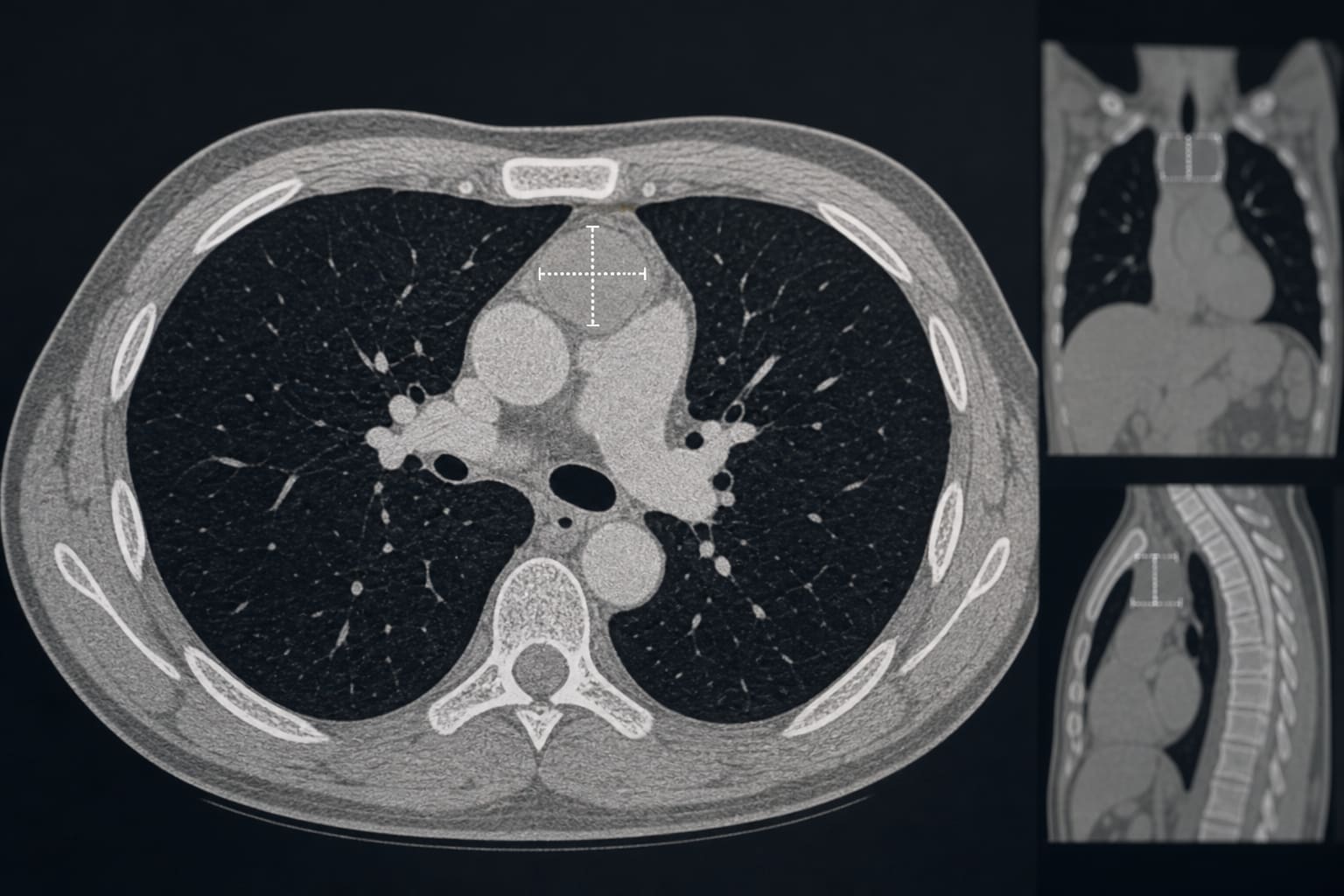
Safe Conservative Approaches for Managing Anterior Mediastinal Lesions Under 3cm in Lung Cancer Screening
By
Amyn Bhamani
Chuen R. Khaw
Ruth Prendecki
Priyam Verghese
Andrew Creamer
Jennifer L. Dickson
Carolyn Horst
Helen Hall
Sophie Tisi
Monica Mullin
Tanya Patrick
John McCabe
Anne-Marie Hacker
Laura Farrelly
Esther Arthur-Darkwa
Neal Navani
Anand Devaraj
Allan Hackshaw
Arjun Nair
Sam M. Janes
July 4, 2026
Clinical Scorecard: Safe Conservative Approaches for Managing Anterior Mediastinal Lesions Under 3cm in Lung Cancer Screening
At a Glance
Category Detail
Condition Anterior Mediastinal Lesions Key Mechanisms Incidental findings during lung cancer screening using low-dose computed tomography (LDCT). Target Population Current or former smokers aged 55-77 with a ≥ 1.3% 6-year lung cancer risk. Care Setting Lung cancer screening programs.
Key Highlights
LDCT screening reduces lung cancer-related mortality. Prevalence of anterior mediastinal lesions is low (0.4% - 0.9%). Most anterior mediastinal lesions are thymic in origin. Conservative management is considered safe for lesions < 3 cm. Follow-up includes annual LDCT imaging for monitoring. Guideline-Based Recommendations
Diagnosis
Further imaging is recommended for non-cystic anterior mediastinal lesions. Management
Lesions < 3 cm are managed conservatively with follow-up imaging. Monitoring & Follow-up
Annual LDCT imaging at 12 and 24 months for lesions < 3 cm. Risks
Potential for over-diagnosis and unnecessary interventions. Patient & Prescribing Data
Participants from the SUMMIT Study, aged 55-77, current or former smokers.
Conservative management with follow-up imaging is effective for small lesions.
Clinical Best Practices
Utilize a standardized reporting template for incidental findings. Refer lesions ≥ 3 cm or with concerning features to multidisciplinary teams. Ensure regular follow-up imaging for monitoring changes in lesion size or morphology. Related Resources & Content