Clinical Scorecard: Respiratory Tract Herpesvirus Reactivation in Critically Ill Patients: An Underrecognized Clinical Concern
At a Glance
Category
Detail
Condition
Pulmonary herpes simplex virus (HSV) reactivation in critically ill patients with persistent acute respiratory failure (ARF)
Key Mechanisms
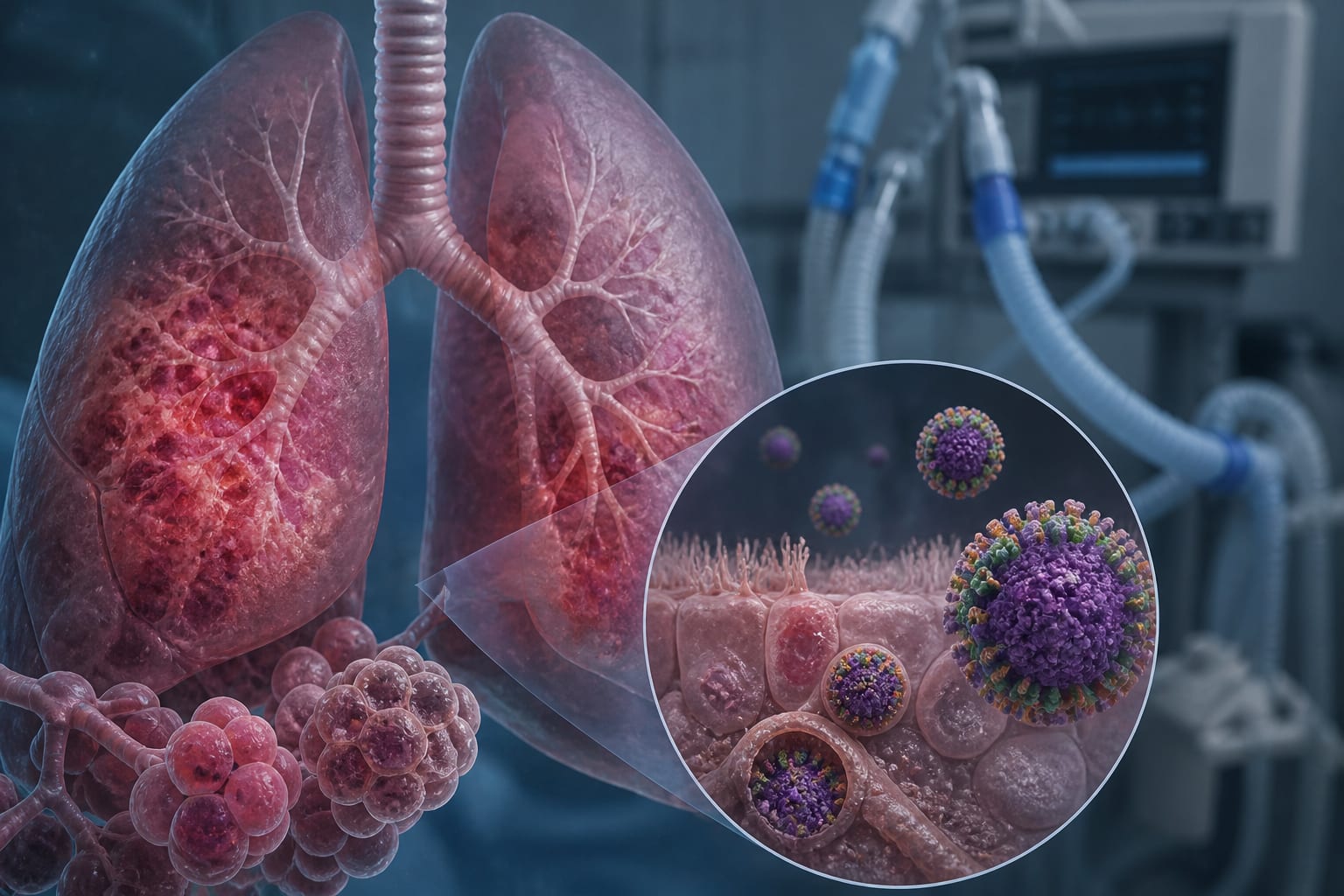
Elevated pulmonary HSV burden is associated with a distinct inflammatory phenotype and compartmentalized alveolar inflammation; HSV may migrate from the upper to the lower respiratory tract in patients with an artificial airway.
Target Population
Critically ill patients with persistent ARF, including patients receiving invasive mechanical ventilation
Care Setting
Critical care, particularly evaluation of lower respiratory tract herpesvirus reactivation in patients with ARF
Key Highlights
A prospective observational cohort linked pulmonary HSV reactivation with less favorable clinical outcomes and localized alveolar inflammation.
Elevated pulmonary HSV load was associated with a distinct inflammatory phenotype; analyses also linked this phenotype to extubation and mortality.
The relationship between HSV reactivation and hyperinflammatory ARF subphenotypes remains unconfirmed.
Oropharyngeal HSV detection alone has not been definitively linked to unfavorable outcomes, whereas upper-to-lower respiratory tract HSV migration in patients with an artificial airway has been associated with longer mechanical ventilation and higher mortality.
The article calls for standardized HSV PCR reporting, further investigation of airway pathogen interactions, and randomized trials of antiviral therapy.
Guideline-Based Recommendations
Diagnosis
Evaluate HSV status in both the upper and lower respiratory tracts in future studies of critically ill patients.
Assess pulmonary HSV burden across ARF subphenotypes and consider stratification by immune status, sepsis status, and molecular profiles.
Standardize HSV PCR results in IU/mL to improve comparability between studies.
Management
The article proposes that early upper-respiratory-tract HSV surveillance and assessment of upper-to-lower tract viral burden may support recognition of high-risk patients and guide timely antiviral initiation; this approach requires further evaluation.
Test antiviral therapy in randomized trials.
Monitoring & Follow-up
Document the timing of artificial airway placement accurately.
Examine the association between HSV burden in the upper and lower respiratory tracts.
Evaluate clinical outcomes, including extubation, duration of mechanical ventilation, and mortality.
Risks
Pulmonary HSV reactivation was associated with less favorable clinical outcomes.
HSV migration from the upper to the lower respiratory tract in critically ill patients with an artificial airway has been associated with longer mechanical ventilation and higher mortality.
The clinical consequences of HSV reactivation across ARF subphenotypes and the causal role of interactions with other airway pathogens remain unresolved.
Patient & Prescribing Data
Critically ill patients with persistent ARF; the article also discusses patients with artificial airways and invasive mechanical ventilation.
The article suggests evaluating timely antiviral therapy in relation to upper- and lower-respiratory-tract HSV burden, but reports no established prescribing regimen and calls for randomized trials.
Clinical Best Practices
In research, interpret pulmonary HSV findings across ARF subphenotypes and consider stratification by immune status, sepsis status, and molecular profiles.
Distinguish oropharyngeal HSV detection from lower-respiratory-tract involvement; oropharyngeal detection alone has not been definitively linked to unfavorable outcomes.
In studies of viral dissemination, document artificial airway placement timing and assess HSV burden in both upper and lower respiratory tracts.
Standardize HSV PCR reporting in IU/mL to improve comparability between studies.
Further investigate clinical and molecular phenotypes, causal pathways, and interactions between herpesviruses and other airway pathogens.