Clinical Scorecard: The Role of Proton-Pump Inhibitors as a Modifiable Contributor to Iron Deficiency in Heart Failure Patients
At a Glance
Category
Detail
Condition
Iron deficiency in heart failure
Key Mechanisms
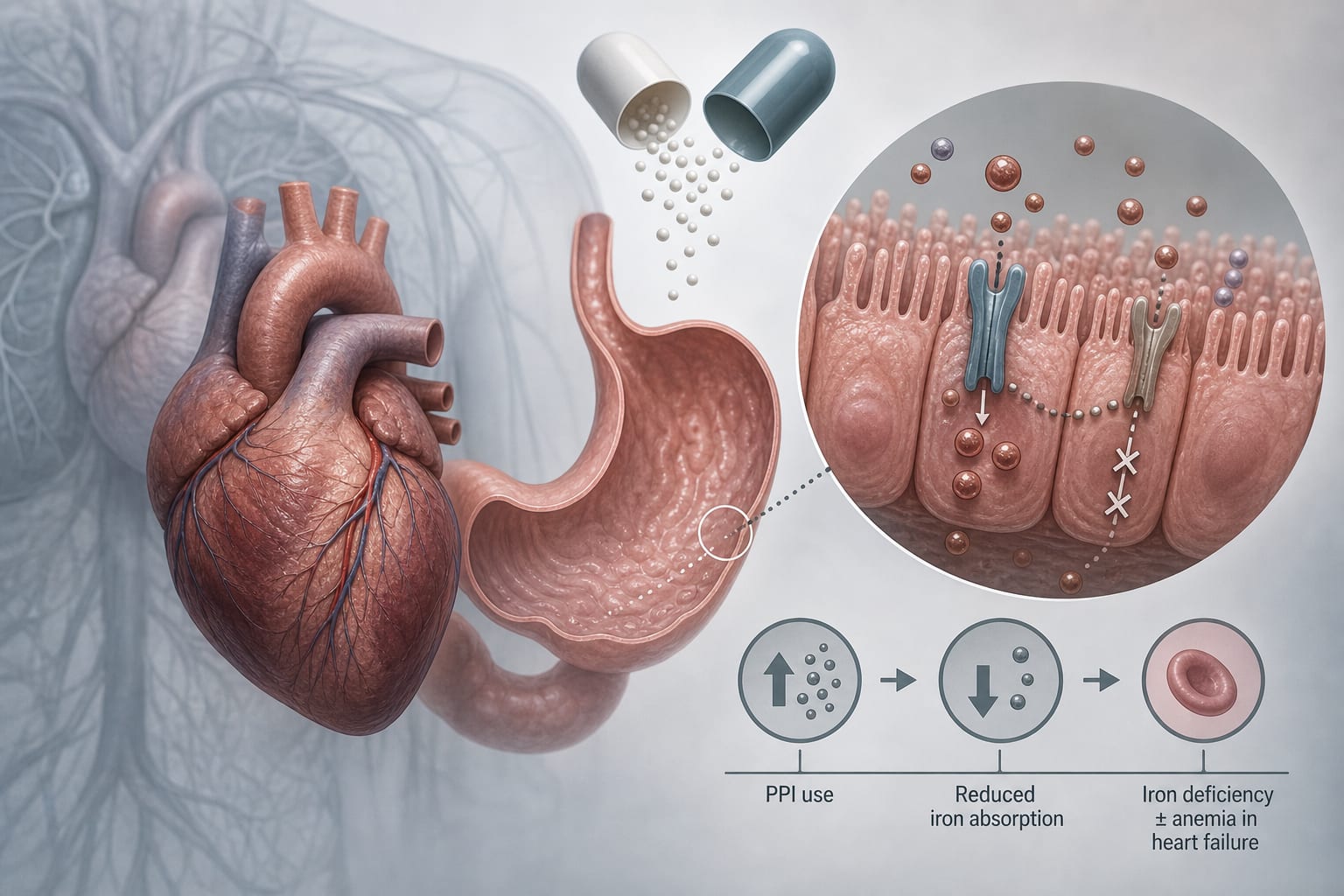
PPI-related gastric acid suppression may impair nonheme iron absorption; experimental evidence also suggests that PPIs may increase hepcidin expression.
Target Population
Adults with new-onset or worsening heart failure and complete iron-parameter and medication data
Care Setting
Post hoc analysis of the BIOSTAT-CHF index and validation cohorts
Key Highlights
Among 4056 patients, 1534 (38%) used a PPI.
Iron deficiency was more prevalent among PPI users than nonusers (64% vs 56%).
PPI use was independently associated with iron deficiency (OR, 1.29; 95% CI, 1.08–1.54).
Each 10-mg increase in omeprazole-equivalent dose was associated with 9% greater odds of iron deficiency.
PPI subtype was not independently associated with iron deficiency after adjustment for acid-suppressive potency.
Guideline-Based Recommendations
Diagnosis
Current heart failure guidelines recommend routine screening for iron deficiency and identifying potentially treatable causes.
In this study, iron deficiency was defined as transferrin saturation below 20%.
Management
The authors recommend critically evaluating the indication for continued PPI therapy.
Monitoring & Follow-up
More frequent iron-status monitoring should be considered in patients with heart failure who are receiving PPIs.
Risks
The association was dose-dependent, but the observational design cannot establish that PPI use causes iron deficiency.
Gastrointestinal disease, duration of PPI use, and C-reactive protein were unavailable for aspects of the analysis, leaving potential residual confounding.
Patient & Prescribing Data
PPI users had lower transferrin saturation, serum iron, hemoglobin, and albumin levels than nonusers. Greater omeprazole-equivalent doses were associated with higher odds of iron deficiency, whereas individual PPI subtypes were not independently associated after potency adjustment.
Clinical Best Practices
Review whether continued PPI therapy remains indicated in patients with heart failure.
Consider closer iron-status monitoring when PPI therapy is continued.
Related Resources & Content
BIOSTAT-CHF study
Kutscher M, van der Wal HH, Voors AA, et al. — Proton-Pump Inhibitor Use as a Modifiable Etiological Factor for Iron Deficiency in Heart Failure
The proposed framework classified 30% of patients as high or extreme risk, compared with 12% classified as having severe or greater tricuspid regurgitation under established grading schemes.