Transcriptomic profiling and IgM and IgT repertoire dynamics in rainbow trout gills following primary and secondary challenge with Lactococcus petauri - Scorecard - MDSpire
Advertisement
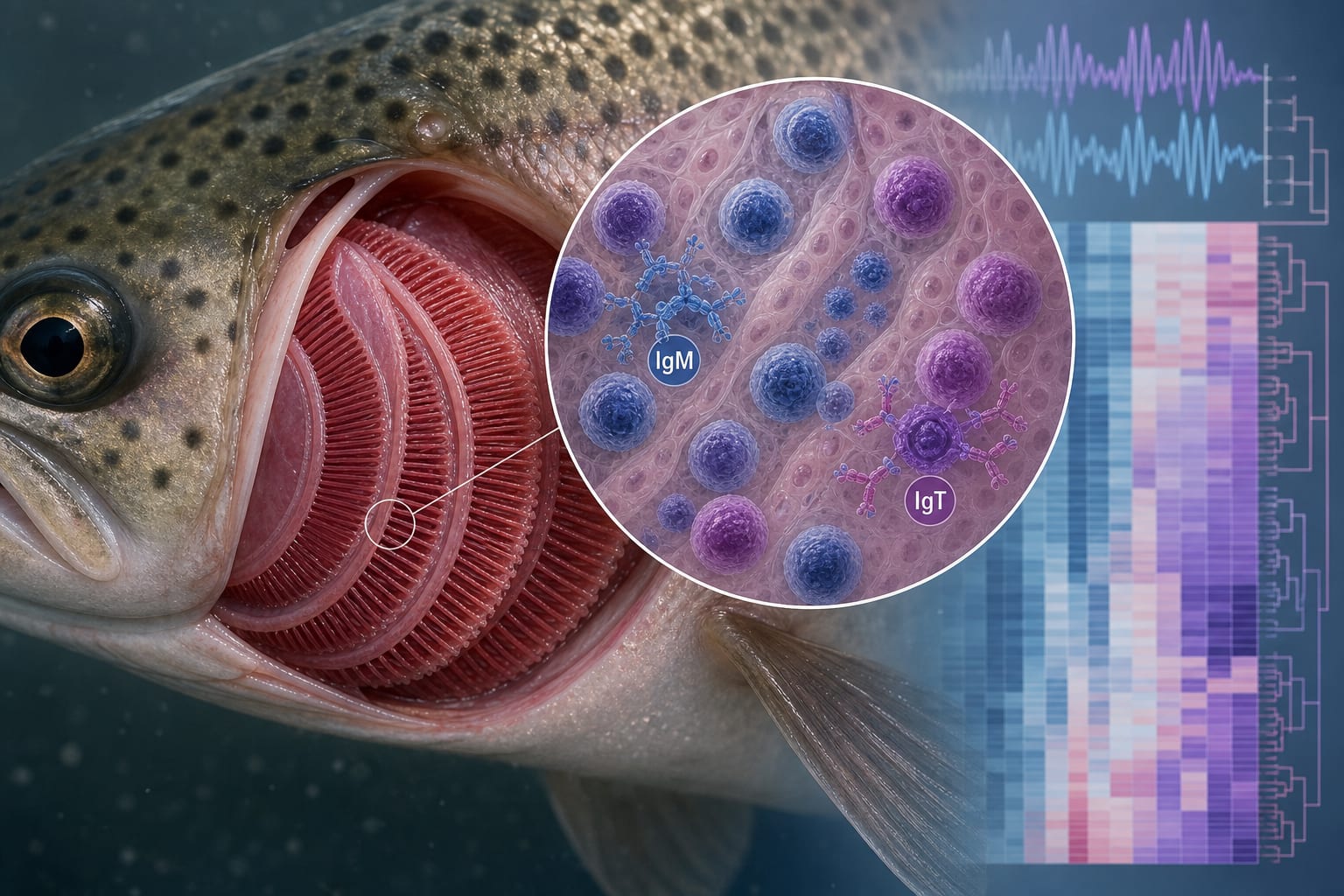
Transcriptomic profiling and IgM and IgT repertoire dynamics in rainbow trout gills following primary and secondary challenge with Lactococcus petauri
Clinical Scorecard: Transcriptomic Analysis and Dynamics of IgM and IgT Repertoires in Rainbow Trout Gills After Initial and Subsequent Exposure to Lactococcus petauri
At a Glance
Category
Detail
Condition
Key Mechanisms
Activation of innate and adaptive immune elements; local organization of memory responses.
Target Population
Care Setting
Key Highlights
Memory responses in gills are locally organized.
Re-infected fish show clonal expansion of IgM and IgT.
No up-regulation of inflammation-related genes during secondary infection.
Increased levels of specific IgM produced locally and in serum.
Gills serve as a site for localized adaptive immune regulation.
Guideline-Based Recommendations
Diagnosis
RNAseq transcriptomic analysis for immune response evaluation.
ELISpot for quantifying IgM-secreting cells.
Management
Monitor immune responses post-infection for adaptive immunity assessment.
Monitoring & Follow-up
Track gene expression changes related to adaptive immunity.
Risks
Potential for pathogen dissemination if immune responses are inadequate.
Patient & Prescribing Data
Secondary exposure leads to enhanced IgM and IgT responses.
Clinical Best Practices
Utilize transcriptomic analysis to understand immune dynamics.
Assess both innate and adaptive immune responses in fish.
by Aitor Arrogante, Esther Morel, Beatriz Abós, Samuel Vicente-Gil, Pablo Jiménez-Barrios, Patricia Díaz-Rosales, Pedro Perdiguero, J. Germán Herranz-Jusdado, Carolina Tafalla