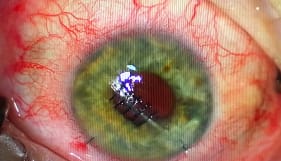
Clinical Scorecard: Seeing the Halo
At a Glance
| Category | Detail |
|---|---|
| Condition | Keratoconus (KC) |
| Key Mechanisms | Optical effects within the ectatic cornea producing an annular light projection (Halo Sign) on the iris during slit-lamp examination |
| Target Population | Patients with keratoconus, particularly advanced cases (Amsler–Krumeich stage IV) |
| Care Setting | Ophthalmology clinics, especially resource-limited settings without access to corneal tomography |
Key Highlights
- The Halo Sign is a novel optical phenomenon seen as an annular light projection on the iris at the cone apex during slit-lamp exam.
- It is predominantly observed in advanced keratoconus and correlates with worse visual acuity, thinner corneas, steeper keratometry, and higher-order aberrations.
- The Halo Morphology Index (HMI) quantifies halo shape variations, reflecting disease severity and optical irregularity.
Guideline-Based Recommendations
Diagnosis
- Use slit-lamp examination to qualitatively recognize the Halo Sign as a complementary indicator of advanced keratoconus.
- Do not rely on the Halo Sign as a standalone diagnostic or staging tool.
Management
- Consider further evaluation or referral when the Halo Sign is observed, especially in settings lacking corneal tomography.
Monitoring & Follow-up
- Monitor halo morphology changes using the Halo Morphology Index (HMI) to assess progression of corneal deformation.
Risks
- Advanced keratoconus with the Halo Sign is associated with increased corneal scarring and higher optical aberrations, indicating risk for visual deterioration.
Patient & Prescribing Data
Patients with keratoconus, particularly those with advanced disease (stage IV)
Recognition of the Halo Sign may prompt timely referral and intervention to manage advanced keratoconus and prevent further visual decline.
Clinical Best Practices
- Incorporate careful slit-lamp observation for the Halo Sign during routine keratoconus assessments.
- Use the Halo Sign as an adjunct to other clinical signs and imaging modalities for comprehensive disease evaluation.
- Apply the Halo Morphology Index (HMI) to quantify halo characteristics and monitor disease progression.
- Educate clinicians in resource-limited settings to recognize the Halo Sign to aid in identifying advanced keratoconus.
Related Resources & Content
Based on findings from:
Seeing the Halo
The Ophthalmologist, 2026.
https://theophthalmologist.com/issues/2026/articles/april/seeing-the-halo/
This content is an AI-generated, fully rewritten summary based on a published scholarly article. It does not reproduce the original text and is not a substitute for the original publication. Readers are encouraged to consult the source for full context, data, and methodology.