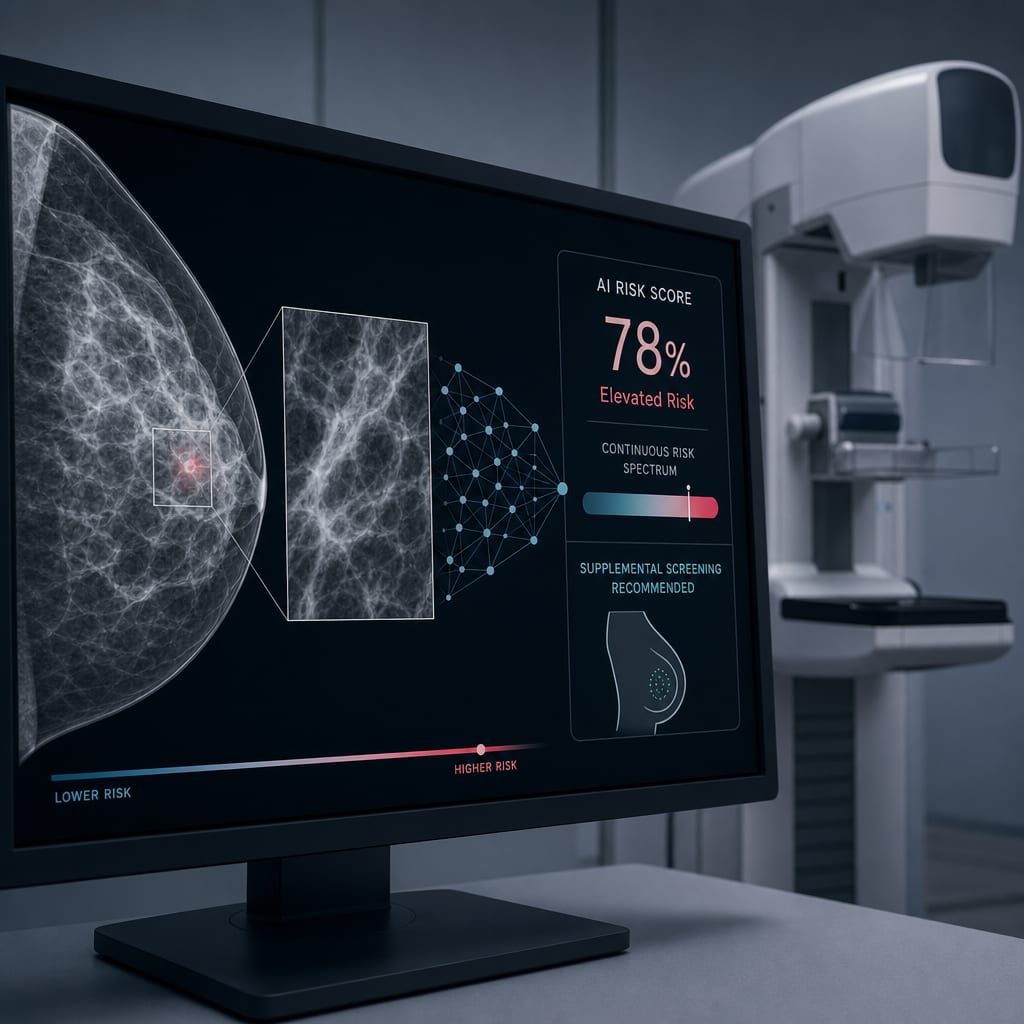
A Deep Learning Breast Cancer Risk Model for Precise Supplemental Screening
-
By
-
Leslie R. Lamb
-
Sarah F. Mercaldo
-
Andrew Carney
-
Constance D. Lehman
-
May 4, 2026
-
Clinical Scorecard: An Advanced Deep Learning Model for Assessing Breast Cancer Risk to Enhance Supplemental Screening Accuracy
At a Glance
| Category | Detail |
|---|
| Condition | Breast Cancer Risk Assessment |
| Key Mechanisms | Deep learning model (Mirai) analyzes mammographic images to estimate breast cancer risk without subjective assessments. |
| Target Population | Women aged 30 years or older undergoing screening mammography. |
| Care Setting | Imaging facilities performing screening mammography. |
Key Highlights
- FDA mandates notification of breast density to patients.
- Deep learning models outperform traditional risk models in predicting breast cancer risk.
- Current density-based screening policies may lead to overuse of imaging resources.
- Mirai model provides risk scores based solely on mammographic data.
- Study cohort included over 123,000 mammograms from nearly 67,000 patients.
Guideline-Based Recommendations
Diagnosis
- Utilize deep learning models for more accurate breast cancer risk assessment.
Management
- Consider supplemental screening based on advanced risk stratification rather than solely on breast density.
Monitoring & Follow-up
- Regularly assess the effectiveness of risk models in clinical practice.
Risks
- Be aware of potential overdiagnosis and false positives associated with broad supplemental screening policies.
Patient & Prescribing Data
Women aged 30 years or older with screening mammograms.
Deep learning models can provide personalized risk assessments to guide screening decisions.
Clinical Best Practices
- Implement deep learning risk models in routine mammography screenings.
- Educate patients on the implications of breast density and risk scores.
- Ensure equitable access to supplemental screening based on individualized risk assessments.
References