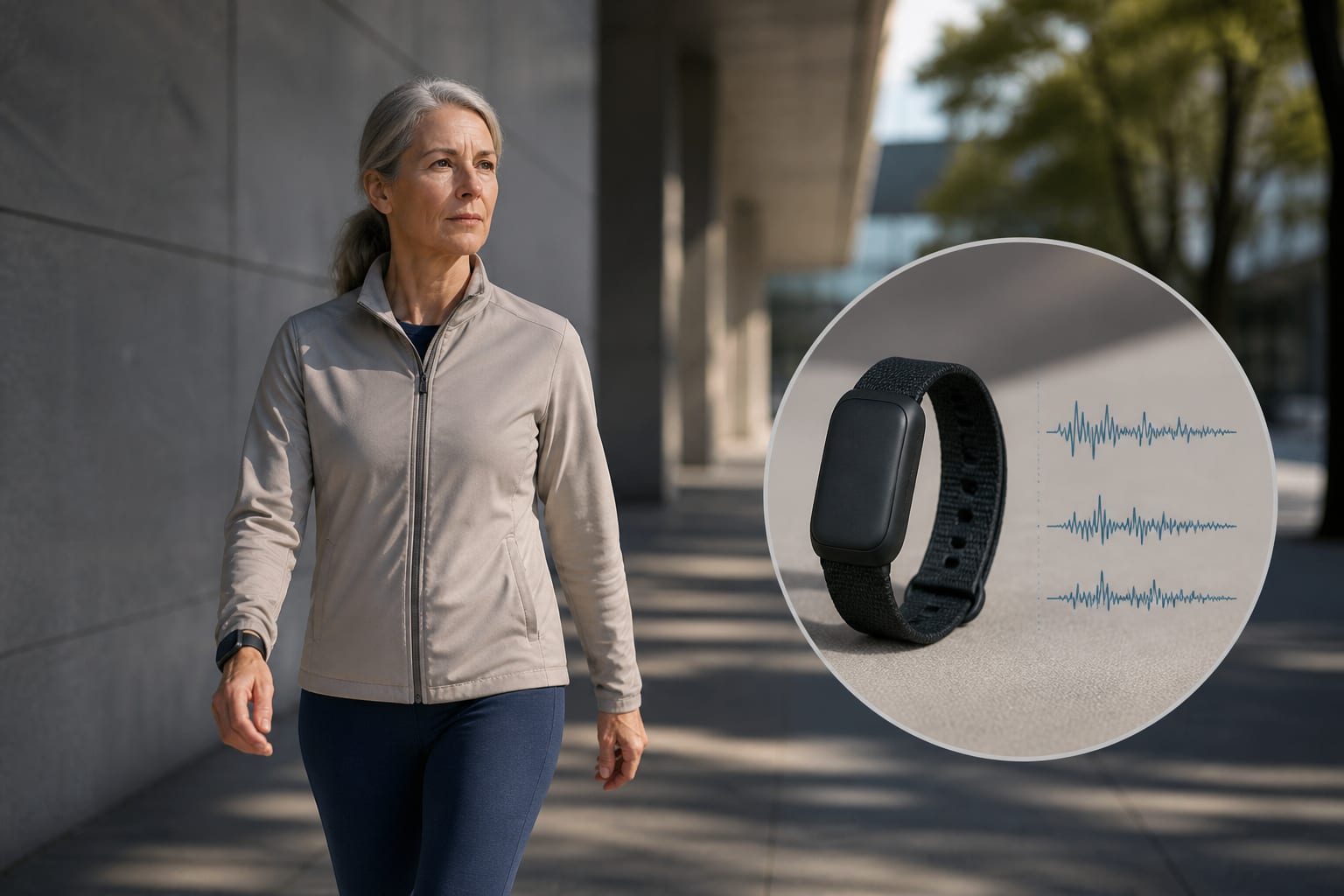
Assessing Real-World Mobility Function Beyond Timed Walking Tests
-
By
-
Davide Liborio Vetrano
-
October 23, 2026
Clinical Scorecard: Assessing Real-World Mobility Function Beyond Timed Walking Tests
At a Glance
| Category | Detail |
|---|---|
| Condition | Clinical topic addressed by the source article: Assessing Real-World Mobility Function Beyond Timed Walking Tests |
| Key Mechanisms | The article describes clinical walking speed as a measure that integrates multiple physiologic systems and may reflect physiologic reserve. It distinguishes standardized clinical walking capacity from free-living mobility, which is influenced by environment, habits, motivation, social participation, opportunity, and everyday demands. |
| Target Population | Population described in the source article. |
| Care Setting | A brief standardized clinical walking test and 9 days of free-living wrist-worn accelerometry. |
Key Highlights
- In 4067 Whitehall II participants, clinical walking speed and free-living cadence measures were each associated with lower all-cause mortality after adjustment.
- The measures had broadly similar discriminative ability, but only clinical walking speed significantly improved discrimination beyond the fully adjusted risk model.
- Clinical walking speed and free-living cadence were only modestly correlated, reflecting distinct assessment contexts.
- The cohort was relatively high functioning and active: mean clinical walking speed was 1.2 m/s and average daily steps were approximately 9500.
- The authors caution that the study provides limited evidence that combining clinical and free-living measures improves mortality discrimination.
Guideline-Based Recommendations
Diagnosis
- The article describes clinical walking speed as a brief functional measure; it does not provide diagnostic criteria for a disease.
Management
- The article does not provide treatment recommendations.
Monitoring & Follow-up
- The study measured usual walking speed with a brief clinical walking test and free-living cadence using 9 days of wrist-worn accelerometry; these are study methods, not guideline recommendations.
Risks
- The article discusses slower gait as potentially reflecting deficits across multiple physiologic systems and reduced physiologic reserve.
- Study limitation: the relatively high-functioning cohort and healthier participants contributing accelerometer data may have constrained the measures’ ability to distinguish mortality risk.
Patient & Prescribing Data
The study included 4067 Whitehall II cohort participants; those contributing accelerometer data were healthier than the overall cohort.
No treatment or prescribing data are reported. The article discusses clinical walking speed and free-living cadence as mobility measures associated with mortality.
Clinical Best Practices
Related Resources & Content
Based on findings from:
Measuring Mobility Function in Everyday Life—Beyond the Stopwatch
Davide Liborio Vetrano. Jama Network Open, 2026.
https://jamanetwork.com/journals/jamanetworkopen/fullarticle/2855786
This content is an AI-generated, fully rewritten summary based on a published scholarly article. It does not reproduce the original text and is not a substitute for the original publication. Readers are encouraged to consult the source for full context, data, and methodology.