Malignant transformation of lower-grade glioma: contrast enhancement, extent of resection, and the natural history under interval-censored analysis - Scorecard - MDSpire
Conexiant’s news site is now MDSpire News. Learn more
Advertisement
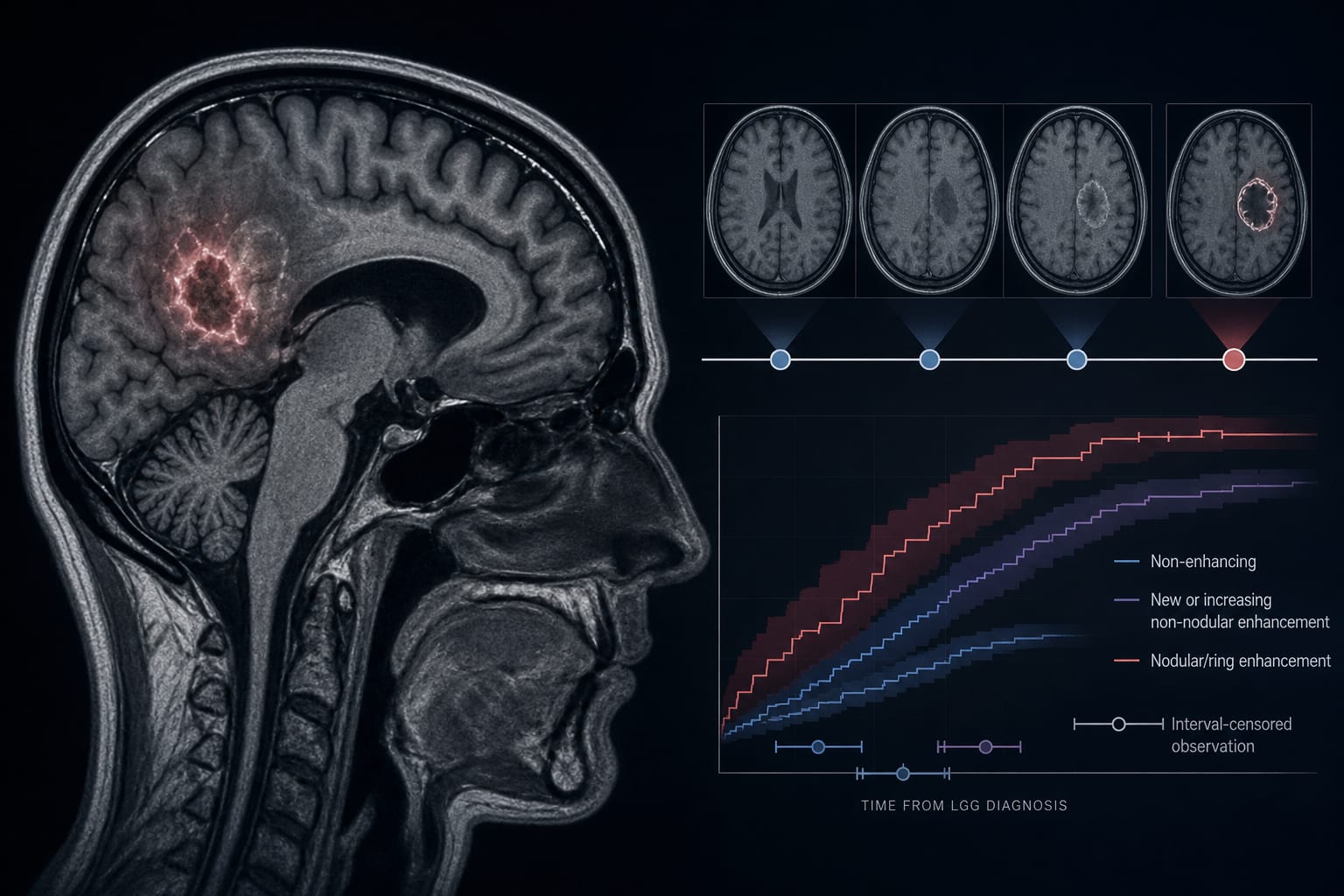
Transformation of Lower-Grade Gliomas to Malignancy: The Role of Contrast Enhancement, Surgical Resection Extent, and Interval-Censored Analysis of Natural History
Clinical Scorecard: Transformation of Lower-Grade Gliomas to Malignancy: The Role of Contrast Enhancement, Surgical Resection Extent, and Interval-Censored Analysis of Natural History
At a Glance
Category
Detail
Condition
Lower-Grade Gliomas (LGGs)
Key Mechanisms
Malignant transformation (MT) influenced by imaging and surgical factors.
Target Population
Adults with histologically confirmed WHO grade 2 or 3 diffuse gliomas.
Care Setting
Neurosurgical and oncological care settings.
Key Highlights
Malignant transformation is a critical event influencing prognosis and treatment timing.
Preoperative imaging serves as the only risk marker before tissue acquisition.
Interval-censored analysis provides a more accurate model for studying transformation timing.
Contrast enhancement is assessed visually on MRI to determine malignancy.
Surgical resection extent may impact the likelihood of malignant transformation.
Guideline-Based Recommendations
Diagnosis
Histological confirmation required for LGG diagnosis.
MRI used for initial radiological diagnosis and monitoring.
Management
Surgical resection is a key component of management for LGGs.
Monitoring & Follow-up
Regular surveillance MRIs are essential for tracking transformation.
Risks
Malignant transformation can occur without clear radiological indicators.
Patient & Prescribing Data
Patients with adult-type diffuse gliomas, WHO grade 2 or 3.
Timing of adjuvant therapy is influenced by the occurrence of malignant transformation.
Clinical Best Practices
Utilize comprehensive imaging protocols for accurate assessment of LGGs.
Incorporate interval-censored analysis in studies of malignant transformation.
Ensure multidisciplinary review of imaging findings to confirm transformation.
Related Resources & Content
Journal of Neuro-Oncology, 2020 -- Geographical Patterns of Malignant Transformation in Low-Grade Glioma Patients
Journal of Neuro-Oncology, 2022 -- Contemporary Approaches to the Surgical Treatment of Incidental Gliomas
Journal of Neuro-Oncology, 2016 -- Prognostic value of the extent of resection in supratentorial WHO grade II astrocytomas stratified for IDH1 mutation status: a single-center volumetric analysis
Journal of Clinical Oncology, 2025 -- Therapy for Diffuse Astrocytic and Oligodendroglial Tumors in Adults: ASCO-SNO Guideline Rapid Recommendation Update
Journal of Neuro-Oncology — Patterns of Spatial Invasion in Temporal Lobe Glioblastoma Following Complete Resection of Contrast-Enhancing Tumors
Therapy for Diffuse Astrocytic and Oligodendroglial Tumors in Adults: ASCO-SNO Guideline Rapid Recommendation Update | Journal of Clinical Oncology
Randomized Trial of Radiation Therapy Plus Procarbazine, Lomustine, and Vincristine Chemotherapy for Supratentorial Adult Low-Grade Glioma: Initial Results of RTOG 9802 - PMC
Risk factors for postoperative malignant progression of lower-grade gliomas: a systematic review and meta-analysis - ScienceDirect
by Baran Atli, Maximilian Wartha, Matthias Gmeiner, Martin Aichholzer, Serge Weis, Dominik Vorhauer, Helga Wagner, Tanja Hauer, Carlo Serra, Petra Böhm, Michael Sonnberger, Nico Stroh-Holly, Stefan Aspalter, Kathrin Aufschnaiter, Tobias Rossmann, Maria Gollwitzer, Jawed Ziai, Annette Leibetseder, Josef Pichler, Wolfgang Thomae, Christian Dorfer, Andreas Gruber, Harald Stefanits, Philip Rauch