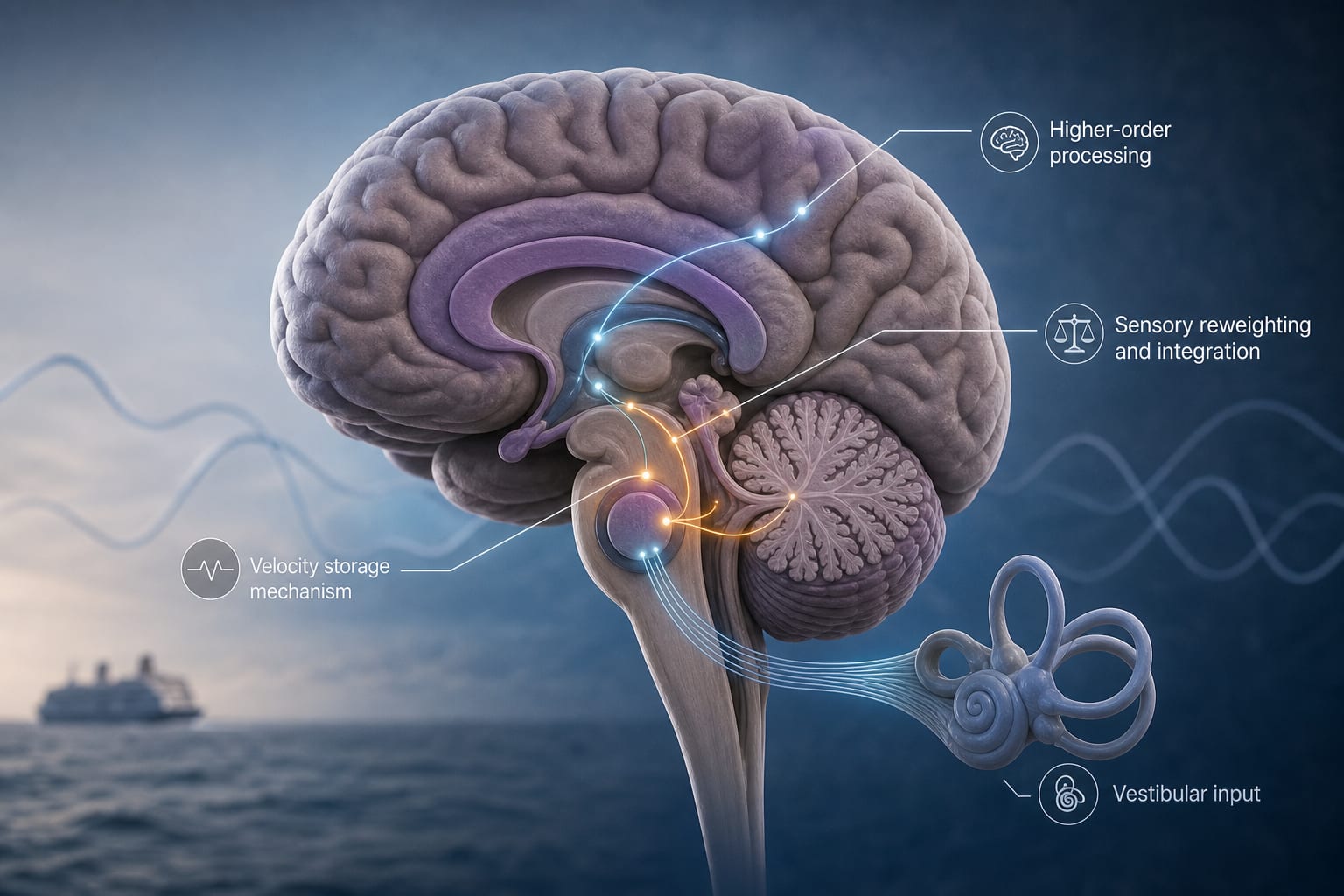
Toward personalized medicine for mal de débarquement syndrome
By
Jun Maruta
Catherine Cho
Sergei B. Yakushin
June 22, 2026
Clinical Scorecard: Advancing Personalized Approaches in the Management of Mal de Débarquement Syndrome
At a Glance
Category Detail
Condition Mal de Débarquement Syndrome (MdDS) Key Mechanisms Maladaptive velocity storage in the central vestibular system Target Population Patients with chronic vestibular disorder characterized by non-spinning vertigo Care Setting Clinical evaluation and treatment of vestibular disorders
Key Highlights
MdDS is characterized by a continuous false sensation of self-motion. Symptoms include non-spinning vertigo, dizziness, fatigue, and cognitive issues. Treatment approaches target maladaptive velocity storage mechanisms. Individual symptom emphasis may influence treatment responsiveness. Many patients do not benefit from existing treatments. Guideline-Based Recommendations
Diagnosis
Diagnosis confirmed by a board-certified physician based on chronic continuous non-oscillatory vertigo and motion trigger. Management
Two treatment approaches: VOR readaptation and velocity storage attenuation. Monitoring & Follow-up
Assessment of overall severity of MdDS as self-reported by patients. Risks
Variability in symptom presentation complicates treatment efficacy evaluation. Patient & Prescribing Data
Individuals diagnosed with MdDS experiencing chronic vestibular symptoms.
Treatment success varies; some patients may not respond to velocity storage-based approaches.
Clinical Best Practices
Consider individual symptom profiles when selecting treatment approaches. Monitor changes in symptom severity through patient self-reporting. Related Resources & Content