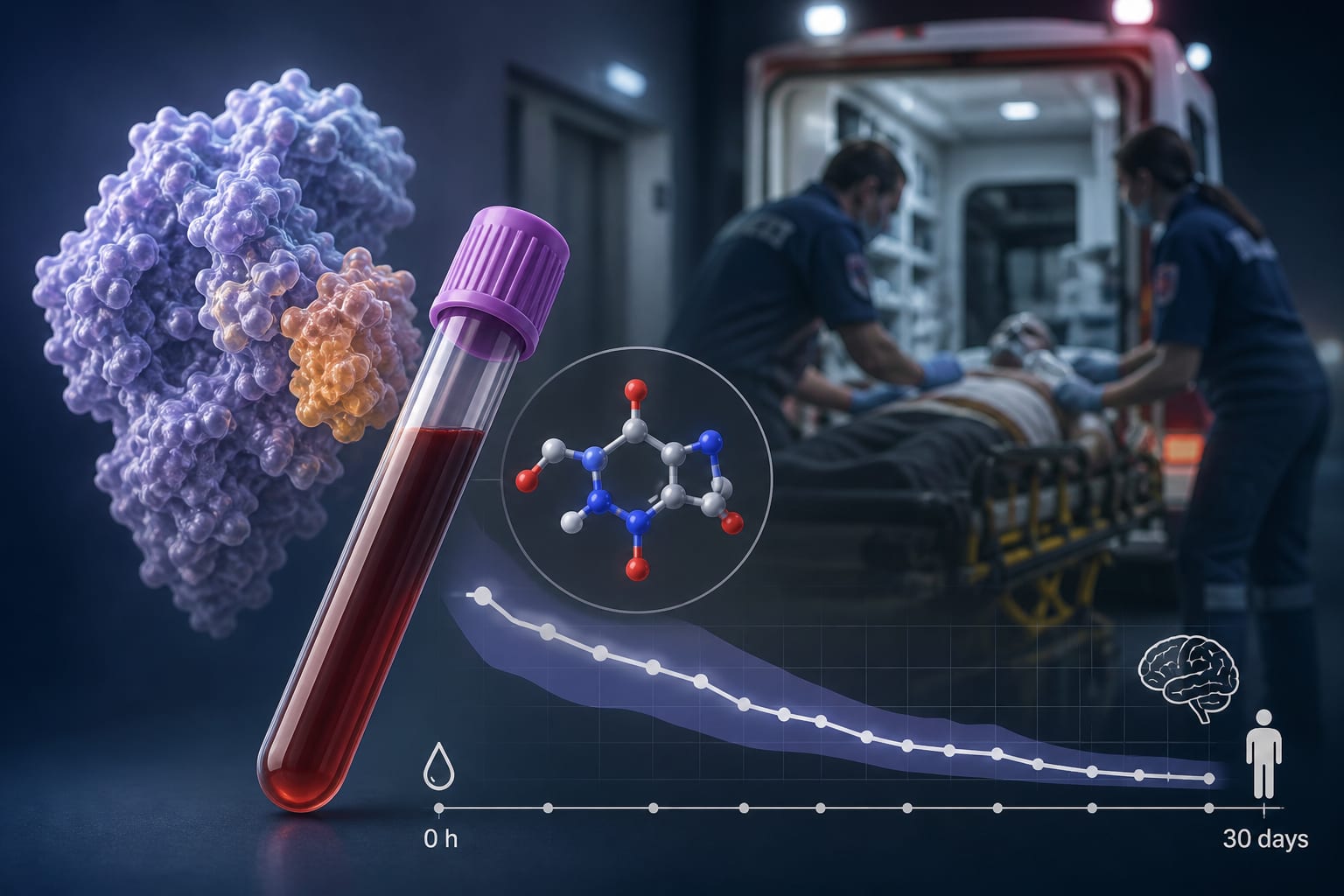
Clinical Scorecard: Early Changes in Serum Uric Acid and 30-Day Outcomes Following Out-of-Hospital Cardiac Arrest
At a Glance
Category
Detail
Condition
Clinical topic addressed by the source article: Early Changes in Serum Uric Acid and 30-Day Outcomes Following Out-of-Hospital Cardiac Arrest
Key Mechanisms
Serum uric acid reflects purine metabolism and the balance of production, renal excretion, and intestinal elimination; the authors note that its change does not directly quantify renal uric acid clearance.
Target Population
Population described in the source article.
Care Setting
Care setting described in the source article.
Key Highlights
The prospective multicenter observational study included 375 patients with paired serum uric acid measurements.
Admission serum uric acid did not differ significantly between 30-day survivors and non-survivors.
A greater 24-hour uric acid decline was associated with 30-day survival (adjusted OR 1.10 per 10-percentage-point increase; 95% CI 1.00–1.20; p=0.048); an analysis accounting for temperature control and pre-arrest renal comorbidity also found an association (adjusted OR 1.09; 95% CI 1.01–1.19; p=0.04).
Uric acid decline was associated with 30-day good neurological outcome, defined as CPC 1 or 2 (adjusted OR 1.19 per 10-percentage-point increase; 95% CI 1.05–1.35; p=0.006).
The authors state that the association was not shown to be independent of renal dysfunction; serial renal-function and urine-output data were unavailable. Requiring a 24-hour measurement excluded some patients, including those who died early, and the direction and extent of selection bias are indeterminate.
Guideline-Based Recommendations
Diagnosis
Management
Monitoring & Follow-up
The study assessed 30-day survival and good neurological outcome, defined as CPC 1 or 2.
The authors state that further studies with serial evaluations of renal function and kidney injury are required to clarify the physiological determinants and potential clinical value of this dynamic measurement.
Risks
Patient & Prescribing Data
The analytic cohort comprised 375 patients with out-of-hospital cardiac arrest treated at 41 tertiary emergency hospitals in metropolitan Japan from September 2019 to March 2021; 209 survived and 166 did not.
This observational study did not test a uric-acid-directed treatment. Temperature control was used in 55% of patients, with institutional targets of 34 °C, 35 °C, or 36 °C.
Clinical Best Practices
The study found no significant survivor–non-survivor difference in admission serum uric acid, while a greater 24-hour decline was associated with outcomes.
The authors report an observational association and state that it was not shown to be independent of renal dysfunction.
The authors state that uric acid decline does not directly quantify renal uric acid clearance.
The authors identify exclusion of patients without 24-hour measurements, including some who died early, as a potential source of selection bias; its direction and extent are indeterminate.
When patients with refractory AFib fall into a treatment gap, a collaborative new multidisciplinary clinic from Keck Medicine of USC gives them a way out.