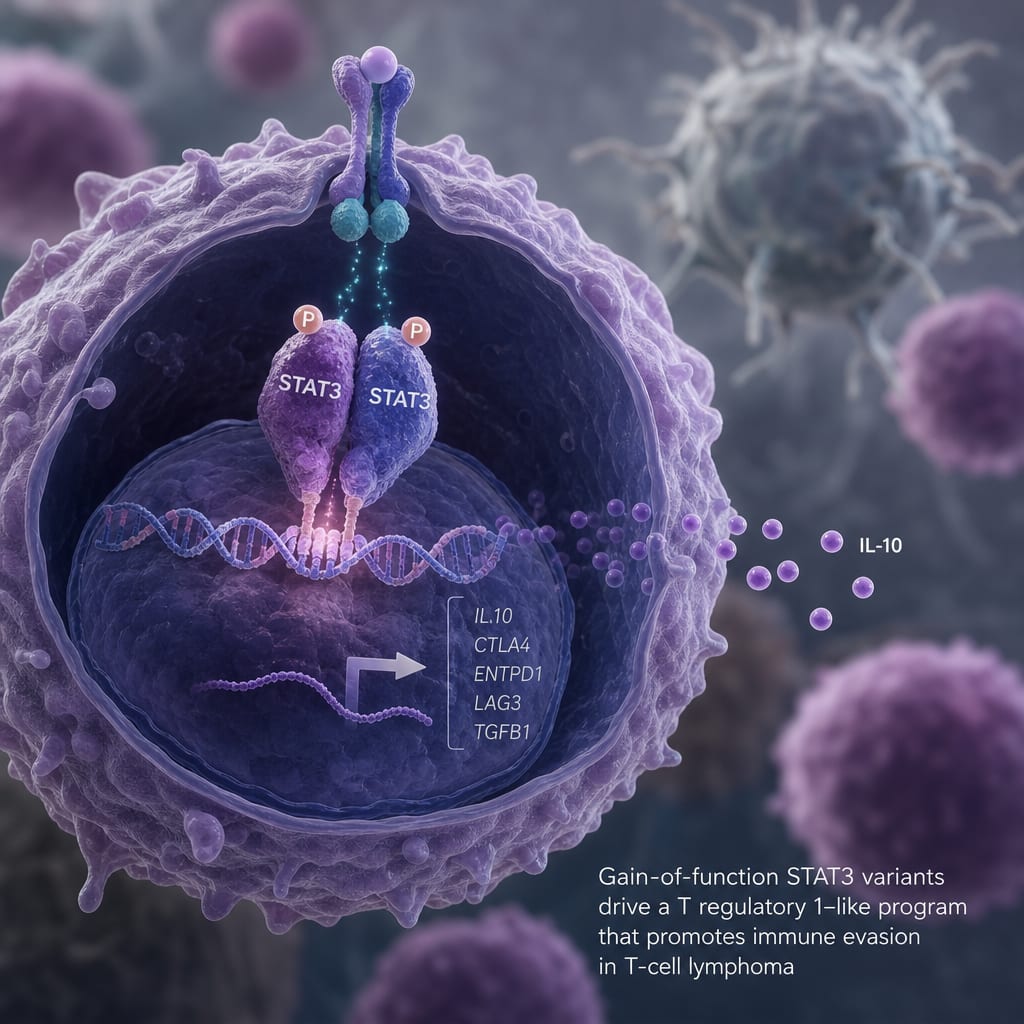
Clinical Scorecard: Variants of STAT3 Linked to T-cell Lymphoma Induce a Regulatory Phenotype Similar to Type 1
At a Glance
Category
Detail
Condition
T-cell malignancies associated with STAT3 mutations
Key Mechanisms
Gain-of-function mutations in STAT3, particularly Y640F and N647I, lead to aberrant signaling that promotes T regulatory 1 (Tr1) gene expression and dampens T-cell responses.
Target Population
Patients with T-cell malignancies, particularly T-cell large granular lymphocytic leukemias (T-LGLLs) and adult T-cell leukemia (ATL).
Care Setting
Oncology and hematology clinics.
Key Highlights
STAT3 mutations are prevalent in T-cell cancers, particularly T-LGLLs (~40%).
Y640F and N647I variants exhibit gain-of-function phenotypes with distinct transcriptome-wide effects.
Both variants induce a Tr1 gene program characterized by IL-10 expression.
Tr1 skewing is observed in both mouse models and human patients with T-cell malignancies.
STAT3 is a tier 1 driver of hematological malignancies.
Guideline-Based Recommendations
Diagnosis
Consider genetic testing for STAT3 mutations in patients with T-cell malignancies.
Management
Targeted therapies against aberrant STAT3 signaling may be beneficial.
Monitoring & Follow-up
Monitor for changes in T-cell populations and cytokine profiles in patients with STAT3 mutations.
Risks
Increased risk of immune evasion and disease progression due to altered T-cell responses.
Patient & Prescribing Data
Patients with hematological malignancies exhibiting STAT3 mutations.
Understanding the specific STAT3 variant may guide targeted therapy choices.
Clinical Best Practices
Incorporate genetic profiling in the management of T-cell malignancies.
Evaluate the role of IL-27 in T-cell activation and malignancy progression.