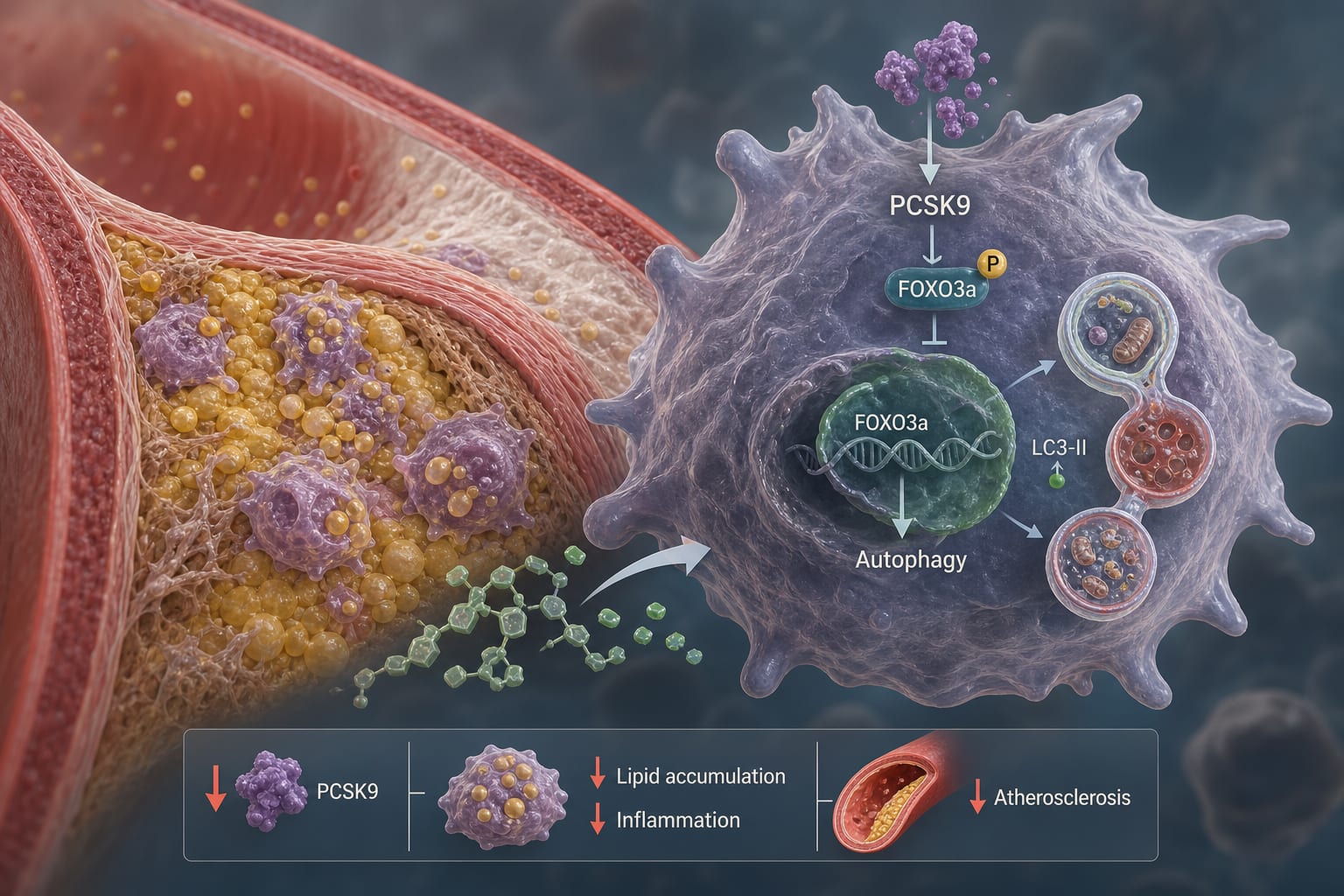
PCSK9 promotes atherosclerosis progression through the FOXO3a autophagy signaling pathway
-
By
-
Yuanjia Shi
-
Jing Zhang
-
Lina Dai
-
Jie Chen
-
Shijia Geng
-
Yan Niu
-
Chongyang Dong
-
Chenlei Li
-
Rujin Liu
-
Ningxia Zhao
-
Xiaomeng Wang
-
Zhanfeng Gao
-
Xi Yang
-
Shang Gao
-
June 15, 2026
-
Clinical Scorecard: The Role of PCSK9 in Advancing Atherosclerosis via the FOXO3a Autophagy Pathway
At a Glance
| Category | Detail |
|---|
| Condition | |
| Key Mechanisms | PCSK9 modulates autophagy via the FOXO3a pathway, influencing macrophage function and plaque progression. |
| Target Population | |
| Care Setting | |
Key Highlights
- PCSK9 enhances autophagy-related protein expression, promoting atherosclerosis.
- COS reduces PCSK9 expression and mitigates atherosclerotic plaque progression.
- FOXO3a is a critical regulator of autophagy in macrophages.
- Excessive autophagy activation may lead to programmed cell death, impacting atherosclerosis.
Guideline-Based Recommendations
Diagnosis
- Monitor PCSK9 levels and autophagy-related proteins in patients with atherosclerosis.
Management
- Consider PCSK9 inhibitors for patients with high LDL cholesterol and atherosclerosis.
Monitoring & Follow-up
- Assess autophagy flux and related protein levels to evaluate treatment efficacy.
Risks
- Excessive autophagy may lead to programmed cell death, complicating atherosclerosis.
Patient & Prescribing Data
Patients with elevated LDL cholesterol and atherosclerosis risk factors.
COS and PCSK9 inhibitors may reduce atherosclerosis progression by modulating autophagy.
Clinical Best Practices
- Evaluate the role of PCSK9 in individual patient cases of atherosclerosis.
- Incorporate autophagy assessment in the management of atherosclerosis.
Related Resources & Content