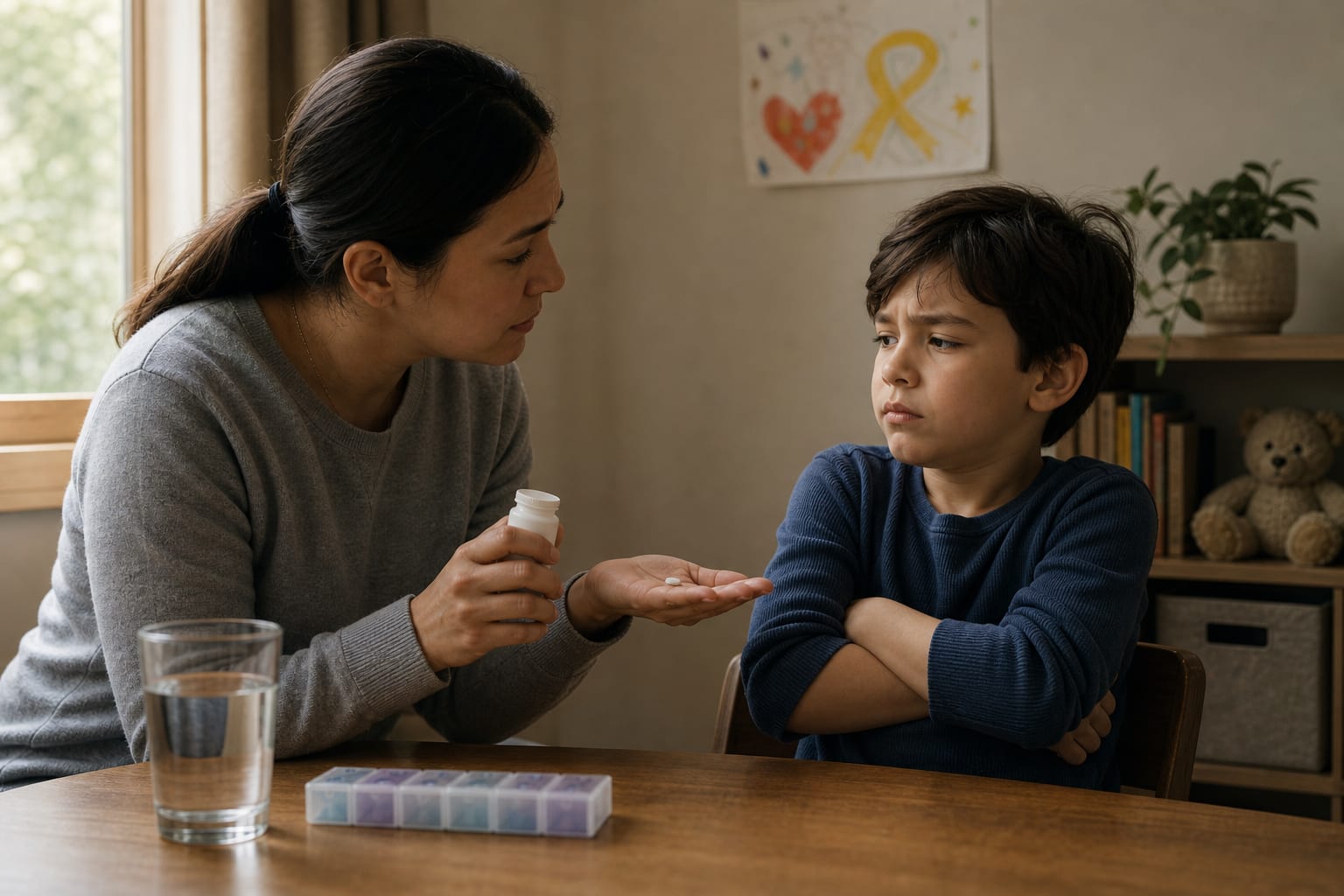
Clinical Scorecard: Parent–Child Interactions and Everyday Experiences With Medication Adherence in Pediatric Care
At a Glance
Category
Detail
Condition
Clinical topic addressed by the source article: Parent–Child Interactions and Everyday Experiences With Medication Adherence in Pediatric Care
Key Mechanisms
Daily parenting stressors were assessed alongside medication adherence. Within-family increases in total daily hassles, challenging child behavior, and parenting-task hassles were associated with higher odds of a missed dose.
Target Population
Patients or participants described in the source article.
Care Setting
Care setting described in the source article.
Key Highlights
The cross-sectional study included 40 families; 43 of 52 eligible families enrolled, and 3 later withdrew.
Monitoring data showed that 13 children (32.5%) missed chemotherapy doses; mean adherence was 92.2% of prescribed days.
Within families, days with above-usual total daily hassles, challenging child behavior, or parenting-task hassles were associated with higher odds of a missed dose.
Each instance of unlabeled praise was associated with a 73.0% longer time to medication ingestion in the observed episode.
The authors note that episode-level and daily experiences were not connected with longer-term adherence patterns or clinical outcomes.
Guideline-Based Recommendations
Diagnosis
The study defined monitoring-system adherence as days chemotherapy was taken divided by days it was prescribed.
Child cooperation was operationally defined as time from initiation of medication administration to ingestion.
Management
The authors identify modifiable targets for future behavioral interventions and suggest investigating interventions focused on high-risk days.
Monitoring & Follow-up
Parents video-recorded one home medication-administration episode; participants self-reported daily parenting stressors and medication adherence, and a monitoring system recorded dose-taking.
Risks
Within-family increases in daily hassles, challenging child behavior, and parenting-task hassles were associated with higher odds of a missed dose.
The authors state that episode-level and daily experiences were not connected with longer-term adherence patterns or clinical outcomes.
Patient & Prescribing Data
Forty children aged 3 to 9 years with ALL receiving oral chemotherapy at home; mean age was 5.1 years, and median time since diagnosis was 17.5 months.
Monitoring-system adherence ranged from 28.6% to 100.0% of prescribed days, with a mean of 92.2%; 13 children missed at least one dose.
Clinical Best Practices
The authors describe the findings as associations from a cross-sectional study.
The authors identify high-risk days as a direction for future intervention research.
The authors identify the relationship of episode-level and daily experiences to longer-term adherence patterns and clinical outcomes as an area for future investigation.
by Elizabeth G. Bouchard, Sharon M. Castellino, Gregory A. Fabiano, Karen Lutfey Spencer, Mark A. Prince, Leonard H. Epstein, Paula C. Vincent, Hital Patel, Diana Fridlyand, Susan A. LaValley, Elisa M. Rodriguez, Kara M. Kelly
For patients with locally advanced pancreatic adenocarcinoma, coordinated evaluation across surgical, medical and interventional oncology can help define treatment options, including eligibility for clinical trials.