Pharmacometric analyses of various ivermectin dose regimens in Kenya to inform dosing in mass drug administration trials for malaria vector control - Scorecard - MDSpire
Clinical Scorecard: Pharmacometric Evaluation of Ivermectin Dosing Strategies in Kenya to Guide Mass Drug Administration for Malaria Vector Control
At a Glance
Category
Detail
Condition
Malaria vector control
Key Mechanisms
Ivermectin reduces the lifespan and fertility of Anopheles mosquitoes, producing a mosquitocidal effect that may contribute to reduced malaria transmission.
Target Population
Mass drug administration-eligible populations in malaria-endemic settings; the pharmacokinetic analysis was based on healthy Kenyan adults receiving ivermectin.
Care Setting
Clinical trials and mass drug administration planning for malaria vector control.
Key Highlights
In the BOHEMIA trials, monthly mass drug administration with 400 µg/kg ivermectin for 3 consecutive months reduced malaria incidence by 26% versus an albendazole control in children aged 5–15 years.
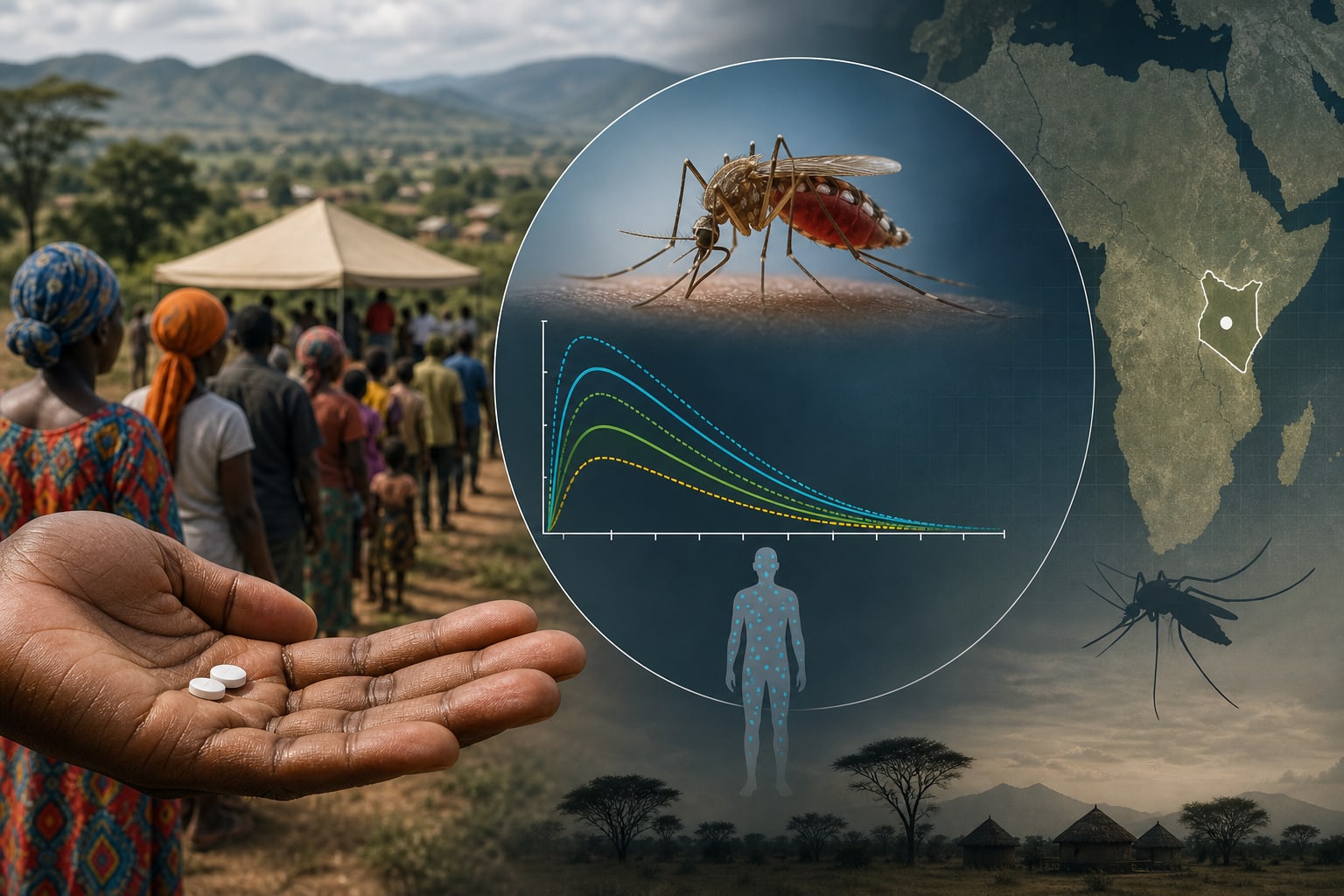
Model-based simulations showed ivermectin concentrations remained above the estimated Anopheles gambiae LC50 for 6.3 days after a single 400 µg/kg dose and 8.5 days after a 3-day regimen of 300 µg/kg.
Dried blood spot ivermectin concentrations were strongly correlated with plasma concentrations (R² = 0.93), and agreement improved after correction for hematocrit and protein binding.
The 3-day regimen produced a longer modeled duration above the LC50 but was sensitive to missed doses, while a single 400 µg/kg dose could simplify implementation and improve adherence in mass drug administration campaigns.
Guideline-Based Recommendations
Diagnosis
The study did not evaluate diagnostic strategies or provide diagnostic recommendations for malaria.
Management
The study did not establish a clinical treatment recommendation. It evaluated ivermectin dosing strategies to inform malaria vector-control trials and deployment planning.
The authors concluded that a single 400 µg/kg dose could simplify implementation, reduce operational costs, and increase adherence compared with a multidose strategy.
Monitoring & Follow-up
The study used pharmacokinetic assessment to characterize ivermectin exposure and the modeled duration that plasma concentrations remained above the estimated A gambiae LC50.
Dried blood spot microsampling may provide a practical alternative to plasma sampling in field trials where venous blood collection is less practical.
Risks
No severe adverse events were reported among the study volunteers.
The 3-day regimen was sensitive to missed doses, which shortened the modeled duration above the LC50.
The study did not evaluate ivermectin resistance in mosquito populations.
Patient & Prescribing Data
The pharmacokinetic model was based on 18 healthy Kenyan adults treated with ivermectin: 12 received a single 400 µg/kg dose and 6 received 300 µg/kg on 3 consecutive days. These data were used to characterize exposure and inform dose selection and deployment strategies for malaria vector control.
Clinical Best Practices
The findings suggest considering the operational advantages of single-encounter dosing when designing ivermectin mass drug administration strategies.
The sensitivity of multidose regimens to missed doses should be considered when planning future trials and deployment campaigns.
Dried blood spot microsampling may be useful for pharmacokinetic field studies because it requires little blood, permits finger-prick collection, simplifies transport without a cold chain, and maintains sample stability under field conditions.
Related Resources & Content
Chaccour C, Maia M, Kariuki M, et al. Ivermectin to control malaria — a cluster-randomized trial.New England Journal of Medicine. 2025;393:362–375.
Kamau Y, Tuwei M, Wanjiku C, et al. Mosquitocidal efficacy and pharmacokinetics of single-dose ivermectin versus three-day dose regimen for malaria vector control compared with albendazole and no treatment: an open-label randomized controlled trial.International Journal of Infectious Diseases. 2024;148:107236.
Smit MR, Ochomo EO, Aljayyoussi G, et al. Safety and mosquitocidal efficacy of high-dose ivermectin when co-administered with dihydroartemisinin-piperaquine in Kenyan adults with uncomplicated malaria (IVERMAL): a randomised, double-blind, placebo-controlled trial.Lancet Infectious Diseases. 2018;18:615–626.
Smit MR, Ochomo EO, Waterhouse D, et al. Pharmacokinetics-pharmacodynamics of high-dose ivermectin with dihydroartemisinin-piperaquine on mosquitocidal activity and QT-prolongation (IVERMAL).Clinical Pharmacology & Therapeutics. 2019;105:388–401.
Duthaler U, Suenderhauf C, Karlsson MO, et al. Population pharmacokinetics of oral ivermectin in venous plasma and dried blood spots in healthy volunteers.British Journal of Clinical Pharmacology. 2019;85:626–633.
Kern C, Müller P, Chaccour C, et al. Pharmacokinetics of ivermectin metabolites and their activity against Anopheles stephensi mosquitoes.Malaria Journal. 2023;22:194.
Somé AF, Somé A, Sougué E, et al. Safety and efficacy of repeat ivermectin mass drug administrations for malaria control (RIMDAMAL II): a phase 3, double-blind, placebo-controlled, cluster-randomised, parallel-group trial.Lancet Infectious Diseases. 2025;25:737–750.
by Charlotte Kern, Yvonne Kamau, Kelly Ominde, Mercy Tuwei, Lawrence Babu, Jonathan Karisa, Jane Adetifa, Marc Pfister, Regina N. Rabinovich, Carlos Chaccour, Marta Maia, Urs Duthaler, Felix Hammann