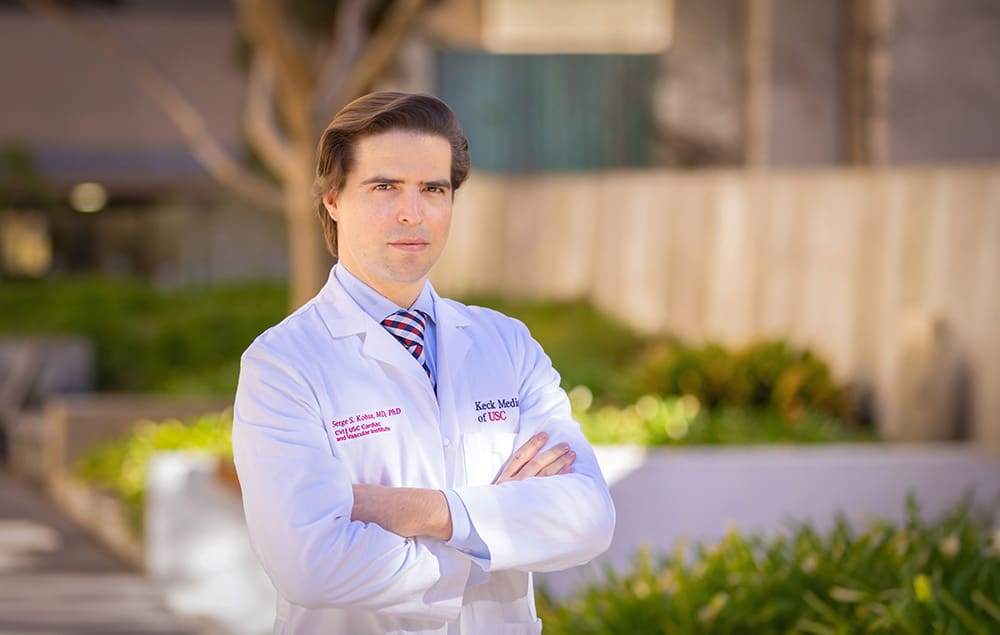
Cardiac and vascular surgery, including care for patients with aortic aneurysms.
Key Mechanisms
Kobsa describes open operations and minimally invasive procedures, including transcatheter valve replacement and aortic stenting.
Target Population
Patients undergoing cardiac or vascular surgery, including patients with complex or life-threatening conditions.
Care Setting
Keck Medicine of USC, including the USC George and Meryl Young Aortic Center and hospitals where Kobsa treats patients.
Key Highlights
Serge Kobsa, MD, PhD, is a cardiac surgeon and associate director of the USC George and Meryl Young Aortic Center.
He serves as chief of cardiac surgery at Los Angeles General and treats patients at Keck Hospital of USC, USC Norris Cancer Hospital and USC Arcadia Hospital.
Kobsa says treatment plans are selected by a multidisciplinary team for each patient and situation.
He describes minimally invasive procedures including transcatheter valve replacement and aortic stenting, alongside open operations.
Kobsa says Keck Medicine treats routine cases as well as cases considered complex or high-risk by other providers.
Guideline-Based Recommendations
Diagnosis
Management
Kobsa says his team selects an approach through multidisciplinary discussion, based on the individual patient and situation.
Kobsa describes open and minimally invasive approaches, including transcatheter valve replacement and aortic stenting; the source does not recommend a particular approach.
Monitoring & Follow-up
Risks
Kobsa cites advice to understand treatment risks and benefits and to recognize the limits of one’s expertise and capabilities.
Patient & Prescribing Data
The article describes Kobsa’s work with patients undergoing cardiac and vascular surgery, including patients with complex and life-threatening conditions.
Kobsa describes individualized, team-based treatment planning and technological advances that enable minimally invasive valve and aortic procedures.
Clinical Best Practices
Kobsa says his team matches the treatment approach to each patient and situation through multidisciplinary collaboration.
Kobsa cites understanding risks and benefits and recognizing one’s expertise and capabilities as advice he received during training.
Kobsa describes team collaboration as important for patients undergoing complex operations.