Nutrient deprivation increases CD3 expression in RAW cells and augments the CD3-induced proinflammatory profile, associated with NFAT and IRF-1 - Scorecard - MDSpire
Advertisement
Nutrient Limitation Enhances CD3 Expression in RAW Macrophages and Intensifies the Proinflammatory Response Mediated by NFAT and IRF-1
Clinical Scorecard: Nutrient Limitation Enhances CD3 Expression in RAW Macrophages and Intensifies the Proinflammatory Response Mediated by NFAT and IRF-1
At a Glance
Category
Detail
Condition
CD3+ Macrophages
Key Mechanisms
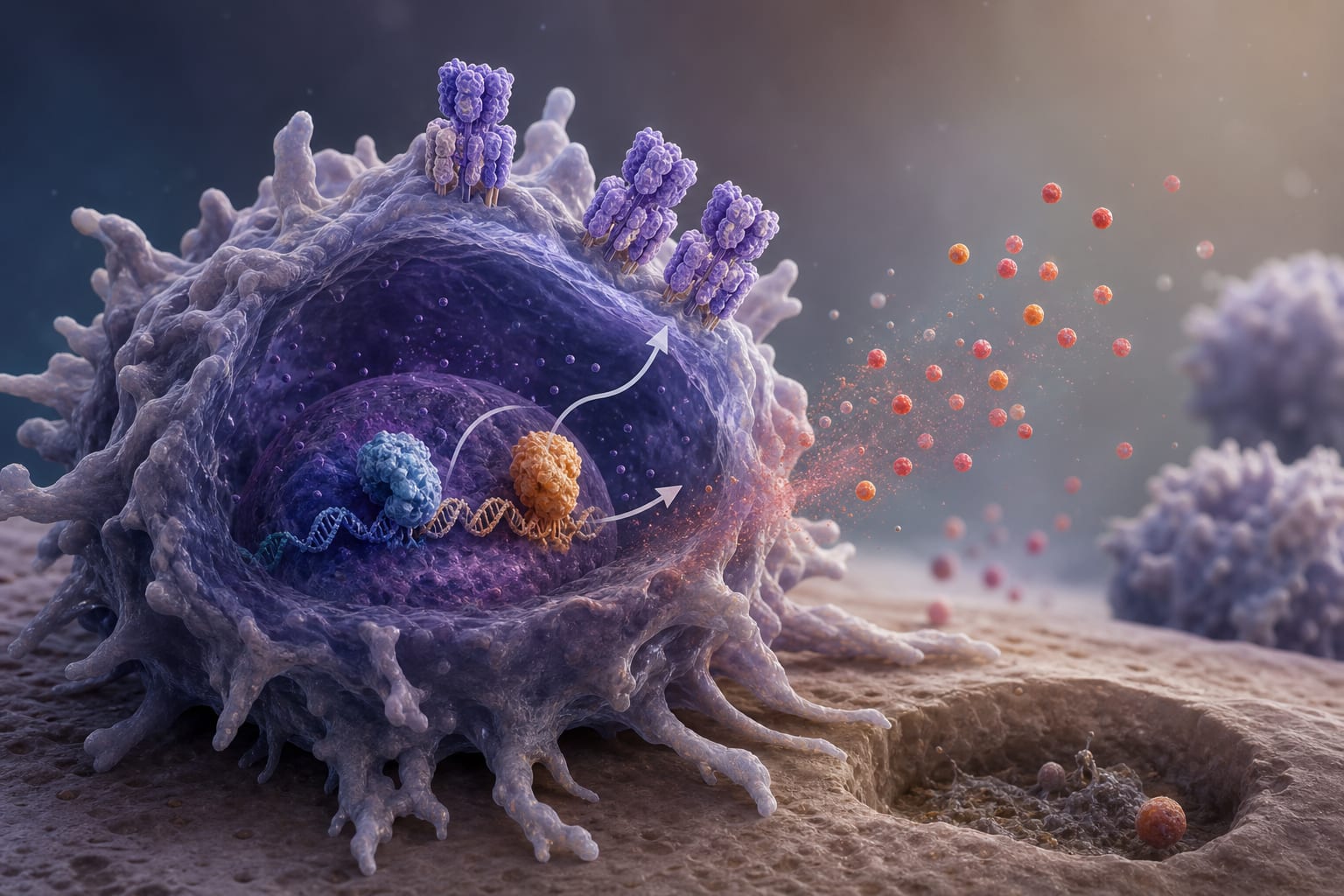
Nutrient deprivation enhances CD3 expression and activates NFAT and IRF-1 signaling pathways.
Target Population
Murine macrophages (RAW 264.7 cell line)
Care Setting
In vitro model for studying myeloid cell signaling
Key Highlights
Nutrient deprivation significantly upregulates CD3 expression in RAW macrophages.
CD3+ RAW cells exhibit enhanced phagocytic activity.
Stimulation with anti-CD3 and IgG2a induces a robust proinflammatory cytokine response.
Activation of NFAT, c-Jun, and IKK signaling pathways is associated with CD3-driven inflammation.
Increased IRF-1 expression and downregulation of MAFB observed in nutrient-deprived conditions.
Guideline-Based Recommendations
Diagnosis
Management
Monitoring & Follow-up
Risks
Patient & Prescribing Data
Not applicable; study conducted in vitro using murine cells.
Nutrient deprivation as a potential modulator of CD3 expression and inflammatory response.
Clinical Best Practices
Utilize RAW macrophage cell line for studying CD3+ signaling mechanisms.
Investigate the role of nutrient status in macrophage activation and inflammation.
Explore CD3+ macrophages in various pathological contexts for deeper understanding.
by Ranferi Ocaña-Guzman, Lucero A. Ramon-Luing, Jahir Mendoza-Ruiz, Guillermo López-Chávez, Alondra Hernández-Hernández, A. Yarelli Huerta-Zarco, Julio Flores-Gonzalez, Leslie Chavez-Galan