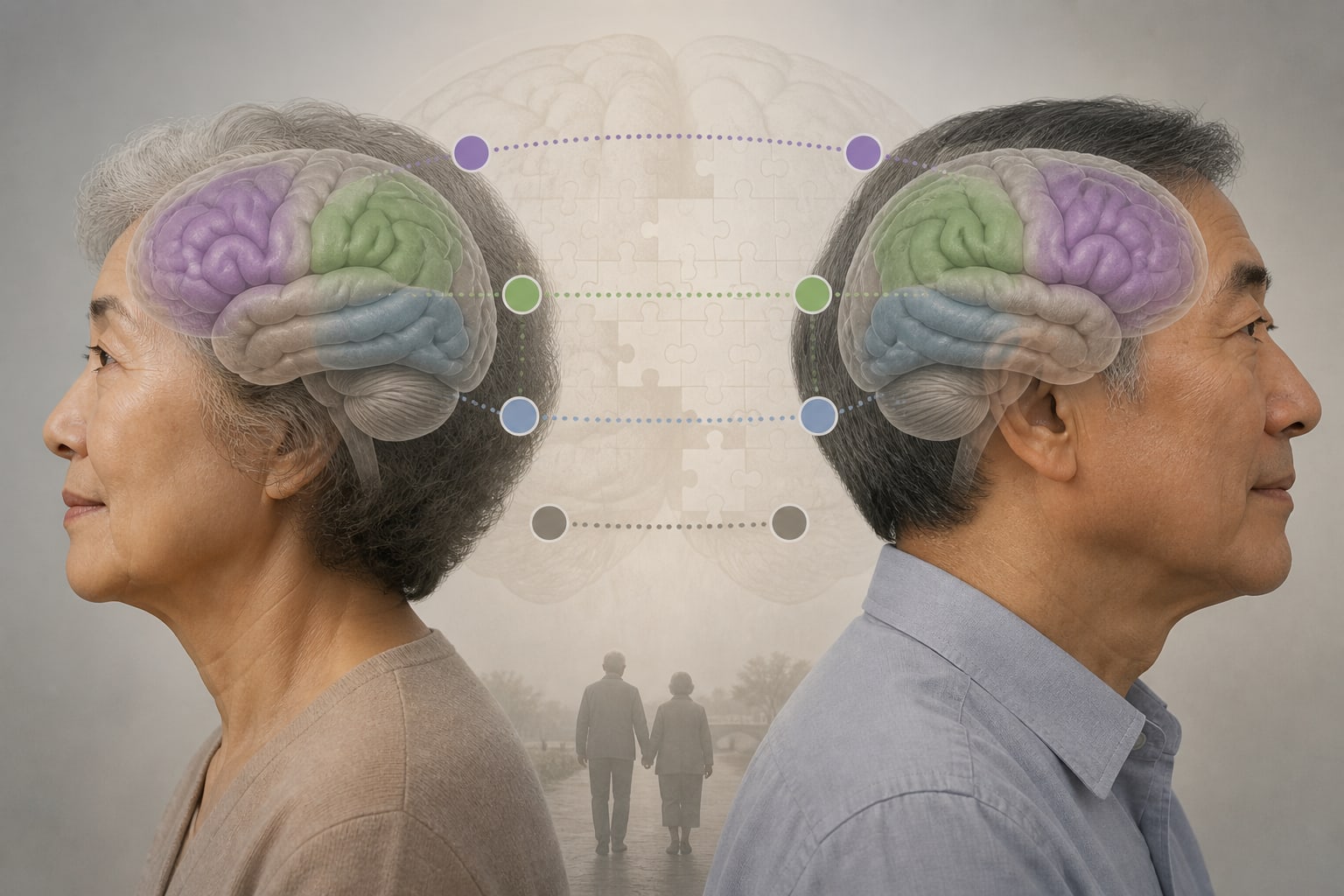
Exploring Domain-Specific Cognitive Concordance Among Older Married Couples
-
By
-
Jianhua Hou
-
August 26, 2026
Clinical Scorecard: Exploring Domain-Specific Cognitive Concordance Among Older Married Couples
At a Glance
| Category | Detail |
|---|---|
| Condition | Cognitive Aging |
| Key Mechanisms | Domain-specific cognitive concordance among spouses influenced by shared environments and experiences. |
| Target Population | Older married couples |
| Care Setting | Clinical and research contexts |
Key Highlights
- Spousal cognitive concordance varies by cognitive domain, with language and visuospatial abilities showing the greatest similarity.
- Global cognitive assessments may obscure meaningful patterns of cognitive similarity between partners.
- Shared environments and routines contribute to cognitive concordance, but effects are selective for particular cognitive systems.
- Domain-specific changes in one partner may indicate risk for both partners in shared decision-making and daily life.
- Cultural factors may influence patterns of cognitive concordance among couples.
Guideline-Based Recommendations
Diagnosis
- Consider domain-specific cognitive assessments rather than relying solely on global cognitive scores.
Management
- Implement personalized interventions targeting specific cognitive domains where early decline is observed.
Monitoring & Follow-up
- Monitor both partners in a couple for cognitive changes, especially in language and visuospatial abilities.
Risks
- Cognitive decline in one partner may affect the other’s functioning and caregiving needs.
Patient & Prescribing Data
Older adults living together as couples
Cognitive stimulation and lifestyle modifications should be tailored to specific cognitive domains.
Clinical Best Practices
- Utilize domain-specific cognitive assessments in clinical evaluations.
- Recognize the potential for shared cognitive decline in couples.
- Consider cultural contexts when assessing cognitive concordance.
Related Resources & Content
Based on findings from:
Beyond Global Cognition—Understanding Domain-Specific Concordance in Older Couples
Jianhua Hou. Jama Network Open, 2026.
https://jamanetwork.com/journals/jamanetworkopen/fullarticle/2853302
This content is an AI-generated, fully rewritten summary based on a published scholarly article. It does not reproduce the original text and is not a substitute for the original publication. Readers are encouraged to consult the source for full context, data, and methodology.