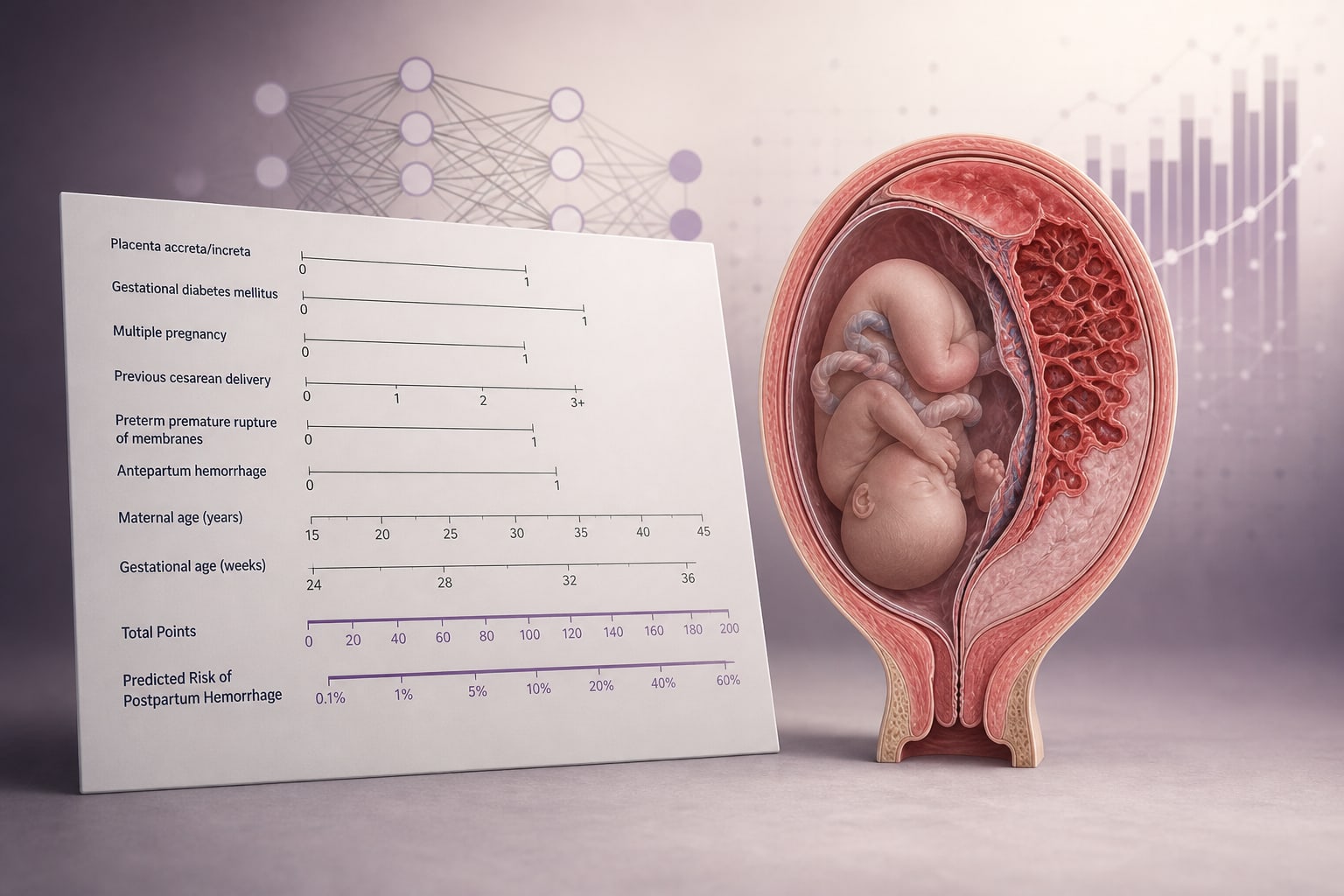
Development of a Predictive Model for Postpartum Hemorrhage in Preterm Deliveries: A Retrospective Matched Case-Control Analysis
By
Qiuping Liao
Baomei Xu
Lin Lin
Lianghui Zheng
Jinying Luo
Qian Yu
Jianying Yan
August 20, 2026
Clinical Scorecard: Development of a Predictive Model for Postpartum Hemorrhage in Preterm Deliveries: A Retrospective Matched Case-Control Analysis
At a Glance
Category Detail
Condition Postpartum Hemorrhage in Preterm Deliveries Key Mechanisms Risk factors include induced abortions, gestational diabetes mellitus, anemia, polyhydramnios, placenta accreta, and placenta increta. Target Population Singleton pregnant women with preterm deliveries Care Setting Obstetrics department in a maternity and child health hospital
Key Highlights
Developed a nomogram prediction model for PPH in preterm deliveries. Identified significant risk factors for PPH: placenta increta (OR = 60.170), placenta accreta (OR = 7.443), and polyhydramnios (OR = 3.539). Achieved a C-index of 0.770 for the predictive model. Study involved 728 singleton pregnant women, with 403 experiencing PPH. Moderate predictive capability demonstrated in internal validation. Guideline-Based Recommendations
Diagnosis
Utilize the nomogram model to assess risk factors for PPH in preterm deliveries. Management
Monitor identified high-risk factors during antepartum care. Monitoring & Follow-up
Implement early warning systems for critical conditions related to PPH. Risks
Consider the increased risk of severe maternal morbidity associated with preterm delivery. Patient & Prescribing Data
Women with singleton preterm deliveries.
Focus on managing identified risk factors to reduce PPH incidence.
Clinical Best Practices
Incorporate risk assessment models in prenatal management. Educate healthcare providers on the significance of risk factors for PPH. Related Resources & Content