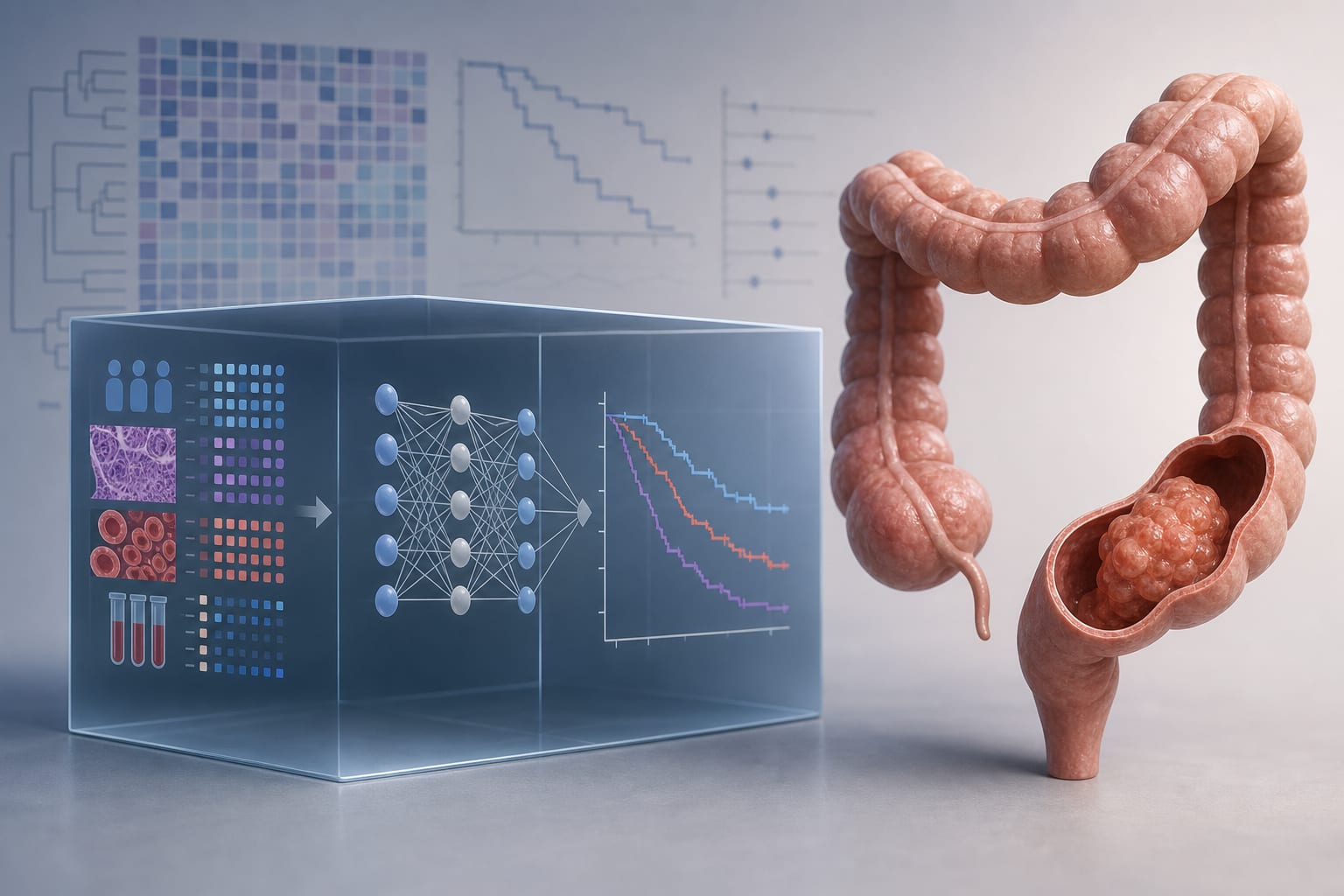
Creation of Collaborative Machine Learning Models Incorporating Innovative Serum Biomarkers for Survival Forecasting in Colorectal Cancer: A Retrospective Cohort Analysis
By
Hailun Xie
Lishuang Wei
Taiqi Chen
Shuangyi Tang
Jialiang Gan
September 15, 2026
Clinical Scorecard: Creation of Collaborative Machine Learning Models Incorporating Innovative Serum Biomarkers for Survival Forecasting in Colorectal Cancer: A Retrospective Cohort Analysis
At a Glance
Category Detail
Condition Colorectal Cancer (CRC) Key Mechanisms Integration of clinical, pathological, serological, and demographic variables for prognostic prediction. Target Population Patients with colorectal cancer. Care Setting Clinical oncology practice.
Key Highlights
Identification of six central prognostic features for CRC: M stage, N stage, Cystatin C, Homocysteine, γ-Glutamyl Transferase, and age. Nomograms demonstrated excellent calibration and strong discrimination for overall survival (OS) and progression-free survival (PFS). AUCs exceeded 75% for OS and 77% for PFS, indicating robust predictive performance. Decision curve analysis showed greater clinical utility than conventional pathological staging. Study emphasizes the need for multidimensional prognostic assessment systems in CRC. Guideline-Based Recommendations
Diagnosis
Utilize a combination of clinical, pathological, and serological markers for comprehensive prognostic assessment. Management
Incorporate machine learning models to enhance prognostic predictions and treatment strategies. Monitoring & Follow-up
Regularly assess identified serum biomarkers alongside traditional TNM staging. Risks
Consider the high recurrence rate and potential for treatment resistance in CRC management. Patient & Prescribing Data
Patients undergoing surgery for colorectal cancer.
Integration of serum biomarkers may improve risk stratification and treatment personalization.
Clinical Best Practices
Employ multi-algorithm approaches for prognostic modeling in CRC. Utilize nomograms for predicting survival outcomes in CRC patients. Related Resources & Content