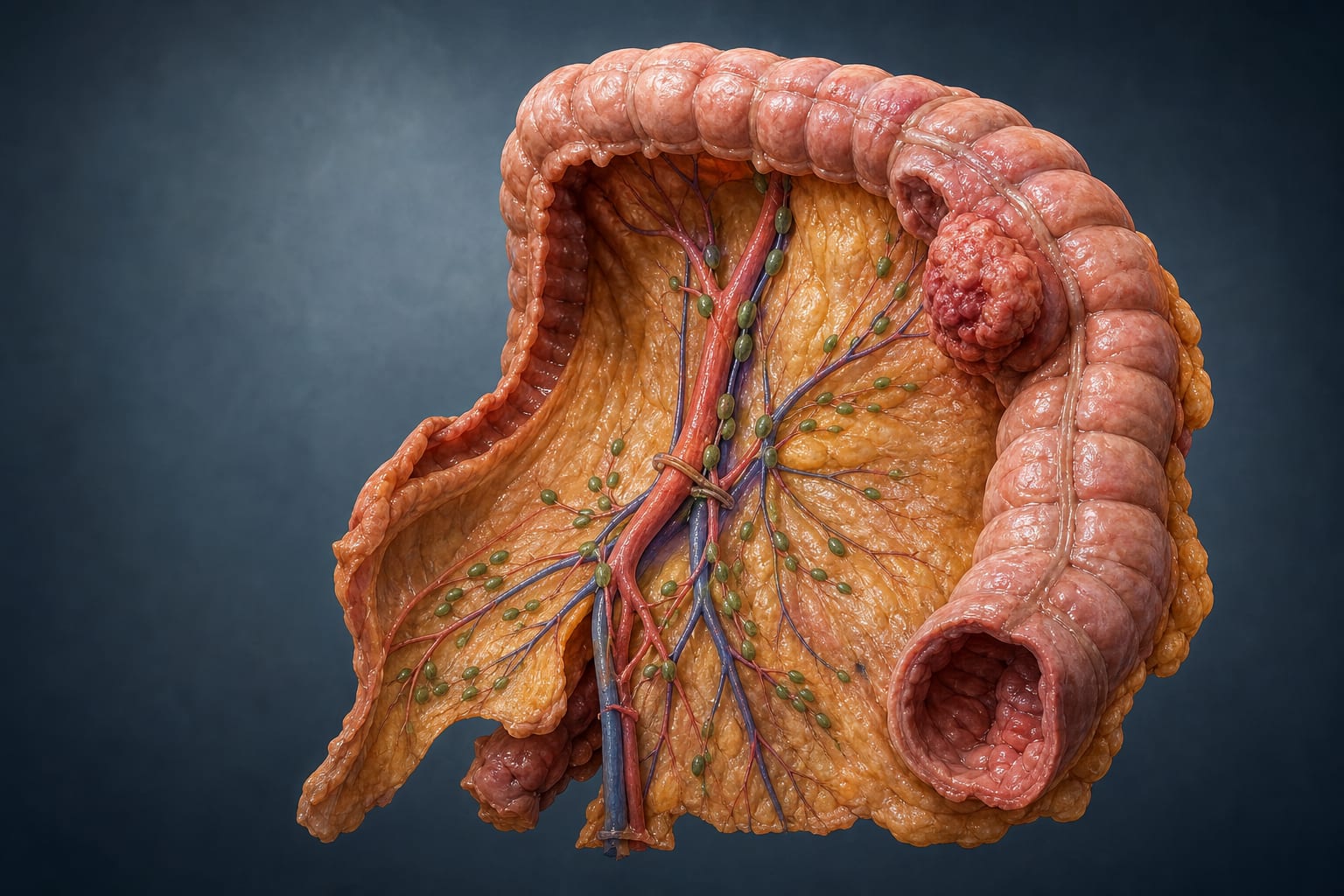
Oncologic standards in colon cancer resection: from margins to lymph node yield and mesentery
By
Mariarosaria Portinaio
Carlo Alberto Schena
Michele Ammendola
Geoffrey Yuet Mun Wong
Patricia Tejedor
Fausto Rosa
Elisa Reitano
Corrado Pedrazzani
Jim Khan
Nicola de’Angelis
June 22, 2026
Clinical Scorecard: Standards for Oncologic Resection in Colon Cancer: Evaluating Margins, Lymph Node Harvesting, and Mesenteric Involvement
At a Glance
Category Detail
Condition Colon Cancer Key Mechanisms Adequate longitudinal margins, lymphadenectomy, and mesenteric excision are critical for oncologic quality in colon cancer surgery. Target Population Adult patients with colon adenocarcinoma undergoing curative-intent resection. Care Setting Surgical oncology
Key Highlights
Optimal longitudinal margins are 5–7 cm, extendable to 10 cm for advanced T stage. Minimum lymph node yield should be ≥12, with optimal assessment around 18–22 nodes. Complete mesocolic excision (CME) with central vascular ligation (CVL) improves nodal yield and specimen quality. CME/CVL/D3 shows oncologic advantage particularly in stage III disease. Systematic reporting of tumor deposits and lymph node ratio is essential. Guideline-Based Recommendations
Diagnosis
Assess longitudinal resection margins based on tumor stage and vascular anatomy. Evaluate lymph node yield for accurate staging. Management
Aim for R0 resection with adequate margins and mesenteric resection to the feeding-vessel origin. Monitoring & Follow-up
Routine audit of outcomes in surgical practices, especially for stage III right colon cancers. Risks
Inadequate resections risk understaging and undertreatment; excessive dissection may increase morbidity. Patient & Prescribing Data
Adult patients with colon adenocarcinoma undergoing curative-intent resection.
Adherence to oncologic principles is essential for improving disease-free and overall survival.
Clinical Best Practices
Follow international guidelines for resection margins and lymphadenectomy. Implement structured training for CME/CVL/D3 techniques. Ensure systematic reporting of surgical outcomes. Related Resources & Content