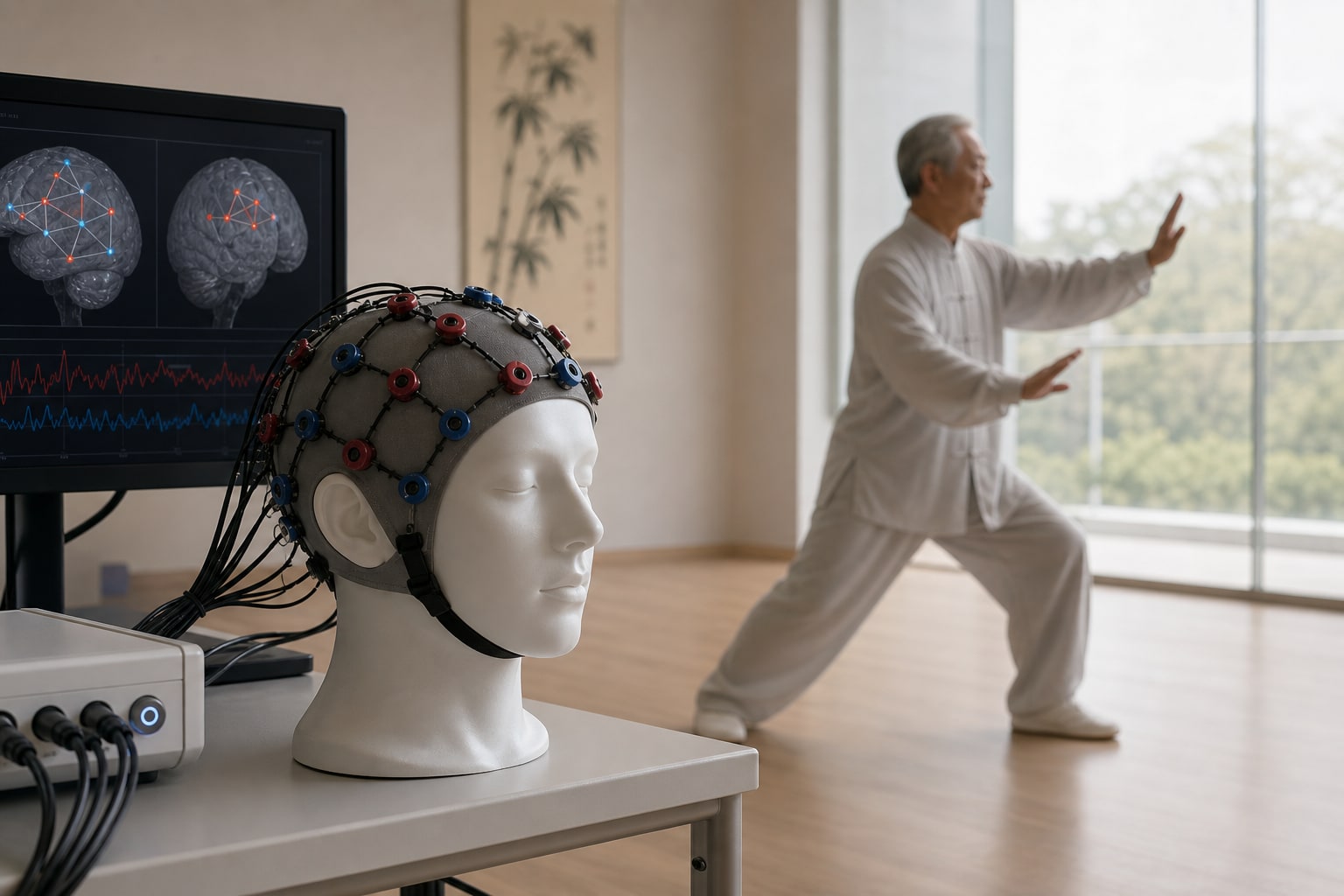
Effects of Tai Chi Cloud Hands on balance and resting-state functional connectivity after stroke: an fNIRS study
-
By
-
Jincheng Li
-
Zhenghao Dong
-
Mingxue Fan
-
Xiang Wang
-
Yingli Bi
-
Zhezhe Ma
-
Shiyan Wang
-
Jin Wang
-
Zunke Gong
-
May 7, 2026
-
Clinical Scorecard: Impact of Tai Chi Cloud Hands on Balance and Resting-State Functional Connectivity Post-Stroke: An fNIRS Investigation
At a Glance
| Category | Detail |
|---|
| Condition | Balance impairment post-stroke |
| Key Mechanisms | Prefrontal–motor network connectivity and balance recovery |
| Target Population | Hospitalized patients experiencing balance issues post-stroke |
| Care Setting | Inpatient rehabilitation |
Key Highlights
- Tai Chi Cloud Hands combined with conventional rehabilitation improved balance and daily functioning.
- Significant enhancements in Berg Balance Scale (BBS) and Modified Barthel Index (MBI) scores.
- Decreased center-of-pressure (COP) path length and sway area in the intervention group.
- Altered resting-state functional connectivity in prefrontal–motor networks post-intervention.
- Study suggests Tai Chi can be a scalable method for balance rehabilitation.
Guideline-Based Recommendations
Diagnosis
- Assess balance impairment using standardized scales such as BBS.
Management
- Incorporate Tai Chi Cloud Hands into conventional rehabilitation for enhanced outcomes.
Monitoring & Follow-up
- Evaluate changes in balance and functional independence using BBS and MBI.
Risks
- Monitor for potential falls during balance training interventions.
Patient & Prescribing Data
Patients recovering from stroke with balance issues
Tai Chi Cloud Hands can be integrated into rehabilitation to improve balance and connectivity.
Clinical Best Practices
- Utilize task-specific training methods in stroke rehabilitation.
- Consider Tai Chi as a low-resource intervention for balance improvement.
- Monitor patient progress with objective measures of balance and mobility.
Related Resources & Content