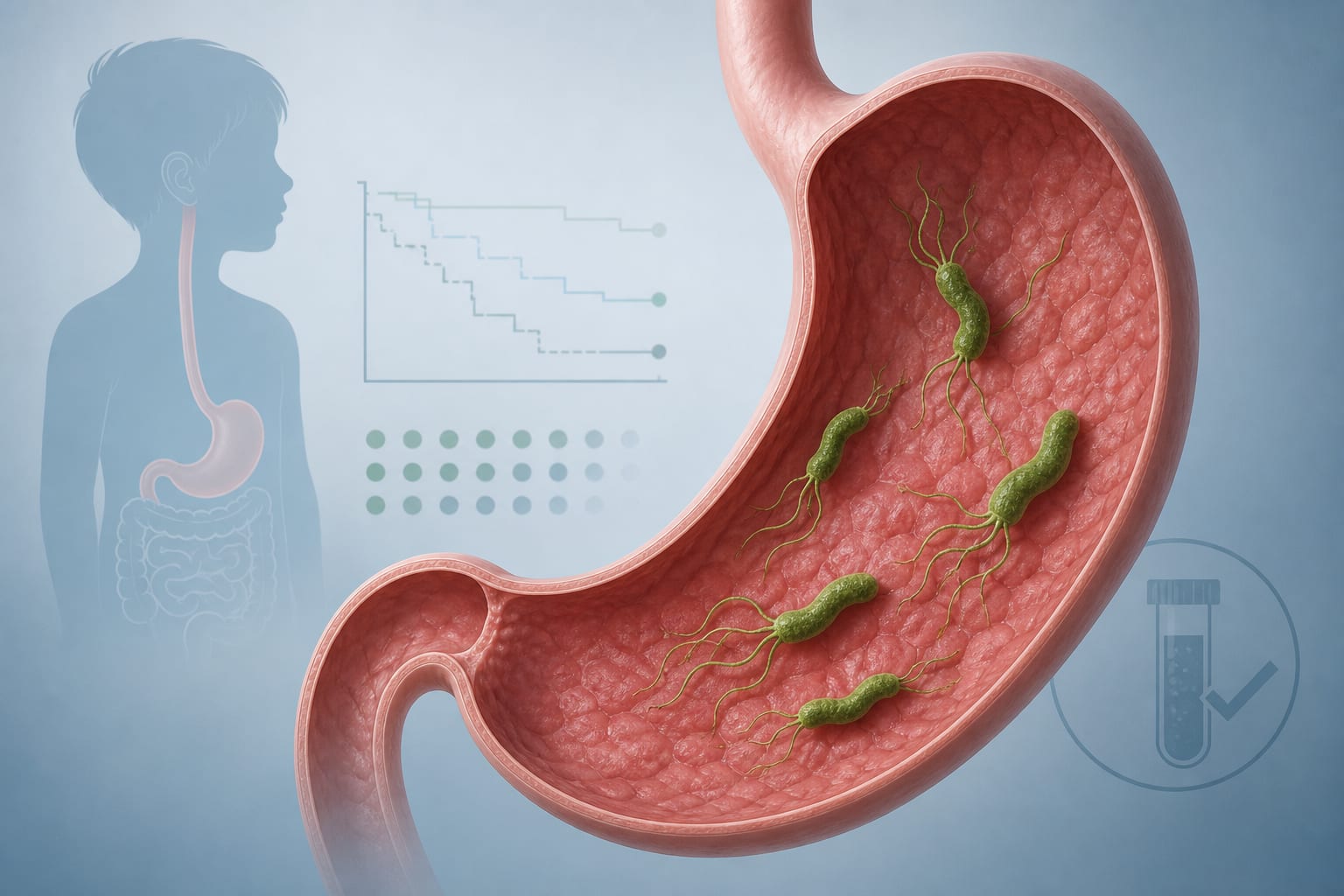
Commentary: Assessment of treatment effectiveness, follow-up results, and recurrence patterns in children with Helicobacter pylori infection - Scorecard - MDSpire
Clinical Scorecard: Discussion: Evaluating the Efficacy of Treatment, Follow-Up Outcomes, and Recurrence Trends in Pediatric Helicobacter pylori Infections
At a Glance
Category
Detail
Condition
Pediatric Helicobacter pylori infection
Key Mechanisms
Recurrence, recrudescence, and reinfection
Target Population
Children with Helicobacter pylori infection
Care Setting
Pediatric gastroenterology
Key Highlights
Recurrence rate of 13.7% observed in children post-eradication therapy.
Recurrence defined operationally through serial 13C-urea breath tests.
Testing at 4 weeks post-treatment may lead to false-negative results.
Distinction between recrudescence and reinfection is crucial for treatment interpretation.
Environmental exposure and household transmission linked to recurrence.
Guideline-Based Recommendations
Diagnosis
Assessment of eradication should occur at 6–8 weeks post-treatment.
Management
Avoid proton pump inhibitors for at least 2 weeks and antibiotics or bismuth salts for at least 4 weeks before testing.
Monitoring & Follow-up
Serial non-invasive testing is recommended to document recurrence.
Risks
Misinterpretation of recurrence as reinfection could lead to underestimating treatment failure.
Patient & Prescribing Data
Children undergoing treatment for Helicobacter pylori infection.
Proper preparation and timing of tests are critical for accurate assessment.
Clinical Best Practices
Differentiate between recurrence, recrudescence, and reinfection in clinical assessments.
Consider environmental factors in recurrence analysis.
Implement molecular characterization for better understanding of recurrence mechanisms.