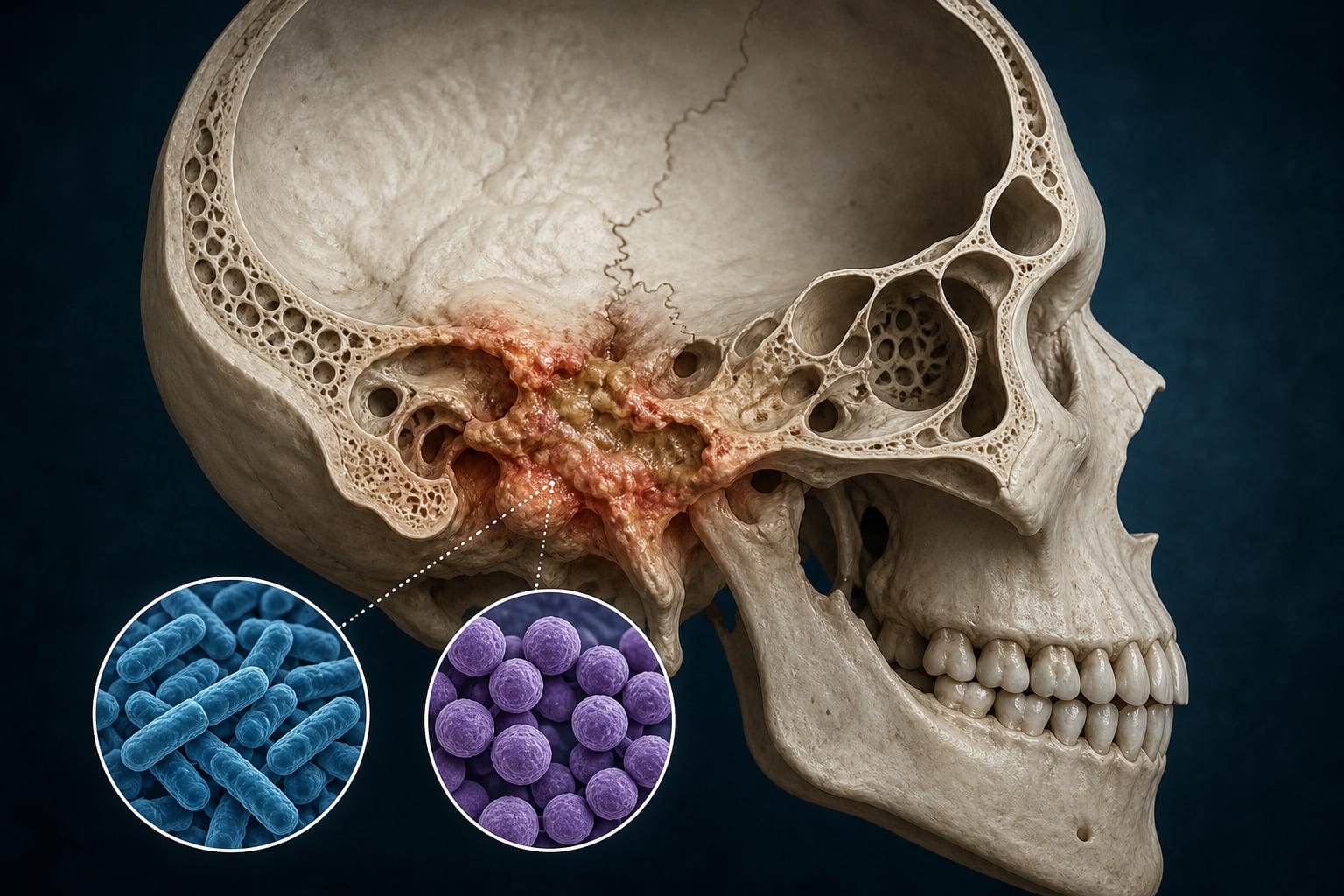
Clinical Scorecard: Outcomes and Distinctive Features of Bacterial versus Fungal Skull Base Osteomyelitis: A Retrospective Study of 127 Cases
At a Glance
Category
Detail
Condition
Bacterial and fungal skull base osteomyelitis
Key Mechanisms
Infection involving skull-base bone, commonly through contiguous spread from otitis in patients with poorly controlled diabetes or immunocompromising conditions
Target Population
Adults with compatible otogenic or non-otogenic symptoms and CT- or MRI-confirmed bone involvement
Care Setting
Lariboisière Hospital, a tertiary care center in Paris
Key Highlights
The study included 127 patients: 97 with bacterial SBO, 27 with fungal SBO, and 3 without final microbiological identification.
Pseudomonas aeruginosa was the most frequently identified pathogen, and Aspergillus flavus was the most common fungus.
Fungal SBO was associated with greater neurologic involvement and more extensive imaging abnormalities.
Deep surgical sampling was required more frequently for fungal than bacterial SBO.
Fungal SBO was associated with longer time to effective treatment, longer hospitalization, and more first-line treatment failure.
No official guidelines exist for SBO diagnostic or treatment modalities.
Guideline-Based Recommendations
This retrospective study did not establish clinical guidelines. The authors described observed diagnostic and management practices and highlighted areas requiring further research.
Diagnosis
Otogenic manifestations included otalgia, otorrhea, hearing loss, facial nerve palsy, edema, or external ear canal granulation.
Non-otogenic manifestations included headache, fever, or cranial nerve palsy.
Study eligibility required radiologic bone involvement on CT or MRI.
Deep surgical sampling should be performed rapidly when fungal infection is suspected to confirm the diagnosis and investigate possible coinfection.
Deep sampling may also be valuable when patients do not improve with treatment or superficial specimens fail to identify a pathogen.
Management
Nearly all bacterial SBO cases received combination antibiotic therapy.
Ceftazidime and fluoroquinolones were the most frequently used agents for Pseudomonas aeruginosa.
Voriconazole was the most frequently administered antifungal for Aspergillus flavus, Aspergillus fumigatus, and Scedosporium apiospermum.
Median antibiotic and antifungal treatment durations were 58.0 and 188.5 days, respectively.
The observational design did not establish the comparative effectiveness of specific treatment regimens.
Monitoring & Follow-up
The study reported available follow-up visits occurring 4–8 and 10–14 weeks after treatment began; these were reporting windows rather than recommended schedules.
Clinical cure was defined as complete resolution of all SBO-related symptoms.
First-line treatment failure was defined as clinical deterioration or death during therapy or within 6 months after treatment ended.
Sequelae were assessed among patients with documented follow-up at least 6 months after treatment.
Overall 1-year mortality was measured from treatment initiation.
Risks
Fungal SBO was associated with higher rates of intensive care admission, first-line treatment failure, and long-term sequelae.
Fungal infections were frequently polymicrobial, with an associated bacterium identified in 21 of 27 cases.
Fungal SBO was independently associated with the combined outcome of intensive care admission or disease-specific mortality.
Disease-specific and all-cause 1-year mortality did not differ significantly between fungal and bacterial cases when evaluated separately.
Delayed sampling and prior antibiotic exposure may reduce microbiological recovery or complicate interpretation.
Patient & Prescribing Data
The cohort included 127 adults with radiologically confirmed SBO. Median age was 72.3 years, 83% had diabetes, and 14% were immunosuppressed.
Among bacterial cases, 99% received at least 1 course of combination antibiotic therapy. Median antibiotic treatment duration was 58.0 days. Median antifungal treatment duration among patients with available data was 188.5 days. Treatment selection was observational and was not tested in a comparative trial.
Clinical Best Practices
Confirm bone involvement with CT or MRI when evaluating suspected SBO.
Obtain microbiological documentation rather than relying on clinical and radiologic findings alone.
Pursue deep surgical sampling promptly when fungal infection is suspected or superficial sampling is inconclusive.
Assess for polymicrobial infection when fungal involvement is identified.
Interpret microbiological findings using the specimen type, clinical context, histology, and potential for contamination.
Apply treatment findings cautiously because standardized diagnostic, cure, and treatment criteria were unavailable.
Related Resources & Content
Comparative Characteristics and Outcomes of Bacterial and Fungal Skull Base Osteomyelitis: A Retrospective Analysis of 127 Cases — Mimram L, Lebeaux D, Verillaud B, et al. International Journal of Infectious Diseases. 2026;171:109017. doi:10.1016/j.ijid.2026.109017.