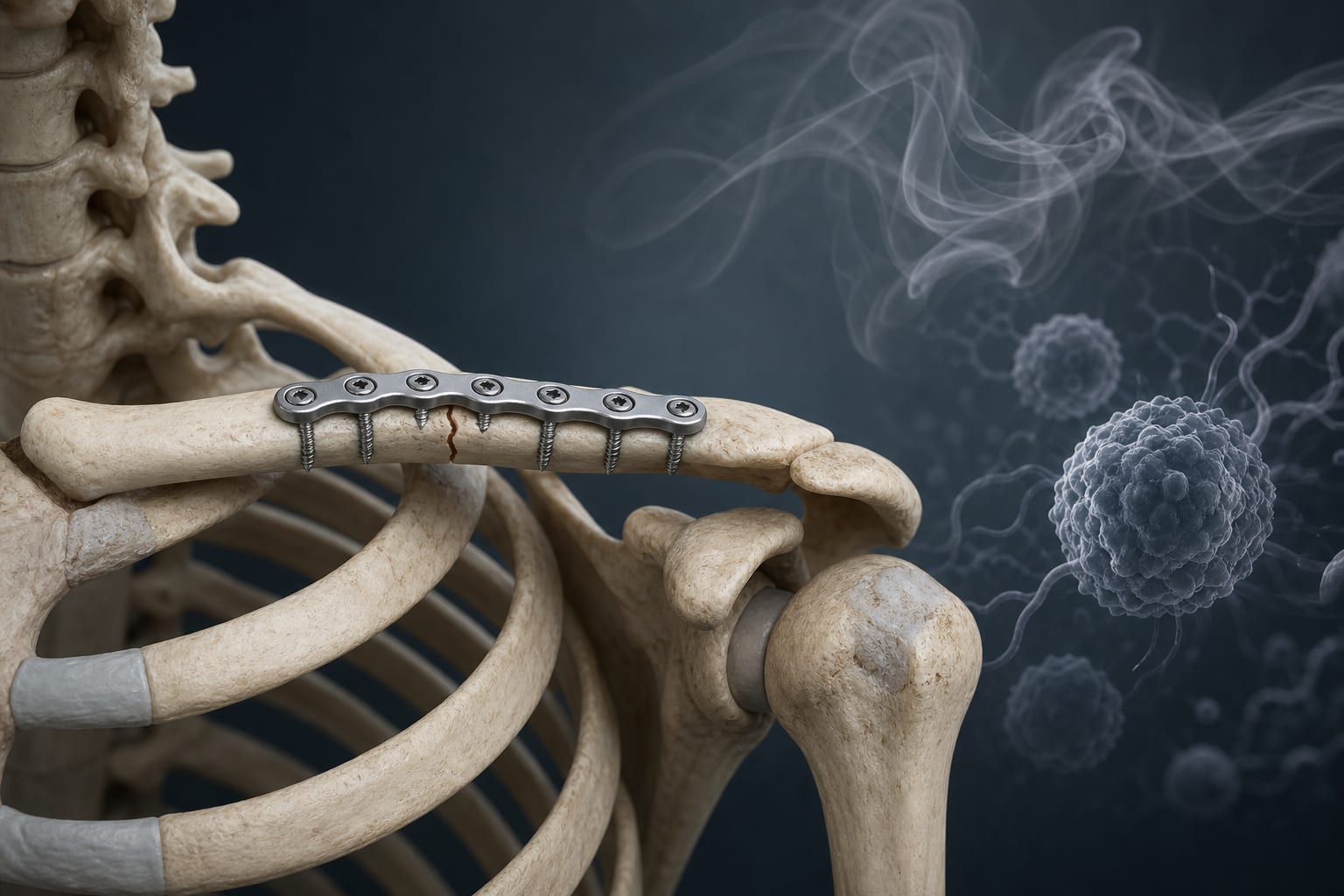
Dependence on Non-Tobacco Nicotine Linked to Higher Complication Rates After Clavicle Open Reduction Internal Fixation
By
Akin A. Adio
Rahul K. Goyal
Abby Skiena
Mohammad Daher
John G. Horneff
Hafiz F. Kassam
Brian W. Hill
Joseph A. Abboud
June 18, 2026
Clinical Scorecard: Dependence on Non-Tobacco Nicotine Linked to Higher Complication Rates After Clavicle Open Reduction Internal Fixation
At a Glance
Category Detail
Condition Clavicle fractures Key Mechanisms Non-tobacco nicotine dependence may impede wound healing and fracture union, increasing complication rates. Target Population Adolescents and young adults with clavicle fractures. Care Setting Orthopedic surgical settings.
Key Highlights
Clavicle fractures account for 2.6-5% of all adult fractures. Surgical fixation rates for clavicle fractures have increased by 445% from 2000 to 2022. Non-tobacco nicotine dependence is on the rise among adolescents and young adults. Tobacco use is known to increase fracture nonunion rates and infection risk. The study investigates postoperative complications related to non-tobacco nicotine dependence. Guideline-Based Recommendations
Diagnosis
Use ICD-10 codes to identify patients with clavicle fractures. Management
Consider non-tobacco nicotine dependence as a risk factor for complications post-ORIF. Monitoring & Follow-up
Evaluate for postoperative complications within 90 days, including infection and nonunion. Risks
Non-tobacco nicotine dependence may lead to higher complication rates after surgical fixation. Patient & Prescribing Data
Patients undergoing ORIF of clavicle fractures.
Patients with non-tobacco nicotine dependence may require closer monitoring for complications.
Clinical Best Practices
Assess nicotine dependence status preoperatively. Utilize propensity score matching to balance cohorts in studies. Monitor for surgical site infections and nonunion in patients with nicotine dependence. Related Resources & Content