Development, simplification, and prospective methodological exploration of a Chinese endoscopy patient experience scale and a decision support system - Scorecard - MDSpire
Clinical Scorecard: Creation, refinement, and future methodological investigation of a patient experience scale for endoscopy in China along with a decision support tool
At a Glance
Category
Detail
Condition
Gastrointestinal Endoscopy
Key Mechanisms
Patient-reported experience measures (PREMs) to assess and improve patient experience during endoscopic procedures.
Target Population
Patients undergoing gastrointestinal endoscopy in China.
Care Setting
Tertiary hospitals in Xi’an, China.
Key Highlights
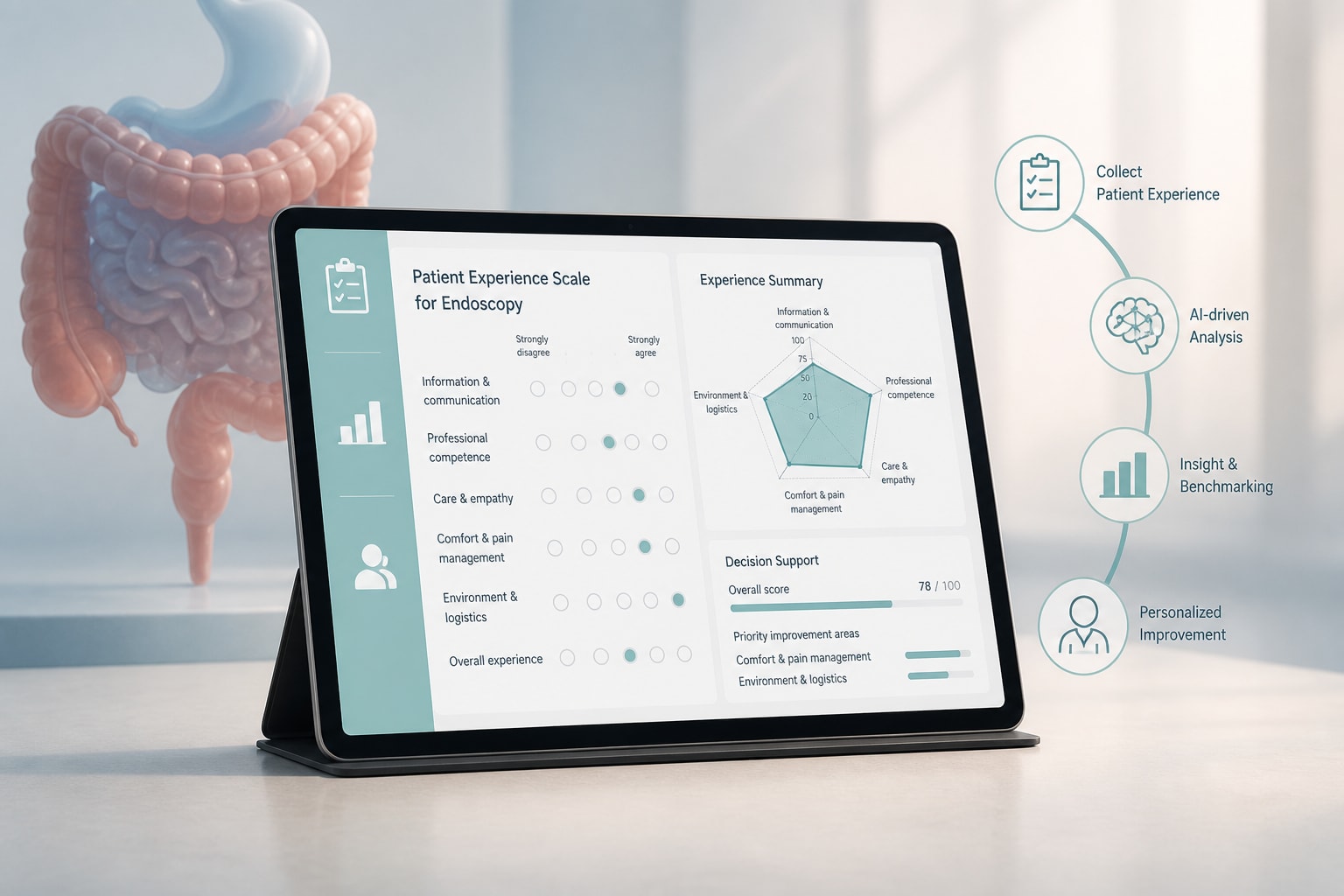
Development of the 54-item Endoscopy Patient Experience Scale (EPES) tailored for Chinese patients.
Introduction of the Simplified Endoscopy Patient Experience Scale (S-EPES) using multi-objective optimization.
Creation of the Endoscopy Patient Experience Decision Support System (EPE-DSS) to assist clinical decision-making.
Guideline-Based Recommendations
Diagnosis
Utilization of patient-reported experience measures to identify areas for improvement in endoscopy services.
Management
Implementation of the EPES and S-EPES for assessing patient experiences.
Monitoring & Follow-up
Regular evaluation of patient feedback to enhance endoscopic care quality.
Risks
Limitations in sample representativeness and potential over-engineering of assessment tools.
Patient & Prescribing Data
Patients scheduled for or having undergone colonoscopy or gastroscopy.
Incorporation of patient experiences into clinical decision-making processes.
Clinical Best Practices
Adapting existing instruments for local contexts to improve generalizability.
Using data-driven methods for scale simplification and validation.
An updated clinical practice guideline from the American Society for Radiation Oncology substantially expands and modernizes recommendations for the use of radiation therapy in pancreatic cancer.