Beyond prediction: AI as a mechanistic microscope and digital twin for colorectal cancer immunotherapy
-
By
-
Zijun Zhou
-
Jianping Zhou
-
June 5, 2026
-
Clinical Scorecard: Exploring AI's Role as a Mechanistic Tool and Digital Replica in Colorectal Cancer Immunotherapy
At a Glance
| Category | Detail |
|---|
| Condition | Colorectal Cancer (CRC) |
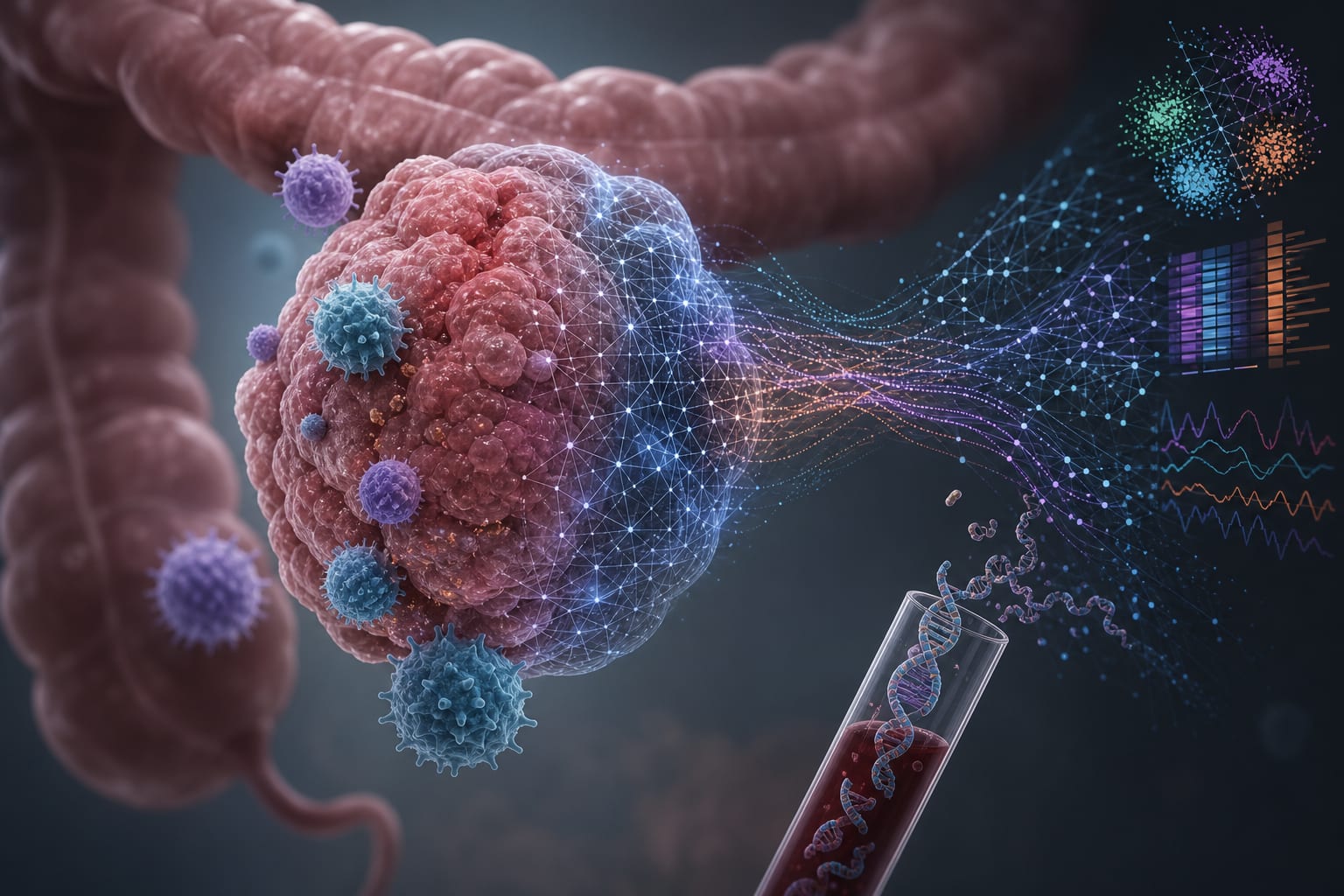
| Key Mechanisms | AI as a mechanistic microscope and digital twin for tumor-immune interactions and therapeutic modeling. |
| Target Population | Patients with colorectal cancer, particularly those with microsatellite instability-high (MSI-H) or mismatch repair-deficient (dMMR) tumors. |
| Care Setting | Oncology, specifically in immunotherapy and precision oncology. |
Key Highlights
- AI can decode tumor-immune biology from multimodal data.
- AI serves as a digital twin for individualized therapeutic modeling.
- Current biomarkers provide static snapshots of tumor-immune interactions.
- AI enhances pathology, imaging, and liquid biopsy for treatment stratification.
- AI may facilitate cold-to-hot tumor transitions and adaptive trial designs.
Guideline-Based Recommendations
Diagnosis
- Utilize AI to predict microsatellite instability (MSI) and mismatch repair deficiency (dMMR) from histology.
Management
- Integrate AI-driven models for dynamic simulation of treatment response and resistance.
Monitoring & Follow-up
- Employ AI-enhanced analysis of circulating tumor DNA (ctDNA) for monitoring minimal residual disease.
Risks
- Address challenges in generalizability, interpretability, and regulatory validation of AI tools.
Patient & Prescribing Data
Patients with advanced colorectal cancer, particularly those with MSI-H or dMMR tumors.
AI can inform treatment decisions by modeling patient-specific therapeutic trajectories.
Clinical Best Practices
- Use multimodal data to enhance understanding of tumor-immune interactions.
- Incorporate AI tools in clinical trials to adaptively design studies based on real-time data.
- Focus on integrating AI insights into routine clinical practice for personalized treatment approaches.
Related Resources & Content