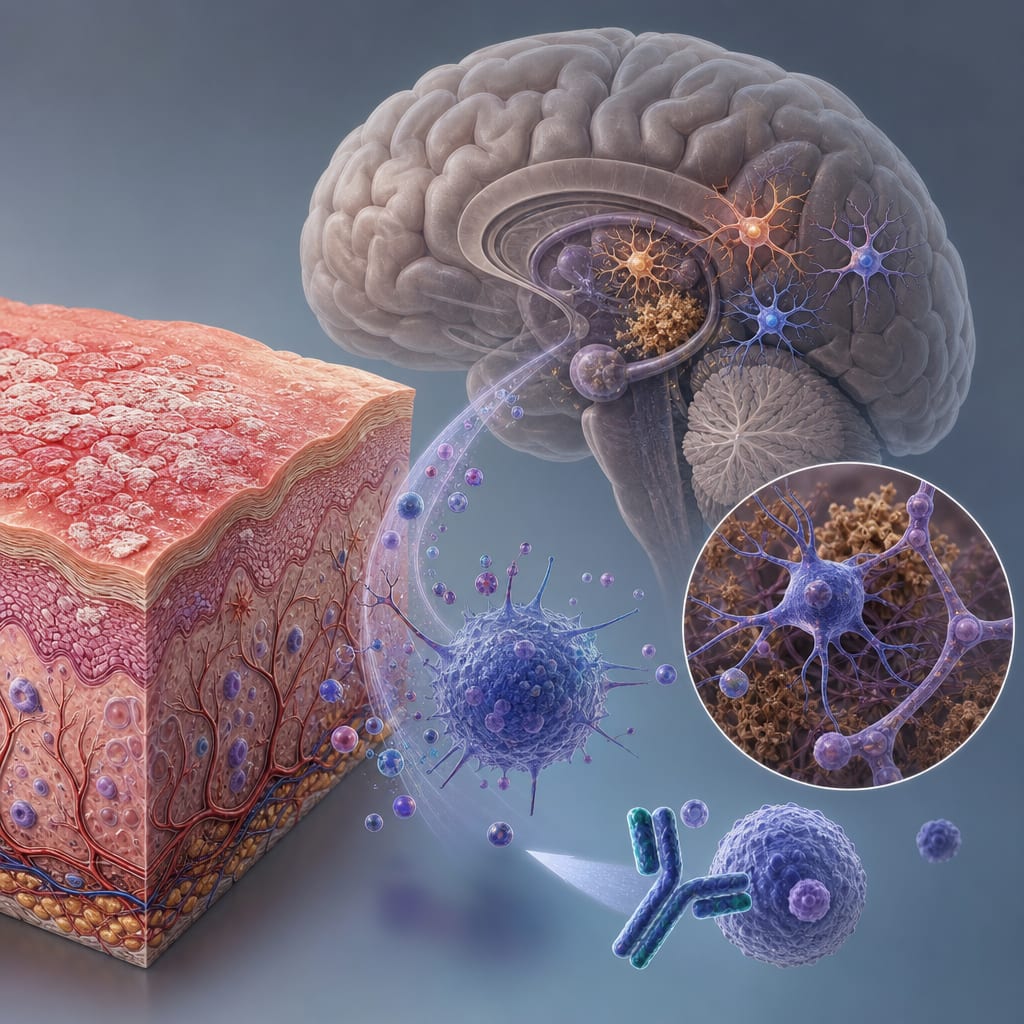
Clinical Scorecard: Genetic Factors and Connectome Influence on Selective Vulnerability and Resilience to Tauopathy in Alzheimer's Disease
At a Glance
Category
Detail
Condition
Alzheimer's disease characterized by tauopathy
Key Mechanisms
Selective vulnerability and resilience mediated by baseline genetic expression and network-based tau propagation
Target Population
Patients with Alzheimer's disease exhibiting tau pathology
Care Setting
Neurological and neurodegenerative disease research and clinical assessment settings
Key Highlights
Selective vulnerability (SV) and selective resilience (SR) in Alzheimer's disease are influenced by both cell-autonomous genetic factors and non-cell-autonomous network connectivity.
An extended network diffusion model (eNDM) fitted on tau PET data captures tau pathology distribution and reveals distinct classes of risk genes aligned or independent of network propagation.
Four gene classes identified (SV-NA, SV-NI, SR-NA, SR-NI) show distinct spatial signatures and functional enrichments, implicating multiple pathways in vulnerability and resilience.
Guideline-Based Recommendations
Diagnosis
Utilize tau PET imaging to assess regional tau pathology distribution in Alzheimer's disease patients.
Consider genetic profiling of Alzheimer's risk genes to understand baseline vulnerability or resilience patterns.
Management
Target interventions may be developed focusing on both network-mediated tau propagation and gene-specific pathways influencing vulnerability or resilience.
Early identification of vulnerable brain regions through combined genetic and network analysis may guide therapeutic strategies.
Monitoring & Follow-up
Monitor progression of tau pathology using network diffusion models to evaluate disease spread and treatment response.
Assess changes in gene expression profiles and tau PET imaging longitudinally to understand disease dynamics.
Risks
Risk genes may confer increased vulnerability to tau accumulation and neurodegeneration through diverse mechanisms including cell death, stress response, amyloid-β processing, and immune response.
Non-alignment between genetic risk loci and tau pathology distribution suggests complexity in disease progression requiring multifaceted monitoring.
Patient & Prescribing Data
Alzheimer's disease patients with varying regional tau pathology and genetic risk profiles
Understanding the interplay between genetic risk factors and network-based tau spread may inform personalized therapeutic approaches targeting specific vulnerability or resilience pathways.
Clinical Best Practices
Incorporate multimodal assessment combining genetic data and network-based imaging to evaluate selective vulnerability and resilience.
Recognize the heterogeneity of Alzheimer's disease pathology influenced by both innate genetic expression and tau propagation along neural networks.
Focus research and clinical interventions on both cell-autonomous and non-cell-autonomous mechanisms to address disease progression comprehensively.