Health-related quality of life after direct endovascular thrombectomy and bridging therapy: findings of DIRECT-MT trial - Scorecard - MDSpire

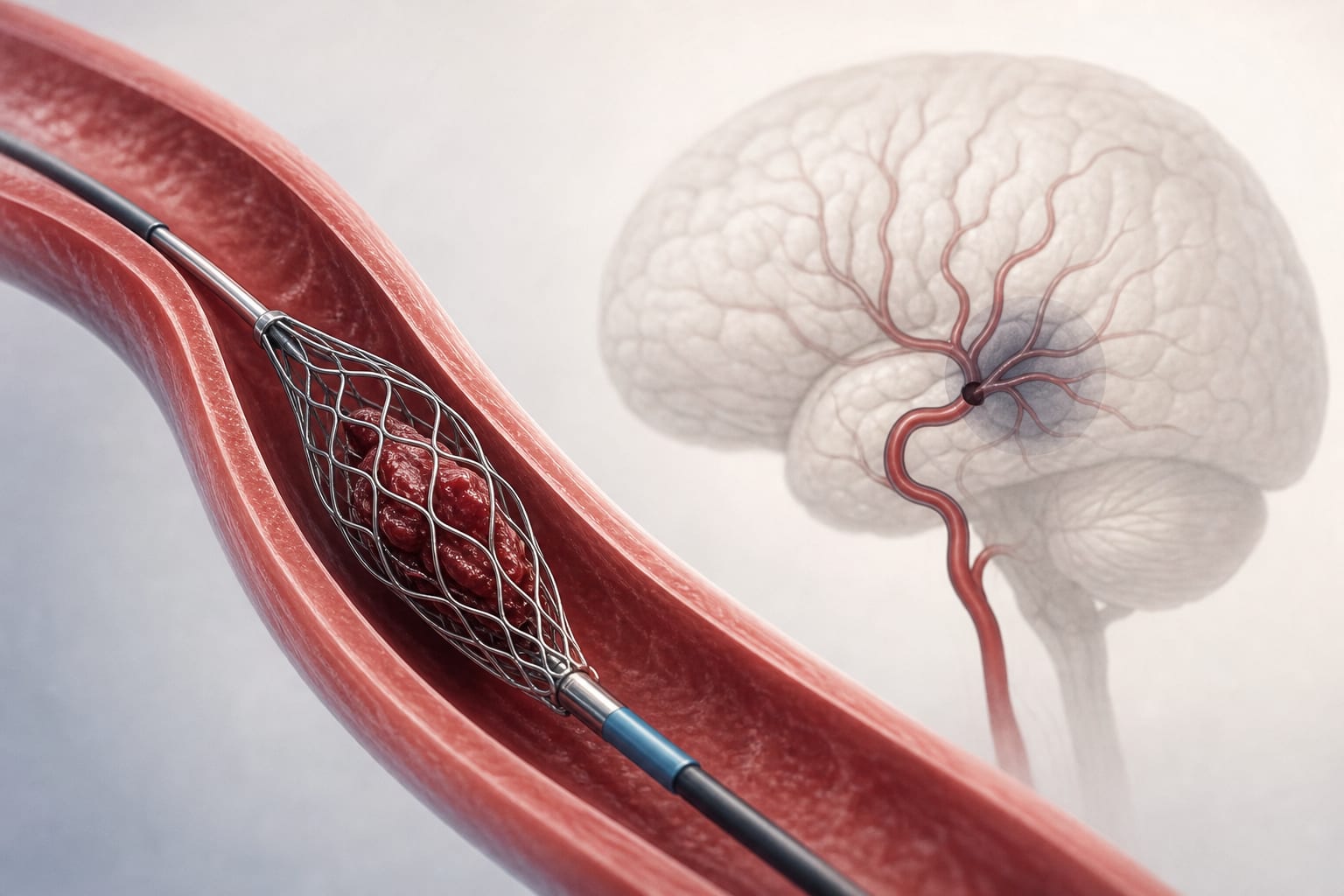
Health-related quality of life after direct endovascular thrombectomy and bridging therapy: findings of DIRECT-MT trial

  • By

  • Renjun Gu

  • Meihua Huyan

  • Hongjian Zhang

  • Fang Shen

  • Hongjian Shen

  • Zifu Li

  • Pengfei Xing

  • Weilong Hua

  • Yongxin Zhang

  • Jianmin Liu

  • Pengfei Yang

  • Lei Zhang

  • Yongwei Zhang

  • May 25, 2026

  • 0 min

Share

Clinical Scorecard: Quality of Life Outcomes Following Direct Endovascular Thrombectomy Versus Bridging Therapy: Insights from the DIRECT-MT Study

At a Glance

CategoryDetail
Condition
Key MechanismsEndovascular thrombectomy (EVT) and bridging therapy with intravenous alteplase (source needed)
Target PopulationPatients with acute ischemic stroke eligible for EVT and intravenous alteplase (source needed)
Care Setting

Key Highlights

  • HRQoL at 90 days was similar between EVT alone and bridging therapy (median EQ-5D 0.84 vs. 0.85) (source needed)
  • Bridging therapy showed higher EQ-5D in patients with moderate-to-severe stroke (NIHSS 16–20 and 21–42) (source needed)
  • Remove exploratory analyses findings unless explicitly stated in the source.
  • Remove treatment effects on HRQoL varied by baseline stroke severity and functional outcome strata unless sourced.
  • Dimension-level analyses revealed differences in symptom-free status for Mobility and Usual activities (source needed)

Guideline-Based Recommendations

Diagnosis

    Management

    • C
    • o
    • n
    • s
    • i
    • d
    • e
    • r
    • E
    • V
    • T
    • a
    • l
    • o
    • n
    • e
    • a
    • s
    • n
    • o
    • n
    • -
    • i
    • n
    • f
    • e
    • r
    • i
    • o
    • r
    • t
    • o
    • b
    • r
    • i
    • d
    • g
    • i
    • n
    • g
    • t
    • h
    • e
    • r
    • a
    • p
    • y
    • f
    • o
    • r
    • f
    • u
    • n
    • c
    • t
    • i
    • o
    • n
    • a
    • l
    • o
    • u
    • t
    • c
    • o
    • m
    • e
    • s
    • (
    • s
    • o
    • u
    • r
    • c
    • e
    • n
    • e
    • e
    • d
    • e
    • d
    • )

    Monitoring & Follow-up

    • E
    • v
    • a
    • l
    • u
    • a
    • t
    • e
    • H
    • R
    • Q
    • o
    • L
    • u
    • s
    • i
    • n
    • g
    • E
    • Q
    • -
    • 5
    • D
    • a
    • t
    • 9
    • 0
    • d
    • a
    • y
    • s
    • p
    • o
    • s
    • t
    • -
    • t
    • r
    • e
    • a
    • t
    • m
    • e
    • n
    • t
    • (
    • s
    • o
    • u
    • r
    • c
    • e
    • n
    • e
    • e
    • d
    • e
    • d
    • )

    Risks

    • P
    • o
    • t
    • e
    • n
    • t
    • i
    • a
    • l
    • f
    • o
    • r
    • v
    • a
    • r
    • y
    • i
    • n
    • g
    • H
    • R
    • Q
    • o
    • L
    • o
    • u
    • t
    • c
    • o
    • m
    • e
    • s
    • b
    • a
    • s
    • e
    • d
    • o
    • n
    • b
    • a
    • s
    • e
    • l
    • i
    • n
    • e
    • s
    • e
    • v
    • e
    • r
    • i
    • t
    • y
    • a
    • n
    • d
    • t
    • r
    • e
    • a
    • t
    • m
    • e
    • n
    • t
    • s
    • t
    • r
    • a
    • t
    • e
    • g
    • y
    • (
    • s
    • o
    • u
    • r
    • c
    • e
    • n
    • e
    • e
    • d
    • e
    • d
    • )

    Patient & Prescribing Data

    Bridging therapy may be more beneficial for patients with moderate-to-severe stroke (source needed)

    Clinical Best Practices

    • Utilize EQ-5D for comprehensive assessment of HRQoL in stroke patients (source needed)
    • Tailor treatment strategies based on baseline stroke severity and expected functional outcomes (source needed)

    Related Resources & Content

    Original Source(s)

    Related Content