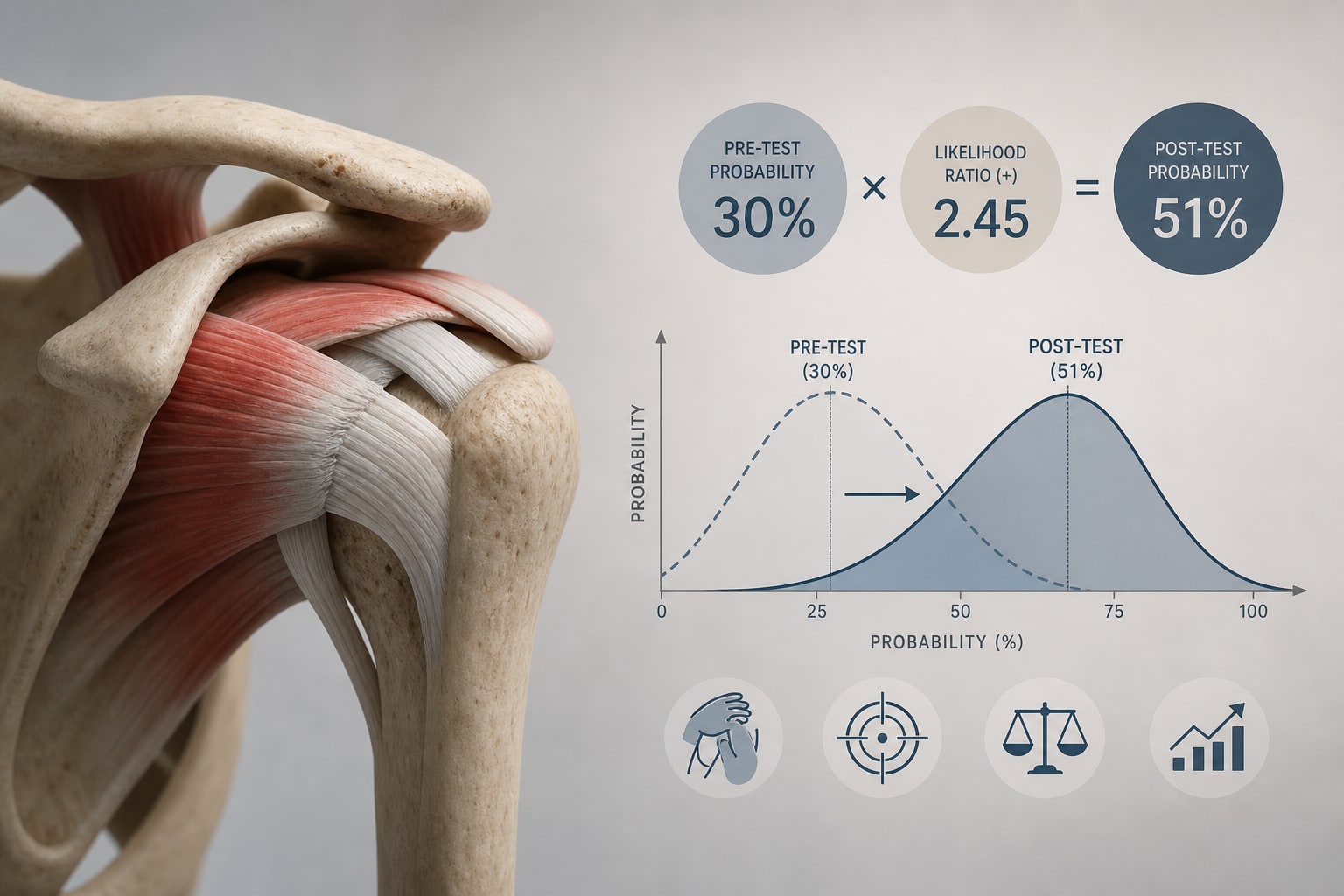
Reframing diagnostic reasoning: the Bayesian imperative in shoulder examination
-
By
-
Eugene Rezk
-
July 8, 2026
-
Clinical Scorecard: Transforming Diagnostic Reasoning: Emphasizing Bayesian Approaches in Shoulder Assessment
At a Glance
| Category | Detail |
|---|
| Condition | Shoulder Disorders |
| Key Mechanisms | Bayesian framework for integrating pre-test probability with pooled likelihood ratios. |
| Target Population | Patients with shoulder complaints in primary and orthopedic care. |
| Care Setting | Musculoskeletal care |
Key Highlights
- Diagnostic accuracy of shoulder tests varies significantly across studies.
- Bayesian modeling allows for transparent calculation of post-test probabilities.
- Sequential application of tests can substantially increase diagnostic probability.
- Individual tests have limited standalone diagnostic value.
- A structured approach to test interpretation is recommended.
Guideline-Based Recommendations
Diagnosis
- Utilize a Bayesian framework to interpret shoulder tests.
Management
- Consider pre-test probability when deciding on imaging or surgical consultation.
Monitoring & Follow-up
- Evaluate changes in post-test probability to guide clinical decisions.
Risks
- Avoid imaging overuse by applying evidence-based diagnostic thresholds.
Patient & Prescribing Data
Individuals presenting with shoulder pain and functional limitations.
Conservative management may suffice for low probability cases, while higher probabilities may necessitate advanced imaging.
Clinical Best Practices
- Apply multiple tests sequentially to enhance diagnostic accuracy.
- Incorporate likelihood ratios into clinical reasoning.
- Avoid binary interpretations of test results.
Related Resources & Content