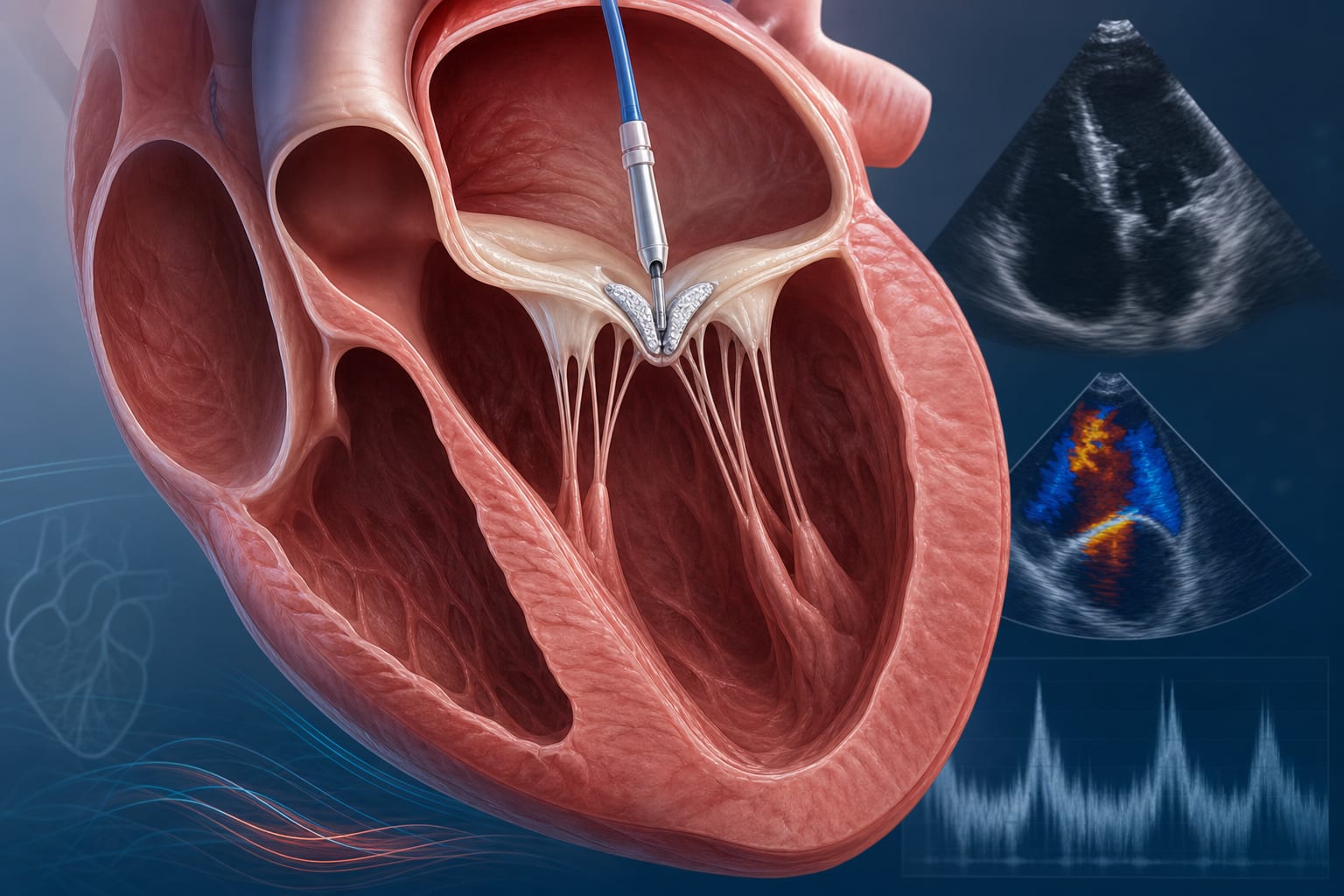
Differential effects of transcatheter edge-to-edge repair on forward stroke volume in atrial and ventricular secondary mitral regurgitation
By
Franziska Grewe
Luise Ulrich
Moritz Haus
Philippe Felfeli
Christian Schach
Andreas Luchner
Christoph Birner
Lars S. Maier
Bernhard Unsöld
Christine Meindl
Kurt Debl
Michael Paulus
June 8, 2026
Clinical Scorecard: Comparative Impact of Transcatheter Edge-to-Edge Mitral Valve Repair on Forward Stroke Volume in Atrial Versus Ventricular Secondary Mitral Regurgitation
At a Glance
Category Detail
Condition Secondary Mitral Regurgitation Key Mechanisms Transcatheter edge-to-edge mitral valve repair (M-TEER) Target Population Patients with symptomatic moderate-to-severe or severe secondary MR Care Setting Single-center study at University Heart Center Regensburg, Germany
Key Highlights
M-TEER is recommended for patients with severe secondary ventricular MR at high surgical risk. Forward stroke volume (FSV) may serve as a more accurate marker for risk stratification in MR. Atrial MR is recognized as a distinct phenotype with limited evidence for M-TEER. Patients with low baseline FSV derived the greatest absolute benefit from M-TEER. Current guidelines recommend M-TEER in symptomatic patients with atrial MR. Guideline-Based Recommendations
Diagnosis
Assessment of MR severity using an integrative, multiparametric approach. Management
M-TEER is recommended for symptomatic patients with severe secondary MR. Monitoring & Follow-up
Follow-up on all-cause mortality and hospitalization for heart failure. Risks
High rates of heart failure hospitalization and all-cause mortality remain. Patient & Prescribing Data
Patients with symptomatic moderate-to-severe or severe secondary MR.
M-TEER is performed under general anesthesia using MitraClip or PASCAL systems.
Clinical Best Practices
Use of non-invasive FSV measurement for risk stratification. Echocardiographic assessment of MR severity before and after M-TEER. Related Resources & Content