Age-specific hospitalization dynamics during a measles outbreak in Nyanza District, Southern Province, Rwanda, 2026: A survival analysis with implications for clinical management - Scorecard - MDSpire
Conexiant’s news site is now MDSpire News. Learn more
Advertisement
Hospitalization Patterns by Age During a Measles Outbreak in Nyanza District, Southern Province, Rwanda, 2026: A Survival Analysis and Its Clinical Management Implications
Clinical Scorecard: Hospitalization Patterns by Age During a Measles Outbreak in Nyanza District, Southern Province, Rwanda, 2026: A Survival Analysis and Its Clinical Management Implications
At a Glance
Category
Detail
Condition
Measles
Key Mechanisms
Transmission primarily through airborne droplets and direct contact with respiratory secretions.
Target Population
Measles cases identified during the 2026 Nyanza District outbreak, with infants younger than 9 months representing the largest age group.
Care Setting
Routine outbreak surveillance, health centers, and hospital care in Nyanza District, Rwanda.
Key Highlights
The analysis included 56 measles cases identified during the Nyanza District outbreak from February 16 to April 17, 2026.
Infants younger than 9 months accounted for 44.6% of cases, while individuals older than 15 years accounted for 25%.
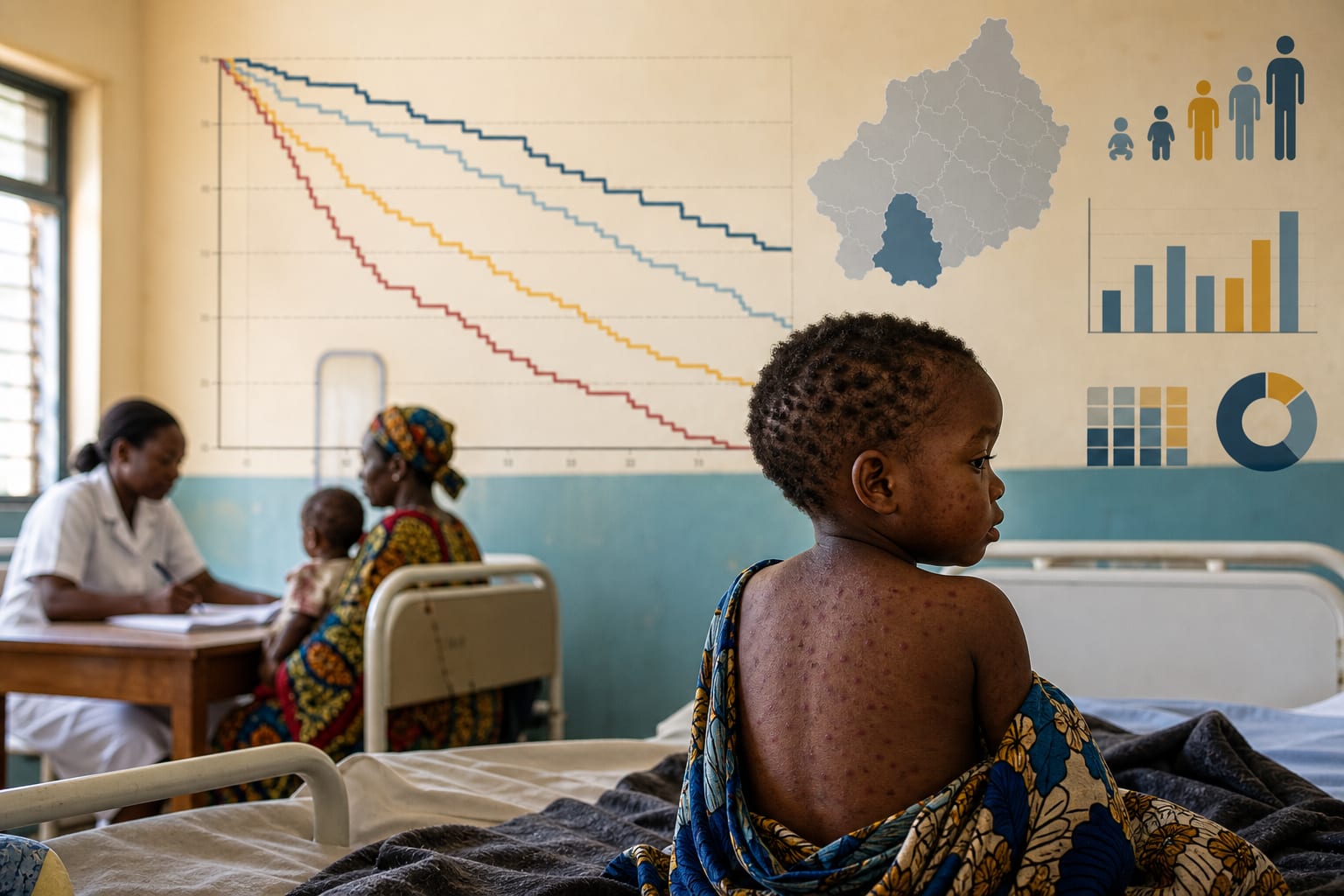
Time to hospital discharge differed significantly across age groups (log-rank P = 0.00049).
Children aged 5-15 years had the most rapid discharge, with a median of approximately 5 days, while infants younger than 9 months, children aged 9-14 months, and individuals older than 15 years had more prolonged hospital stays.
Kaplan–Meier survival analysis was used to characterize time to hospital discharge by age group.
Guideline-Based Recommendations
Diagnosis
Laboratory confirmation was based on measles-specific IgM serology; epidemiologically linked cases were identified through compatible clinical features and documented contact with a confirmed case within the transmission chain.
Management
The findings support age-targeted clinical triage and resource planning during measles outbreaks, particularly given the prolonged clinical courses observed among infants.
Monitoring & Follow-up
Hospitalization duration can help characterize clinical course and healthcare burden during outbreaks.
The authors recommend improving early recognition of complications in infants and strengthening age-aware clinical management.
Risks
Infants younger than 9 months showed particular vulnerability, accounting for the largest proportion of cases and experiencing prolonged hospitalization.
Persistent immunity gaps can permit measles transmission even in settings with high routine vaccination coverage.
Patient & Prescribing Data
The analysis included 56 measles cases identified during the outbreak. Time-to-event analysis was restricted to hospitalized patients with documented admission and discharge dates; these cases represented disease severe enough to require admission rather than the full spectrum of measles cases, most of which were managed on an outpatient basis.
No medication or prescribing regimen was evaluated in this study.
Clinical Best Practices
Use age-aware clinical triage during measles outbreaks.
Prioritize early recognition of complications among infants.
Strengthen vaccination coverage among vulnerable age groups.
Improve immunization documentation to support assessment of population immunity.
Reinforce infection prevention and control measures during outbreaks in healthcare settings.
Related Resources & Content
Hassan MY, Mohamud RYH, Kassim MM, et al. “Clinical characteristics and outcomes of patients hospitalized with measles during an outbreak in Somalia.” IJID Regions. 2023;8:31-35.
Misin A, Antonello RM, Di Bella S, et al. “Measles: an overview of a re-emerging disease in children and immunocompromised patients.” Microorganisms. 2020;8:276.
Kalimba SE, Gahutu JB, Gatera M, Karenzi B, Mambo CM, Bergström T. “Measles seroprevalence and outbreak in Rwanda: evidence from measles epidemiological surveillance and control.” International Journal of Infectious Diseases. 2014;21:146.
Porretta A, Quattrone F, Aquino F, et al. “A nosocomial measles outbreak in Italy, February-April 2017.” Euro Surveillance. 2017;22.
Benet T, Fougere E, Gounon M, et al. “Investigation of a measles outbreak in a highly vaccinated middle school, France, 2023.” Eurosurveillance. 2025;30(46).