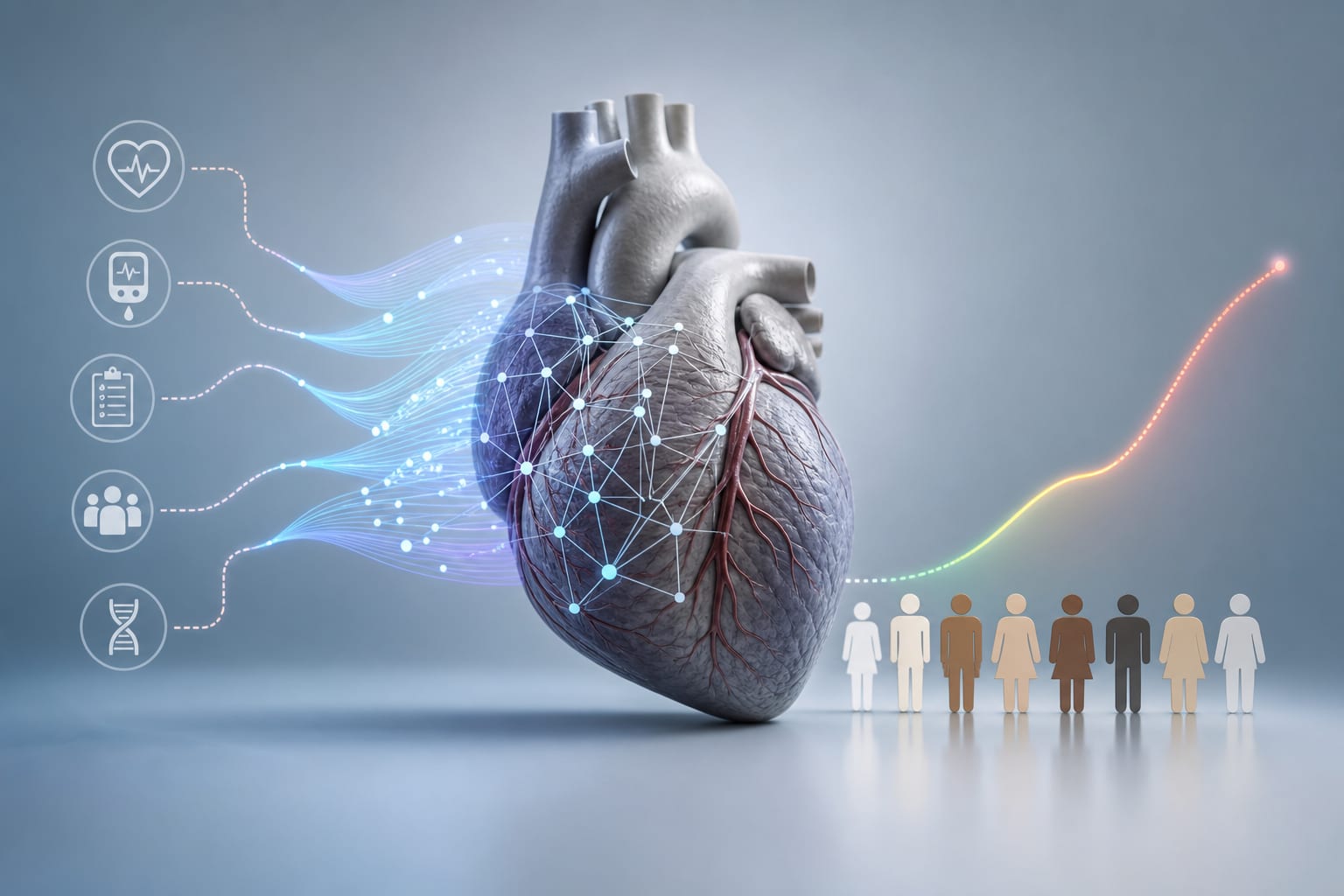
Clinical Scorecard: Harnessing AI for Cardiovascular Risk Assessment in Diabetic Patients: Connecting Algorithmic Advances to Fair Clinical Implementation
At a Glance
Category
Detail
Condition
Cardiovascular disease in patients with type 2 diabetes
Key Mechanisms
Machine learning models, including neural networks and gradient boosting, improve risk prediction by identifying non-linear patterns in high-dimensional data.
Target Population
Patients with type 2 diabetes, particularly in low- and middle-income countries.
Care Setting
Clinical practice and public health.
Key Highlights
Machine learning models show superior discriminative performance compared to traditional risk assessment tools.
Existing models exhibit high risk of bias and poor adherence to reporting standards.
Current algorithms are predominantly developed using populations from Europe and North America, lacking representativeness for Asian populations.
Future advancements should focus on external validation and subgroup-specific performance reporting.
Methodological frameworks like TRIPOD+AI and PROBAST+AI support equitable prediction modeling.
Guideline-Based Recommendations
Diagnosis
Utilize machine learning models for improved cardiovascular risk prediction in diabetic patients.
Management
Implement targeted interventions based on machine learning-derived risk assessments.
Monitoring & Follow-up
Ensure continuous evaluation of model performance across diverse populations.
Risks
Be aware of the high risk of bias and poor model generalizability in current algorithms.
Patient & Prescribing Data
Adults aged 20–79 years with type 2 diabetes.
Machine learning may complement existing diabetes management strategies for personalized intervention.
Clinical Best Practices
Prioritize external validation and local recalibration of predictive models.
Adhere to transparent reporting standards in algorithm development.
Incorporate biologically plausible biomarkers in risk assessment.
"AI could help reduce the burden on ophthalmology services by triaging large numbers of patients with diabetes and allowing specialists to focus on those who most urgently need care."