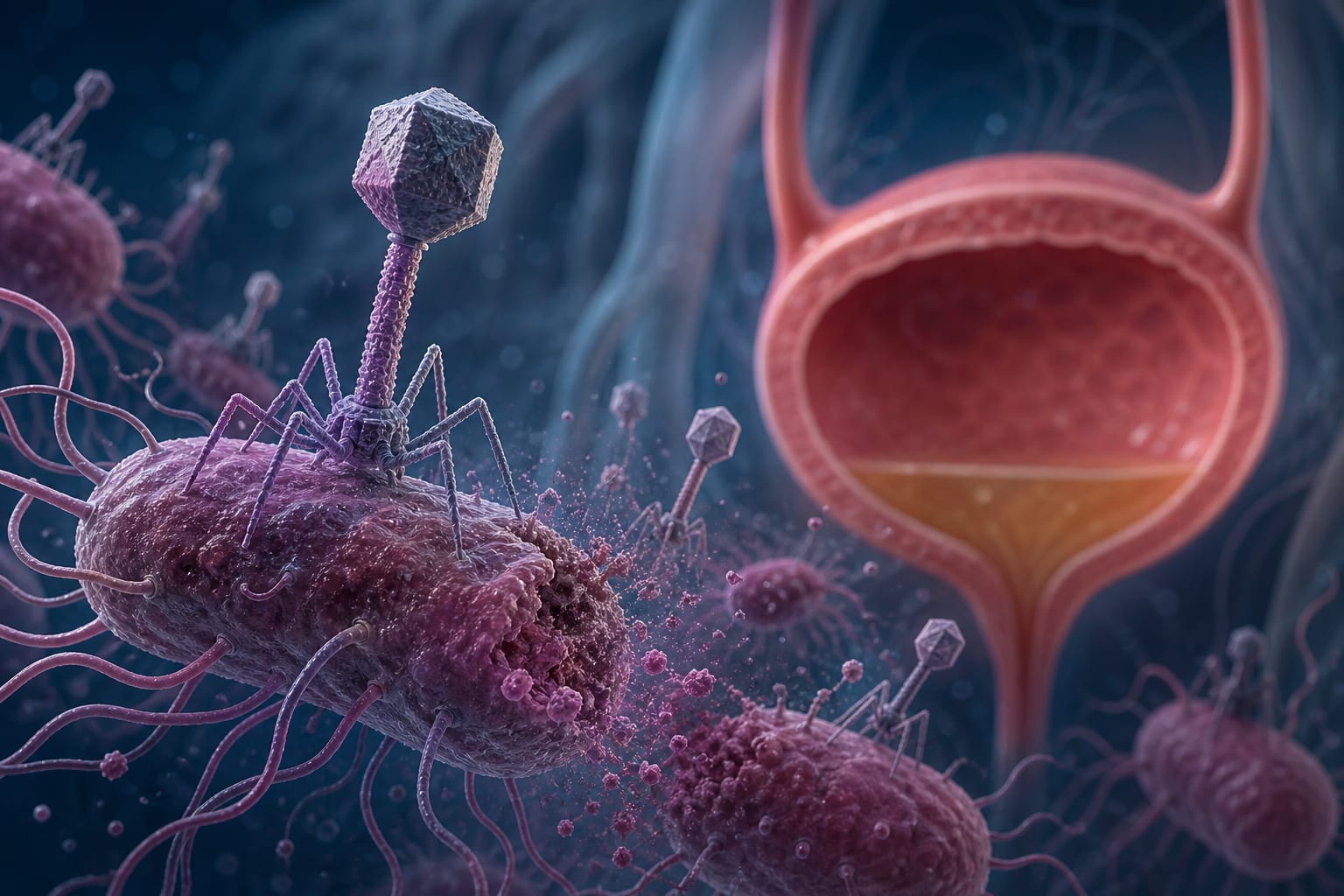
Three lytic phages targeted a clinical MDR K. pneumoniae strain. Phage-resistant bacteria emerged during laboratory testing.
Target Population
Patients with recurrent MDR K. pneumoniae UTI, including those with neurogenic bladder.
Care Setting
Laboratory testing using a strain from a patient with neurogenic bladder and recurrent UTI; no patients received phages in this study.
Key Highlights
The World Health Organization classifies MDR K. pneumoniae as a critical priority pathogen.
Two phages had narrow host ranges; the third infected 29% of 79 tested clinical UTI isolates.
Against the original clinical strain, lytic activity was generally stronger and more sustained in human urine than in laboratory broth.
A separate retrospective study cited by the authors reported clinical improvement in 77% of 100 cases treated with personalized phage therapy. This was not a result of the present study.
Guideline-Based Recommendations
The supplied paper does not provide a clinical guideline or recommend phage therapy for recurrent UTI. The following sections describe information reported in the paper and areas the authors identify for further study.
Diagnosis
The paper defines recurrent UTI as at least two episodes in six months or three episodes in one year.
Management
The laboratory findings support further evaluation of these phages as treatment candidates. They do not establish a treatment approach for patients.
Monitoring & Follow-up
Phage resistance emerged during testing. The authors identify dosing, timing, and integration with antibiotics as questions requiring further study.
Risks
The paper associates MDR UTIs in patients with neurogenic bladder with treatment failure, longer hospital stays, and increased risk of renal failure.
Patient & Prescribing Data
Researchers used an MDR K. pneumoniae strain from one patient with neurogenic bladder and recurrent UTI and tested phage host range against 79 clinical UTI isolates. They did not administer phages to patients or measure prescribing outcomes.
Clinical Best Practices
The authors call for testing phages under conditions resembling the infection site and for in vivo modeling of interactions among phages, bacteria, and host defenses. These are research priorities; the study does not establish clinical best practices for phage treatment.
Related Resources & Content
Calin R, Bernabeu Vilaplana B, Gédéon J, et al. “Lytic bacteriophages active in urine against multidrug-resistant clinically derived Klebsiella pneumoniae causing urinary tract infection.” International Journal of Infectious Diseases. 2026;172:108966.
World Health Organization. “WHO bacterial priority pathogens list 2024: bacterial pathogens of public health importance, to guide research, development, and strategies to prevent and control antimicrobial resistance.” World Health Organization. 2024.
Pirnay J-P, Djebara S, Steurs G, et al. “Personalized bacteriophage therapy outcomes for 100 consecutive cases: a multicentre, multinational, retrospective observational study.” Nature Microbiology. 2024;9:1434–1453.
Study found species-specific differences in biofilm -forming capacity and antimicrobial susceptibility among supragingival bacterial isolates from patients with active dental caries.
A retrospective cohort study of more than 520,000 hospitalized patients found no clinically meaningful improvement in deterioration or mortality with early treatment targeting community-acquired pneumonia.