Smaller WEB devices show lower retreatment rates than larger devices: results from the WorldWideWEB study - Scorecard - MDSpire
Coming Soon: Introducing MDSpire News. Learn more
Conexiant’s news site is now MDSpire News. Learn more

Reduced retreatment rates observed with smaller WEB devices compared to larger counterparts: findings from the WorldWideWEB study

  • By

  • Franja Dugar

  • Hamza Adel Salim

  • Basel Musmar

  • Nimer Adeeb

  • Mahmoud Dibas

  • Davide Simonato

  • Yan-Lin Li

  • Muhammed Amir Essibayi

  • Oktay Algin

  • Sherief Ghozy

  • Sovann V. Lay

  • Adrien Guenego

  • Leonardo Renieri

  • Joseph Carnevale

  • Guillaume Saliou

  • Panagiotis Mastorakos

  • Eimad Shotar

  • Markus Möhlenbruch

  • Michael Kral

  • Charlotte Chung

  • Mohamed M. Salem

  • Ivan Lylyk

  • Paul M. Foreman

  • Hamza Shaikh

  • Vedran Župančić

  • Muhammad U. Hafeez

  • Joshua Catapano

  • Muhammad Waqas

  • Ahmet Gurhan Gurcay

  • Giyas Ayberk

  • Muhammet Arslan

  • James D. Rabinov

  • Onur Ergun

  • Julian Maingard

  • Clemens M. Schirmer

  • Mariangela Piano

  • Anna L. Kühn

  • Caterina Michelozzi

  • Robert M. Starke

  • Ameer Hassan

  • Mark Ogilvie

  • Jesse Jones

  • Waleed Brinjikji

  • Marios Psychogios

  • Marie T. Nawka

  • Jens Fiehler

  • Thi Dan Linh Nguyen-Kim

  • Bryan Pukenas

  • Jan-Karl Burkhardt

  • Thien Huynh

  • Juan Carlos Martinez-Gutierrez

  • Sunil A. Sheth

  • Diana Slawski

  • Rabih G. Tawk

  • Benjamin Pulli

  • Boris Lubicz

  • Pietro Panni

  • Ajit S. Puri

  • Guglielmo Pero

  • Eytan Raz

  • Christoph J. Griessenauer

  • Hamed Asadi

  • Adnan Siddiqui

  • Elad I. Levy

  • Neil Haranhalli

  • David Altschul

  • Andrew F. Ducruet

  • Robert W. Regenhardt

  • Christopher J. Stapleton

  • Peter Kan

  • Vladimir Kalousek

  • Pedro Lylyk

  • Srikanth Boddu

  • Jared Knopman

  • Stavropoula I. Tjoumakaris

  • Hugo H. Cuellar-Saenz

  • Pascal M. Jabbour

  • Frédéric Clarençon

  • Nicola Limbucci

  • Maurizio Fuschi

  • Aman B. Patel

  • Mohammad Almohammad

  • Andre Kemmling

  • Adam A. Dmytriw

  • Peter B. Sporns

  • September 8, 2026

Share

Clinical Scorecard: Reduced retreatment rates observed with smaller WEB devices compared to larger counterparts: findings from the WorldWideWEB study

At a Glance

Category

Detail

Condition

Intracranial Aneurysms

Key Mechanisms

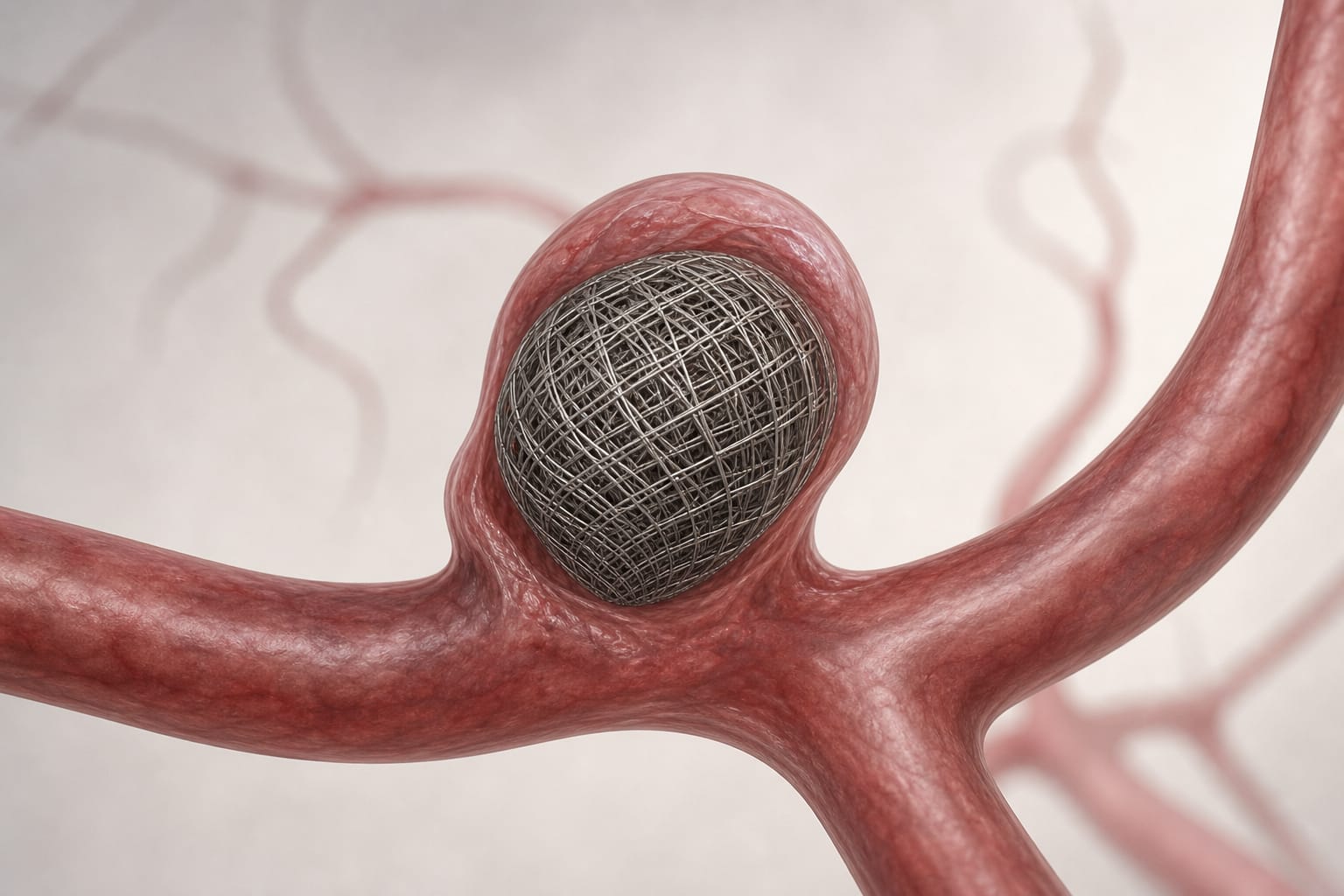
Deployment of Woven EndoBridge (WEB) devices for aneurysm treatment.

Target Population

Adults (age ≥ 18 years) with ruptured or unruptured intracranial aneurysms.

Care Setting

Multicenter academic institutions across Europe, North and South America, and Australia.

Key Highlights

  • Smaller WEB devices (≤ 4.5 mm) may present distinct occlusion and complication profiles compared to larger devices (> 4.5 mm).

  • Retreatment rates were observed to be lower with smaller WEB devices.

  • The study utilized a retrospective cohort design across 30 institutions.

Guideline-Based Recommendations

Diagnosis

  • Assessment of aneurysm characteristics including rupture status, location, dimensions, and neck morphology.

Management

  • Use of WEB devices as a therapeutic option for intracranial aneurysms.

Monitoring & Follow-up

  • Follow-up imaging to evaluate angiographic outcomes and retreatment decisions.

Risks

  • Increased risks of complications with smaller devices, including thromboembolic and hemorrhagic events.

Patient & Prescribing Data

Adults with intracranial aneurysms treated with WEB devices.

Consideration of device size and aneurysm characteristics is crucial for treatment planning.

Clinical Best Practices

  • Follow institutional protocols for antiplatelet and anticoagulation regimens.

  • Evaluate angiographic outcomes using standardized scoring systems.

Related Resources & Content

  1. Kallmes DF, et al., American Journal of Neuroradiology, 2019 -- "Woven EndoBridge (WEB) Device for the Treatment of Intracranial Aneurysms: A Review of the Literature"

  2. Bourcier R, et al., Journal of NeuroInterventional Surgery, 2020 -- "Outcomes of the Woven EndoBridge Device for the Treatment of Intracranial Aneurysms: A Systematic Review"

  3. Khan A, et al., Neurosurgery, 2021 -- "Comparative Effectiveness of WEB Device and Coiling for Intracranial Aneurysms: A Meta-Analysis"

  4. Brinjikji W, et al., Stroke, 2022 -- "Long-Term Outcomes of Patients Treated with Woven EndoBridge Devices for Intracranial Aneurysms"

  5. Kumar V, et al., Journal of NeuroInterventional Surgery, 2022 -- "Retreatment Rates After Woven EndoBridge Treatment of Intracranial Aneurysms"

  6. Almandoz JP, et al., Neurosurgery, 2023 -- "Safety and Efficacy of Smaller WEB Devices in Treating Intracranial Aneurysms: A Multicenter Study"

  7. Hussain MS, et al., Journal of Vascular and Interventional Radiology, 2023 -- "Clinical Outcomes of Woven EndoBridge Devices in the Treatment of Intracranial Aneurysms"

  8. 2023 Guideline for the Management of Patients With Aneurysmal Subarachnoid Hemorrhage: A Guideline From the American Heart Association/American Stroke Association

  9. Comparative analysis of long term effectiveness of Neuroform Atlas stent versus low profile visualized intraluminal stent/Woven EndoBridge devices in treatment of wide necked intracranial aneurysms

  10. Retreatment rate and strategies for recurrent and residual aneurysms after Woven EndoBridge (WEB) treatment: a comprehensive systematic review and meta-analysis - PMC

Original Source(s)

Related Content