Endoscopic mucosal resection versus endoscopic submucosal dissection for early colorectal cancer and precursor lesions: a retrospective study - Scorecard - MDSpire
Advertisement
Endoscopic mucosal resection versus endoscopic submucosal dissection for early colorectal cancer and precursor lesions: a retrospective study
Clinical Scorecard: Comparative Analysis of Endoscopic Mucosal Resection and Endoscopic Submucosal Dissection for Early Colorectal Cancer and Precursor Lesions: A Retrospective Investigation
At a Glance
Category
Detail
Condition
Early Colorectal Cancer and Precursor Lesions
Key Mechanisms
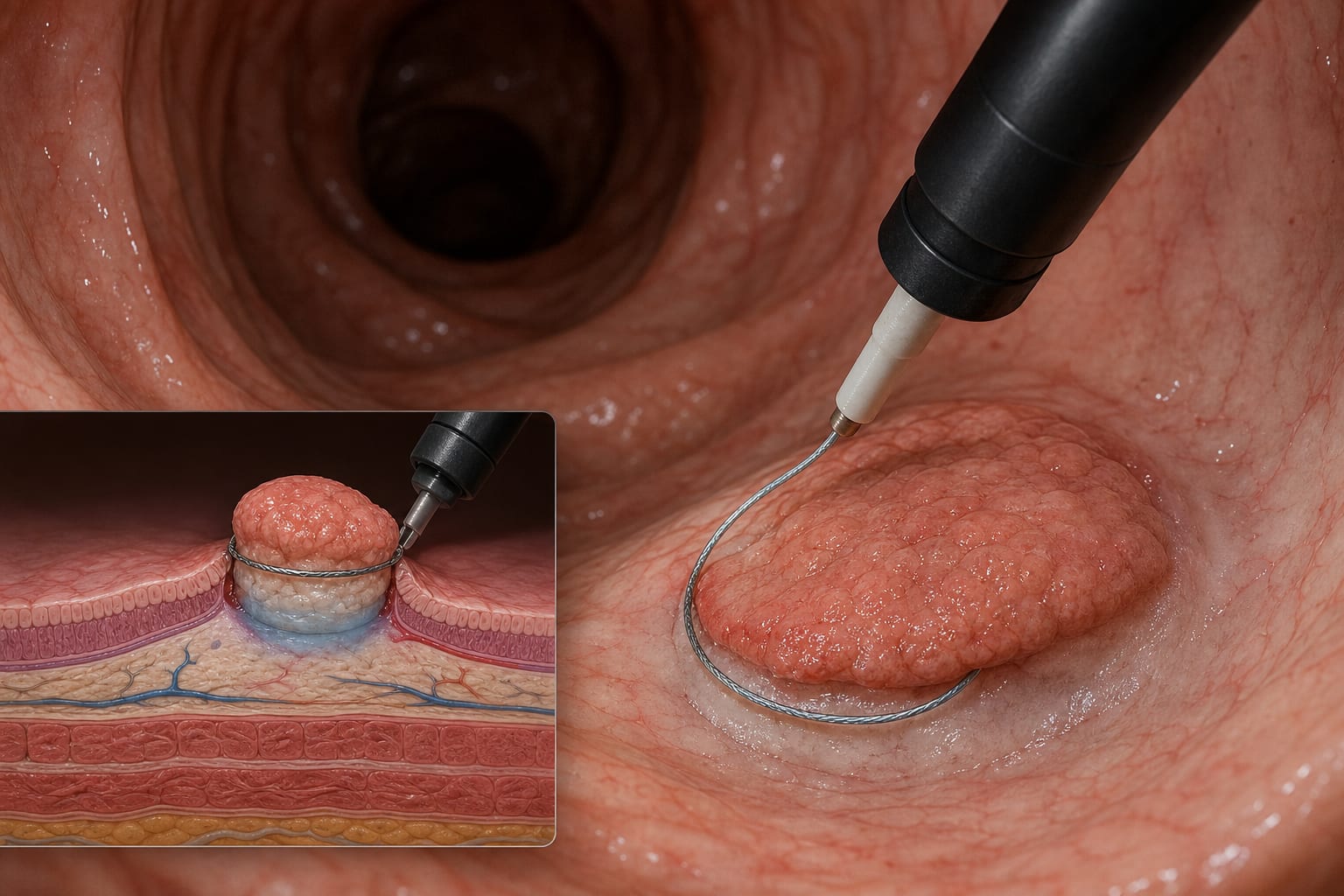
Endoscopic mucosal resection (EMR) and endoscopic submucosal dissection (ESD) are techniques for resection.
Target Population
Patients with early colorectal cancer or precursor lesions.
Care Setting
Single-center retrospective study.
Key Highlights
ESD shows superior en bloc, complete, and curative resection rates for lesions ≥20 mm compared to EMR.
Higher complication rates observed with ESD in right-colon lesions.
For lesions <20 mm, EMR is preferred.
Recurrence rates at 12 months were lower for ESD compared to EMR.
Guideline-Based Recommendations
Diagnosis
Pre-procedural evaluation includes white-light endoscopy, chromoendoscopy, and endoscopic ultrasound/computed tomography.
Management
For lesions ≥20 mm, prioritize ESD; for lesions <20 mm, EMR is preferred.
Monitoring & Follow-up
Surveillance colonoscopy at 3, 6, and 12 months to assess recurrence.
Risks
Higher complication rates associated with ESD, particularly in right colon.
Patient & Prescribing Data
101 patients with early CRC or precursor lesions.
ESD is an independent predictor of en bloc resection.
Clinical Best Practices
Select ESD for larger lesions or when en bloc EMR is not feasible.
Conduct thorough pre-procedural evaluations to guide resection technique.