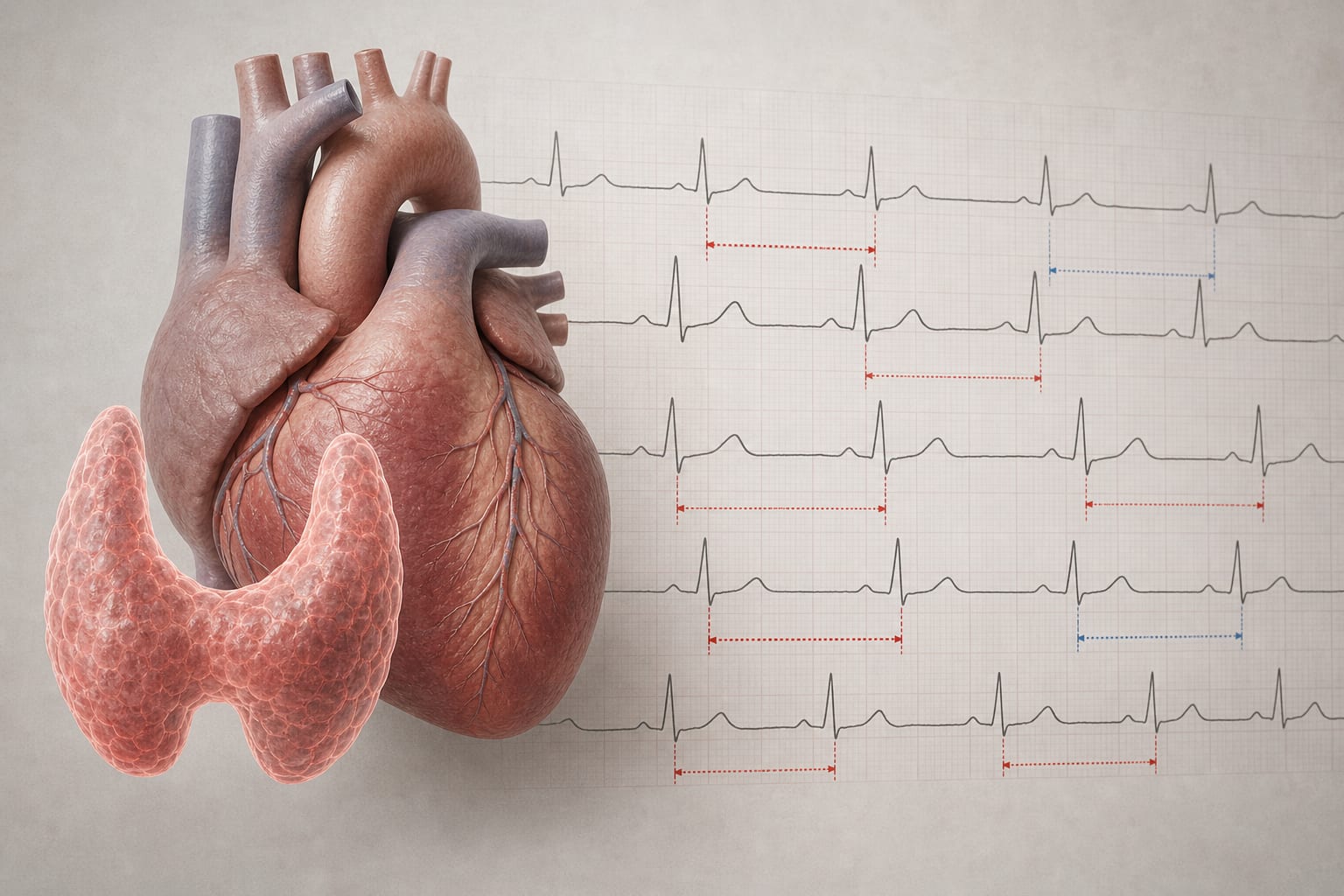
Clinical Scorecard: Increased Ventricular Repolarization Dispersion Linked to Overt Hyperthyroidism: Findings from a Case-Control Investigation
At a Glance
Category
Detail
Condition
Overt Hyperthyroidism
Key Mechanisms
Altered ventricular repolarization as indicated by increased dispersion parameters on ECG.
Target Population
Adults with overt hyperthyroidism and healthy euthyroid controls.
Care Setting
Clinical Department of Internal Medicine, Nephrology and Endocrinology.
Key Highlights
All six assessed ventricular repolarization dispersion parameters were significantly higher in patients with overt hyperthyroidism compared to controls.
The best discriminatory performance for identifying overt hyperthyroidism was observed for JTcFd (AUC 0.813) and QTcBd (AUC 0.804).
Tp-ed was independently associated with overt hyperthyroidism in multivariable analysis.
Weak and non-significant correlations were found between thyroid hormone levels and dispersion indices.
Guideline-Based Recommendations
Diagnosis
Utilize advanced electrocardiographic markers to assess ventricular repolarization in patients with overt hyperthyroidism.
Management
Monitor cardiovascular health in patients with overt hyperthyroidism due to increased risk of arrhythmias.
Monitoring & Follow-up
Regular ECG assessments to evaluate ventricular repolarization parameters in patients with overt hyperthyroidism.
Risks
Increased cardiovascular morbidity, including tachyarrhythmias and heart failure.
Patient & Prescribing Data
Adults diagnosed with overt hyperthyroidism.
Electrocardiographic monitoring may be necessary to assess arrhythmic risk.
Clinical Best Practices
Incorporate advanced ECG parameters in routine assessments for patients with overt hyperthyroidism.
Consider the potential for increased ventricular repolarization dispersion when managing patients with hyperthyroidism.