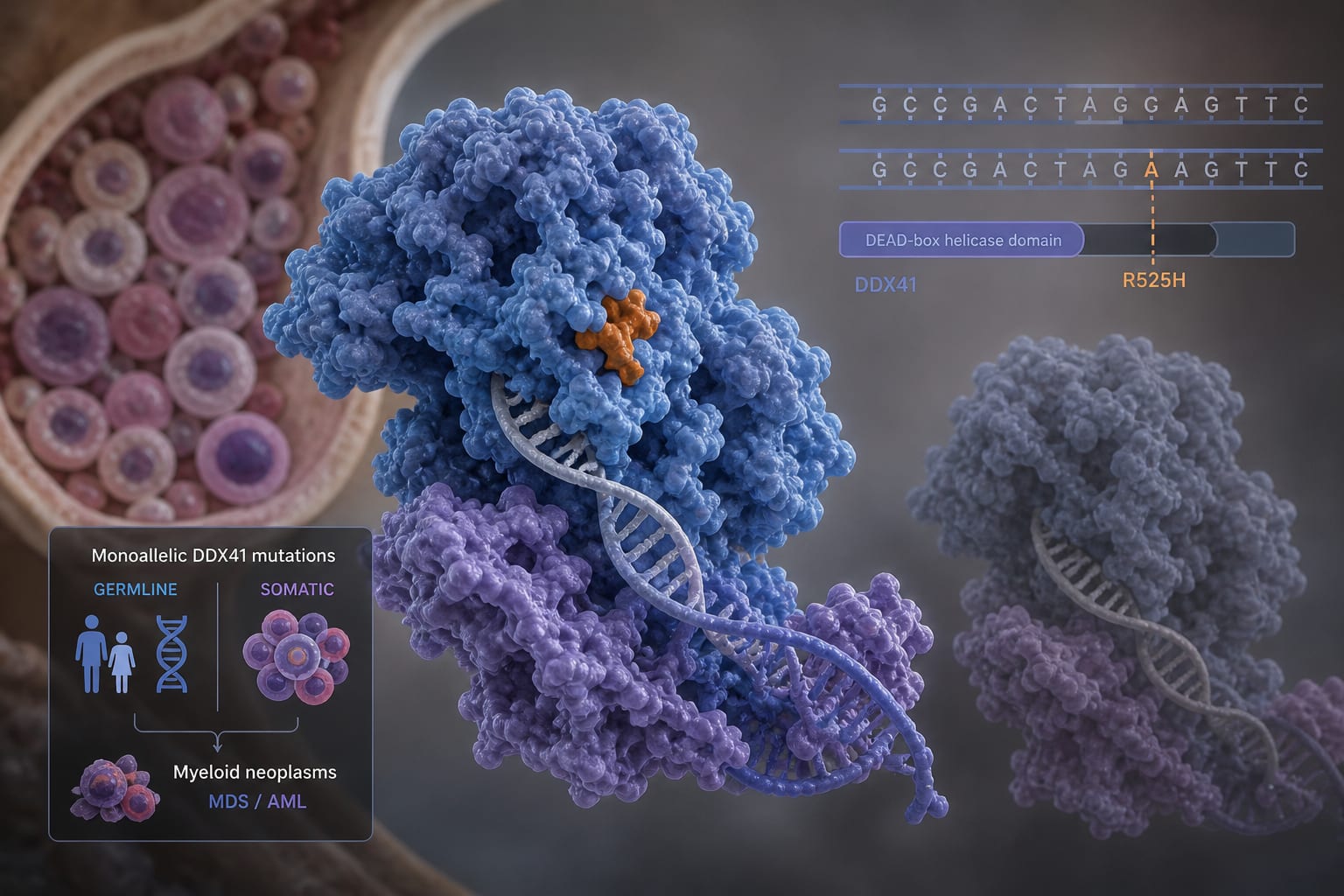
Clinical Scorecard: Molecular Profile of Monoallelic DDX41 Mutations in Hematologic Disorders
At a Glance
Category
Detail
Condition
DDX41 mutations in hematologic disorders, including myelodysplastic syndromes (MDS) and acute myeloid leukemia (AML)
Key Mechanisms
The authors discuss loss-of-function, hypomorphic, and change-of-function models. Germline DDX41 variants are heterozygous; cases may also carry somatic hits, commonly R525H, or mutations in other DDX/DHX RNA helicases.
Target Population
Patients assessed for DDX41 mutations, including germline, somatic, and monoallelic cases
Care Setting
Not specified in the supplied source
Key Highlights
Among 1,893 patients assessed, DDX41 mutations were identified in 168.
Among DDX41-mutant cases, 61% had germline variants alone, 25% had both germline and somatic hits, and 14% had a somatic hit alone.
MDS and AML occurred in 27% and 36% of cases, respectively, and were associated with a normal karyotype.
Mutations in other DDX/DHX RNA helicases occurred in 15% of monoallelic germline DDX41 cases; identifying these mutations reduced the unexplained case fraction from 61% to 53%.
Guideline-Based Recommendations
Diagnosis
Management
Monitoring & Follow-up
Risks
The authors note that low clonal fractions of somatic DDX41 mutations in blood or marrow leukocytes may limit detection and may account for unexplained monoallelic cases.
Approximately one-fifth of patients with monoallelic germline mutations had a prior history of cytopenia.
Patient & Prescribing Data
The analysis included 1,893 patients from Cleveland Clinic and public datasets; DDX41 mutations were identified in 168. Median age was comparable between mutant and wild-type groups; the mutant group had a higher proportion of males.
by Valeria Visconte, Carlos Bravo-Perez, Serhan Unlu, Arda Durmaz, Luca Guarnera, Ishani Nautiyal, Zachary Brady, Mark Orland, Atsushi Marumo, Aashray Mandala, Christopher Haddad, Matteo D’Addona, Yasuo Kubota, Eckhard Jankowsky, Chao-Yie Yang, Benjamin Kroger, Stephen S. Chung, David Bosler, Carmelo Gurnari, Jaroslaw P. Maciejewski
A new imaging technique produces H&E-like images and molecular measurements directly from fresh tissue, potentially accelerating intraoperative pathology