Clinical Scorecard: Bayesian Network Meta-Analysis of Palliative Treatments for Malignant Gastric Outlet Obstruction
At a Glance
Category
Detail
Condition
Malignant gastric outlet obstruction (GOO) in people with pancreaticobiliary or gastroduodenal malignancies.
Key Mechanisms
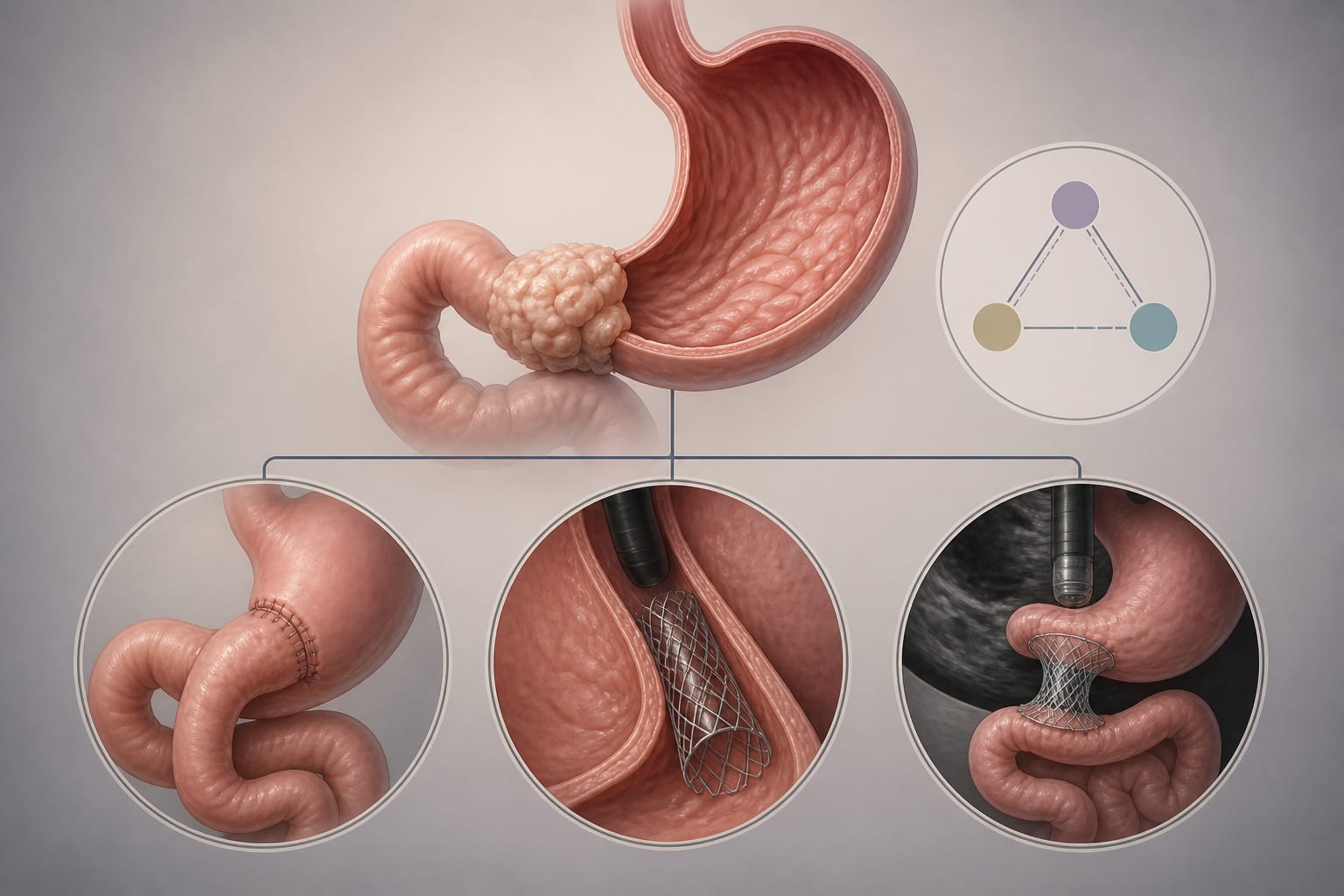
Surgical gastrojejunostomy creates a bypass; endoscopic stenting restores luminal patency with self-expanding metal stents; EUS-guided gastroenterostomy forms an endoscopic bypass using lumen-apposing metal stents.
Target Population
Adults with malignant GOO in eligible comparative studies of two or more of surgical gastrojejunostomy, endoscopic stenting, and EUS-guided gastroenterostomy.
Care Setting
Not specified in the supplied excerpt.
Key Highlights
Malignant GOO is associated with nausea, vomiting, inability to tolerate oral intake, progressive malnutrition, and diminished quality of life in advanced disease.
The Bayesian network meta-analysis compared surgical gastrojejunostomy, endoscopic stenting, and EUS-guided gastroenterostomy for palliation.
Primary outcomes were clinical success and reintervention; secondary outcomes included adverse events, 30-day mortality, time until oral intake, hospital length of stay, and overall survival.
The supplied excerpt describes the methods and outcomes but does not provide comparative outcome estimates or treatment rankings.
Guideline-Based Recommendations
Diagnosis
The supplied excerpt does not provide diagnostic recommendations for malignant GOO.
Management
The study compared surgical gastrojejunostomy, endoscopic stenting, and EUS-guided gastroenterostomy as palliative approaches; the supplied excerpt does not report comparative results or identify a preferred approach.
Monitoring & Follow-up
The study assessed clinical success, reintervention, adverse events, 30-day mortality, time until oral intake, hospital length of stay, and overall survival; these are study outcomes, not monitoring recommendations.
Risks
The source describes surgical gastrojejunostomy as involving surgical morbidity and prolonged recovery.
The source describes stent dysfunction and subsequent reintervention as limitations of endoscopic stenting.
Patient & Prescribing Data
Eligible studies compared at least two of the three procedures in adults with malignant GOO; the supplied excerpt does not report the total number of participants.
The supplied excerpt contains no medication or dosing information. It describes three procedural approaches and notes trade-offs involving efficacy, durability, safety, and recovery.
Clinical Best Practices
The study defined clinical success using each study's criteria for restored oral intake and alleviation of obstructive symptoms; definitions varied and were harmonized to a shared clinical construct.
The primary network included randomized controlled trials and eligible comparative cohort studies; prespecified randomized-trial-only sensitivity analyses and study-design subgroup analyses assessed robustness.
The supplied excerpt does not establish a preferred procedure or provide patient-level selection criteria.
Antibody-drug conjugates (ADCs) have become an increasingly important part of treatment for several advanced cancers, pairing a tumor-targeting antibody with a cytotoxic payload.