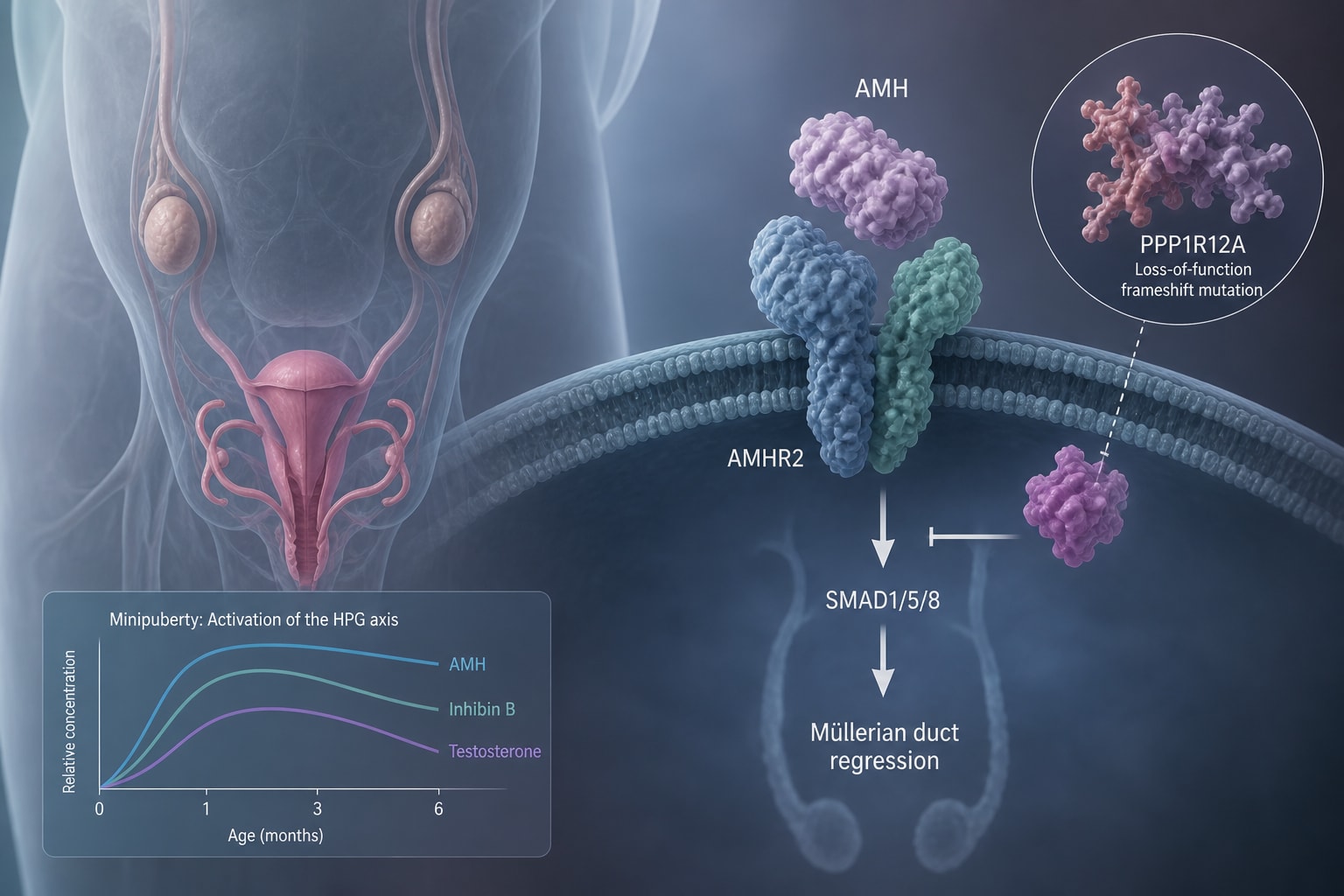
Clinical Case Study: Hormonal Profile During Minipuberty in Persistent Müllerian Duct Syndrome Associated with PPP1R12A Mutations
-
By
-
Marie Voide
-
Federico Santoni
-
Lucia Bartoloni
-
Jenny Meylan-Merlini
-
Oliver Sanchez
-
Michael Hauschild
-
Nelly Pitteloud
-
Kanetee Busiah
-
September 15, 2026
Clinical Scorecard: Clinical Case Study: Hormonal Profile During Minipuberty in Persistent Müllerian Duct Syndrome Associated with PPP1R12A Mutations
At a Glance
| Category | Detail |
|---|
| Condition | Persistent Müllerian Duct Syndrome (PMDS) |
| Key Mechanisms | Mutations in anti-Müllerian hormone (AMH) or its receptor, and PPP1R12A gene variants. |
| Target Population | 46,XY individuals with PMDS. |
| Care Setting | Clinical evaluation of differences/disorders of sex development (DSD). |
Key Highlights
- PMDS is characterized by the presence of Müllerian derivatives in 46,XY individuals.
- A novel PPP1R12A mutation was identified in a neonate with bilateral cryptorchidism.
- Endocrine findings indicate activation of the hypothalamic-pituitary-gonadal axis during minipuberty.
- Longitudinal hormonal profiles suggest potential Sertoli cell dysfunction.
- PPP1R12A may play a role in Müllerian duct regression rather than primary gonadal development.
Guideline-Based Recommendations
Diagnosis
- Karyotyping to confirm 46,XY status.
- Comprehensive biological and radiological evaluation for DSD.
Management
- Monitor hormonal profiles during neonatal and minipuberty periods.
Monitoring & Follow-up
- Regular assessment of AMH, inhibin B, LH, and FSH levels.
Risks
- Potential for evolving Sertoli cell dysfunction.
Patient & Prescribing Data
Neonates diagnosed with PMDS.
Management of associated conditions such as hypoglycemia and jaundice.
Clinical Best Practices
- Utilize appropriate hormonal assays for monitoring endocrine function.
- Consider genetic evaluation for unexplained cases of PMDS.
Related Resources & Content