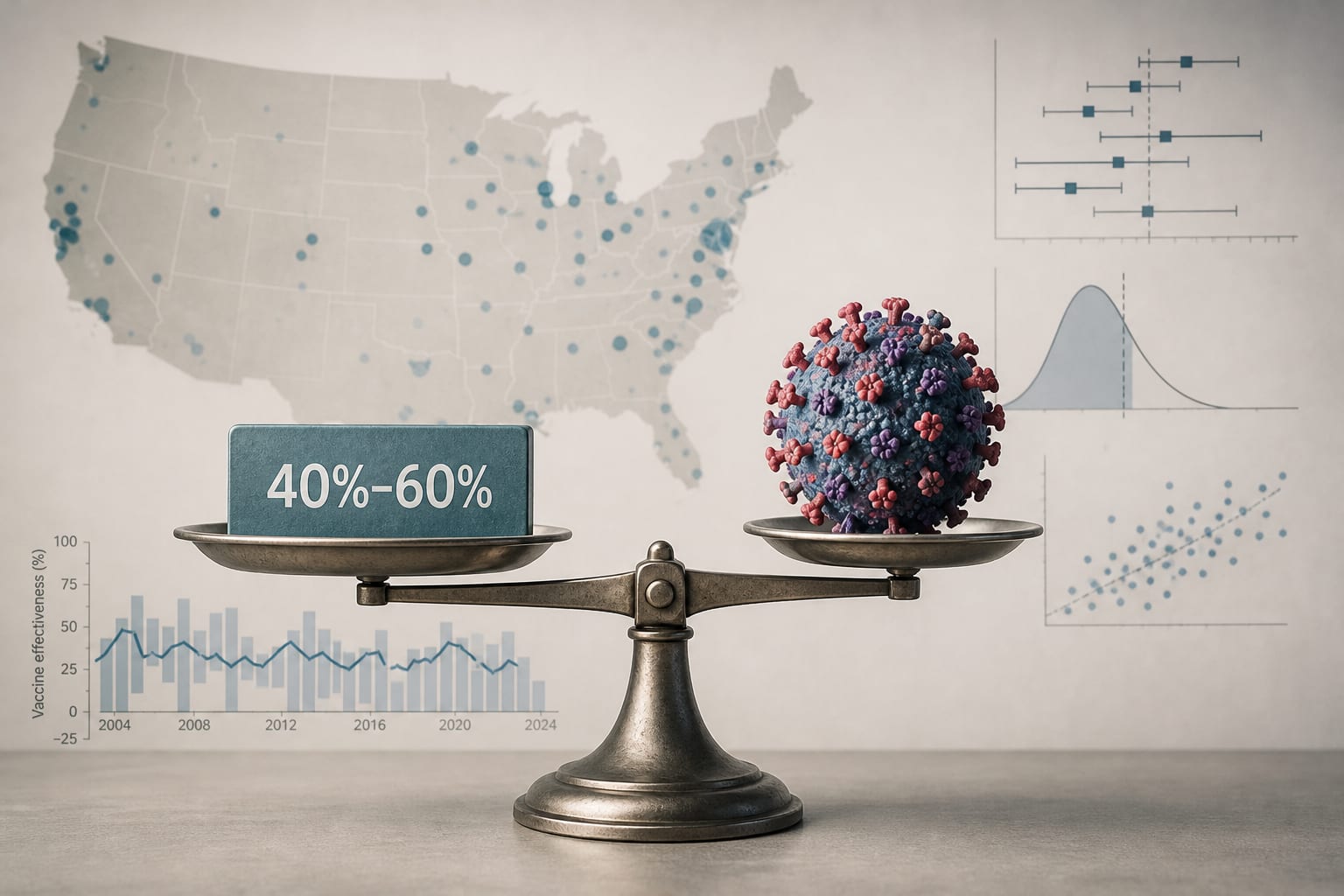
Evaluating the Common 40%–60% Estimate of Influenza Vaccine Effectiveness: A Meta-Analysis
-
By
-
Matthew D. Wolpert
-
Yuanyuan Liang
-
Meagan C. Fitzpatrick
-
Justin R. Ortiz
-
November 10, 2026
Clinical Scorecard: Evaluating the Common 40%–60% Estimate of Influenza Vaccine Effectiveness: A Meta-Analysis
At a Glance
Category | Detail |
|---|---|
Condition | Seasonal influenza and influenza vaccine effectiveness |
Key Mechanisms | Vaccine effectiveness varies across seasons; reported antigenic mismatch between circulating viruses and at least one vaccine component was associated with lower pooled effectiveness. |
Target Population | People represented in 18 US Influenza Vaccine Effectiveness Network season-level estimates from 2004–2005 through 2023–2024; participant-level characteristics were unavailable. |
Care Setting | US seasonal influenza surveillance and medically attended influenza evaluated through observational studies using a standardized test-negative design. |
Key Highlights
Across 18 seasons and 96,335 participants, pooled vaccine effectiveness was 41.3% (95% CI, 35.6%–46.5%).
Season-specific effectiveness ranged from 10% to 60%; 9 seasons had estimates below 40%, 9 were within 40%–60%, and none exceeded 60%.
The prediction interval for effectiveness in one future season was 15.6%–59.3%, with substantial between-season heterogeneity (I² = 82.8%).
Pooled effectiveness was 36.2% in seasons reporting antigenic mismatch and 50.4% in seasons without reported mismatch; the subgroup difference was significant (P = .001).
Antigenic mismatch was reported in 11 of 18 seasons; the authors note that the mismatch comparison was associational and seasons also differed in other factors.
Guideline-Based Recommendations
Diagnosis
The analysis evaluated medically attended influenza using observational studies with a standardized test-negative design; it does not provide clinical diagnostic recommendations.
Management
The authors state that limiting expectations to biologically favorable seasons may fail to represent performance across typical seasons and conclude that the 40%–60% heuristic does not fully characterize historical performance across the included seasons.
Monitoring & Follow-up
Vaccine effectiveness should be interpreted in the context of season-to-season variability. The authors report substantial heterogeneity and a prediction interval of 15.6%–59.3% for effectiveness in one future season.
Risks
The analysis reports effectiveness estimates, not vaccine safety outcomes or adverse-event risks. Effectiveness was lower in seasons with reported antigenic mismatch, but this association does not establish that mismatch alone caused the difference.
Patient & Prescribing Data
The article reports seasonal influenza vaccine effectiveness, not prescribing or dosing data. Overall pooled effectiveness across 18 season-level estimates was 41.3% (95% CI, 35.6%–46.5%).
Clinical Best Practices
Interpret the 40%–60% effectiveness estimate as a heuristic rather than a consistent season-specific result: observed estimates ranged from 10% to 60%, and the prediction interval for one future season was 15.6%–59.3%.
Consider antigenic match and other season-specific factors when interpreting effectiveness; the reported mismatch subgroup comparison was observational and may reflect differences beyond mismatch.
Apply these findings within their scope: the analysis used season-level estimates from US observational studies, and participant-level characteristics were unavailable.
Related Resources & Content
JAMA Network Open, Year not stated -- Evaluating the Common 40%–60% Estimate of Influenza Vaccine Effectiveness: A Meta-Analysis
CDC/ACIP, 2025 -- Prevention and Control of Seasonal Influenza with Vaccines: Recommendations of the Advisory Committee on Immunization Practices — United States, 2025–26 Influenza Season
CDC, 2025 -- Interim Estimates of 2024–2025 Seasonal Influenza Vaccine Effectiveness — Four Vaccine Effectiveness Networks, United States, October 2024–February 2025
Kaiser Family Foundation (KFF) — Estimating Effectiveness of Influenza and COVID-19 Vaccines: The “Test-Negative” Design
The Journal of Infectious Diseases — Estimating Standard-Dose and High-Dose Fluzone Vaccine Efficacies for Influenza A Based on Hemagglutination Inhibition Titers
American Journal of Epidemiology — Assessing the Community-Level Indirect Impact of Influenza Vaccination: A Combined Approach Utilizing Mathematical Modeling and Bias Evaluation
Open Forum Infectious Diseases — Assessing the Efficacy of the 2023 Southern Hemisphere Influenza Vaccine Against Outpatient Influenza-Like Illness: Findings from a Multi-Nation Test-Negative Study
Prevention and Control of Seasonal Influenza with Vaccines: Recommendations of the Advisory Committee on Immunization Practices — United States, 2025–26 Influenza Season
Interim Estimates of 2024–2025 Seasonal Influenza Vaccine Effectiveness — Four Vaccine Effectiveness Networks, United States, October 2024–February 2025
Prevention and Control of Seasonal Influenza with Vaccines: Recommendations of the Advisory Committee on Immunization Practices — United States, 2025–26 Influenza Season
Testing the 40% to 60% Influenza Vaccine Effectiveness Heuristic: A Meta-Analysis | Infectious Diseases | JAMA Network Open | JAMA Network
Vaccine Effectiveness Against Influenza A(H1N1), A(H3N2), and B–Associated Hospitalizations — United States, September 1, 2023–May 31, 2024
Influenza vaccine effectiveness against influenza A-associated hospitalization and severe in-hospital outcomes among adults in the United States, 2024-2025.
Based on findings from:
Testing the 40% to 60% Influenza Vaccine Effectiveness Heuristic: A Meta-Analysis
Matthew D. Wolpert, Yuanyuan Liang, Meagan C. Fitzpatrick, Justin R. Ortiz. Jama Network Open, 2026.
https://jamanetwork.com/journals/jamanetworkopen/fullarticle/2856370
This content is an AI-generated, fully rewritten summary based on a published scholarly article. It does not reproduce the original text and is not a substitute for the original publication. Readers are encouraged to consult the source for full context, data, and methodology.