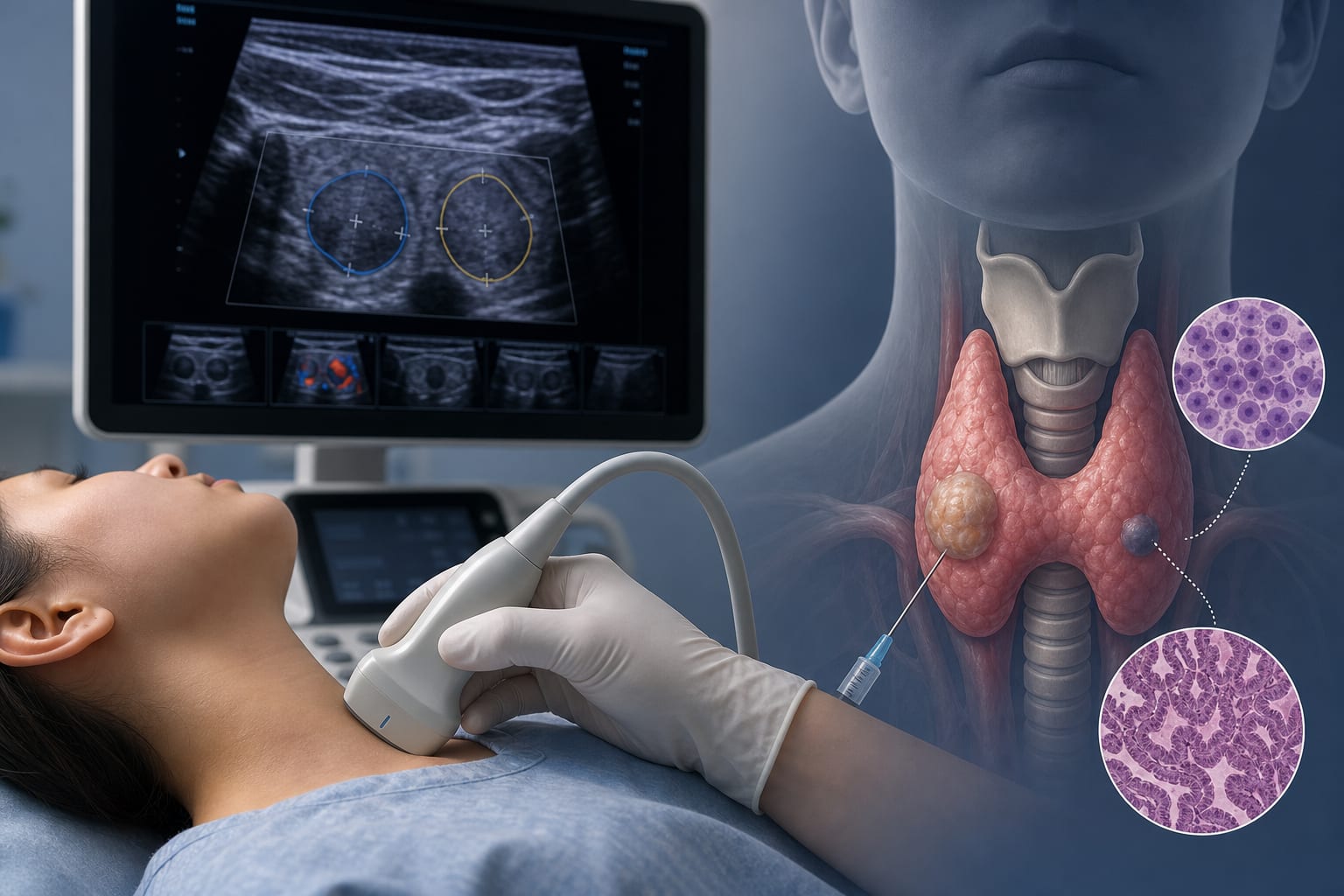
Clinical Scorecard: Evaluating the Diagnostic Efficacy of ACR-TIRADS and C-TIRADS for Thyroid Nodules in Adolescents
At a Glance
Category
Detail
Condition
Thyroid Nodules
Key Mechanisms
Differentiation between malignant and benign thyroid nodules using ultrasound-based risk stratification systems.
Target Population
Pediatric patients (aged 18 years or less)
Care Setting
Retrospective analysis of thyroid ultrasound findings
Key Highlights
Study analyzed 461 thyroid nodules from 393 pediatric patients.
Scenario 1 and Scenario 2 showed higher diagnostic performance than ACR-TIRADS and C-TIRADS.
Unnecessary biopsy rates were lower in both scenarios compared to TIRADS systems.
Biopsy triage failure rates were also reduced in the proposed scenarios.
Guideline-Based Recommendations
Diagnosis
Use ACR-TIRADS and C-TIRADS for risk stratification of thyroid nodules.
Management
Recommend biopsy for ACR-TR3 nodules ≥35 mm and all ACR-TR5 nodules (Scenario 1); for all C-TR4B, C-TR4C, and C-TR5 nodules, with no biopsy for C-TR4A (Scenario 2).
Monitoring & Follow-up
Follow-up strategies for nodules without a conclusive histopathologic diagnosis should be based on ACR-TIRADS.
Risks
Pediatric thyroid nodules have a higher likelihood of malignancy compared to adult nodules.
Patient & Prescribing Data
393 pediatric patients with thyroid nodules.
Early differentiation of malignant nodules is critical due to the higher malignancy rates in pediatric populations.
Clinical Best Practices
Utilize ultrasound as a non-invasive diagnostic tool for thyroid nodules.
Implement risk stratification systems tailored for pediatric populations.