Clinical Scorecard: An Effective Motion Stabilization Method for Infrared Thermography in Awake Craniotomy Procedures
At a Glance
Category
Detail
Condition
Brain surface temperature variations during neurosurgery
Key Mechanisms
Infrared thermography detects spatial and temporal temperature gradients affected by brain physiology and pathology; motion artifacts disrupt accurate temperature mapping
Target Population
Patients undergoing awake craniotomy and other neurosurgical procedures
Care Setting
Intraoperative neurosurgical operating room
Key Highlights
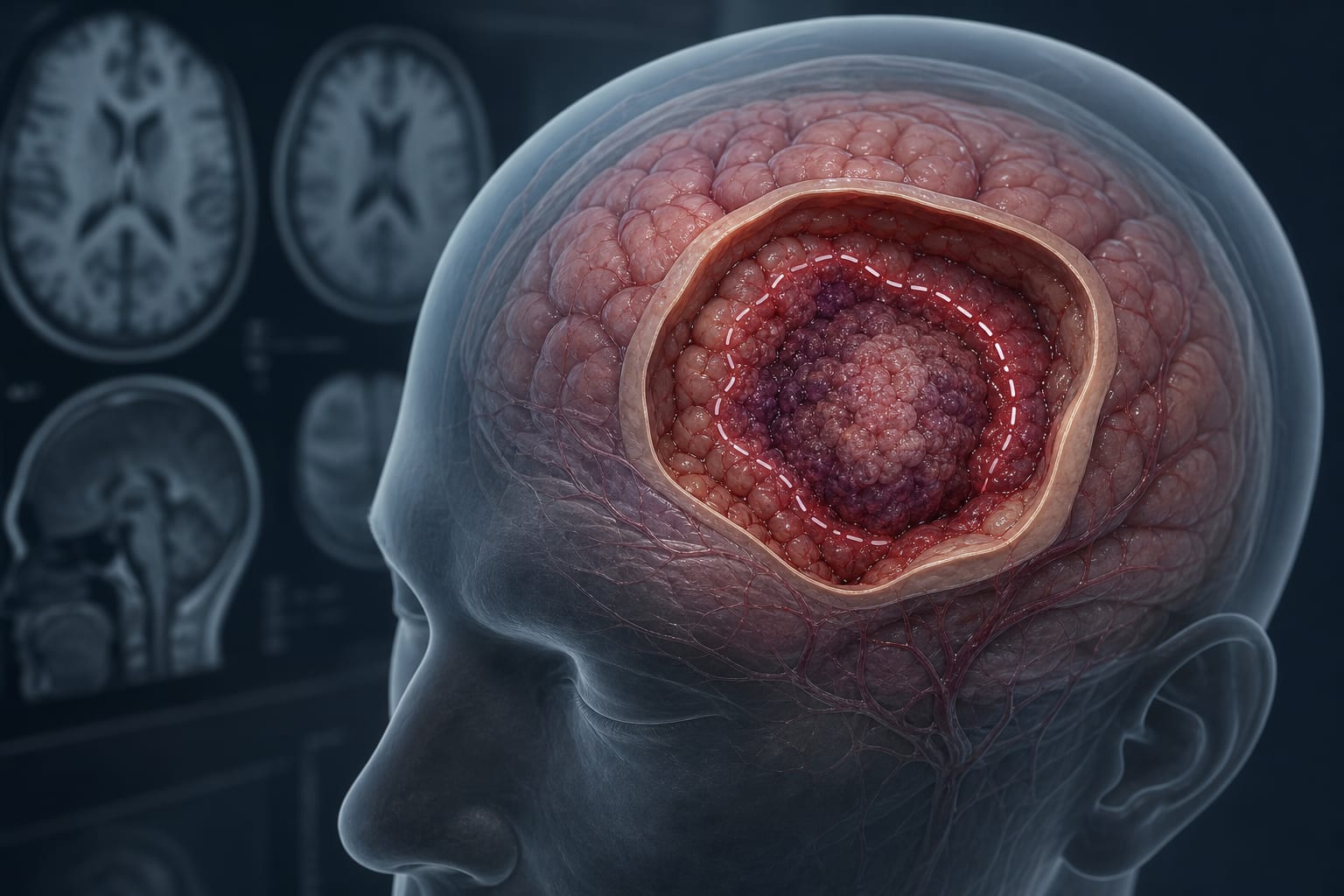
Infrared thermography (IRT) can detect brain temperature gradients related to tumors, cerebral bypass patency, and functional brain mapping.
Motion artifacts from brain pulsation, brain shifting, and patient movement limit the effectiveness of IRT in neurosurgery.
A novel fast motion correction method using bilinear spline registration improves IRT data quality without requiring multimodal imaging.
Guideline-Based Recommendations
Diagnosis
Use IRT to observe spatial and temporal temperature gradients on the brain surface during craniotomy for tumor detection and functional mapping.
Management
Apply motion correction techniques to IRT data to mitigate artifacts caused by brain pulsation, shifting, and patient movement.
Consider bilinear spline-based single-modality image registration for near-real-time motion correction without additional imaging hardware.
Monitoring & Follow-up
Monitor cerebral bypass patency intraoperatively by observing temporal warming patterns via IRT with motion correction.
Risks
Motion artifacts can lead to inaccurate temperature gradient measurements, potentially compromising diagnostic and monitoring utility of IRT.
Patient & Prescribing Data
Ten human patients undergoing awake craniotomy with thermal video data collected intraoperatively.
The proposed bilinear spline motion correction method demonstrated robust performance and faster processing compared to existing techniques, enabling practical use in neurosurgical settings.
Clinical Best Practices
Incorporate motion correction algorithms when analyzing IRT data to preserve spatiotemporal correspondence of temperature signals.
Prefer single-modality intensity-based registration methods that do not require concurrent white-light imaging to reduce hardware complexity.
Balance motion correction accuracy with processing speed to enable near-real-time intraoperative application.