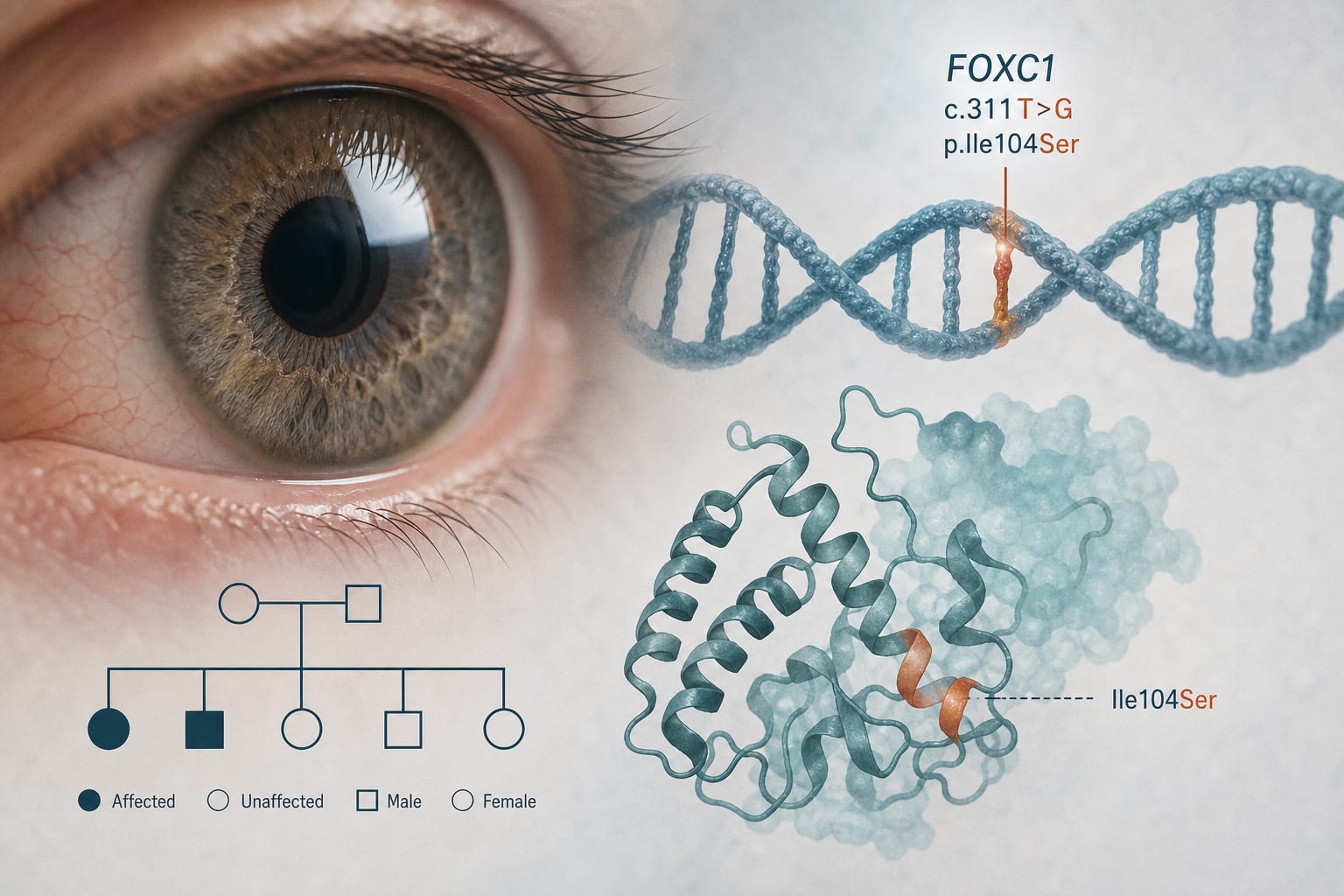
Case Study: Identification of a New FOXC1 Variant c.311T>G (p.Ile104Ser) in a Chinese Family Affected by Axenfeld-Rieger Syndrome
-
By
-
Bin Lin
-
Li Li
-
Dong-kan Li
-
June 8, 2026
Clinical Scorecard: Case Study: Identification of a New FOXC1 Variant c.311T>G (p.Ile104Ser) in a Chinese Family Affected by Axenfeld-Rieger Syndrome
At a Glance
| Category | Detail |
|---|
| Condition | Axenfeld-Rieger Syndrome (ARS) |
| Key Mechanisms | Caused by FOXC1 variants leading to anterior segment dysgenesis and glaucoma. |
| Target Population | Individuals with early-onset glaucoma, particularly in families with a history of ARS. |
| Care Setting | Ophthalmology clinics and genetic testing facilities. |
Key Highlights
- Identification of a novel FOXC1 variant c.311T>G (p.Ile104Ser).
- Initial misdiagnosis of juvenile-onset open-angle glaucoma (JOAG) in affected family members.
- Clinical features include anterior segment dysgenesis and characteristic facial features.
- Incomplete penetrance observed in an unaffected carrier father.
Guideline-Based Recommendations
Diagnosis
- Consider genetic testing for FOXC1 variants in patients with early-onset glaucoma.
Management
- Systematic evaluation for systemic features associated with ARS in glaucoma patients.
Monitoring & Follow-up
- Regular ophthalmic examinations to assess intraocular pressure and visual acuity.
Risks
- Potential for misdiagnosis of JOAG in patients with ARS.
Patient & Prescribing Data
Chinese family with a history of ARS and JOAG.
Patients may require surgical intervention due to poor response to medical therapy.
Clinical Best Practices
- Utilize whole-exome sequencing for accurate genetic diagnosis in glaucoma cases.
- Conduct thorough systemic evaluations in patients with early-onset glaucoma.
Related Resources & Content